

- 8 Views
- 19 Min Read
- (0) Comment
You are planning a Southern Africa safari and keep seeing Hwange on the map, but you want to know exactly where it sits. The Hwange National Park location is in western Zimbabwe, in Matabeleland North Province, roughly 100 miles (about 170 km) southeast of Victoria Falls. The Botswana border lies to the west, which makes the park an easy add-on to a Chobe or Victoria Falls trip.
Here is the short answer. Hwange is Zimbabwe’s largest park, covering about 5,600 square miles (14,600 sq km), an area close to the size of Connecticut. The nearest town is Hwange, and most visitors arrive by road from Victoria Falls in around two to three hours. It is home to more than 100 mammal species and one of the largest elephant populations on the continent. Elephants number in the tens of thousands here.
Below, we cover the province, nearby towns, distances, size, key wildlife, and how to visit on a game drive. Our guides at Maximum Adventure Trails run Hwange trips regularly, so you get practical details from people who drive these roads, not just map coordinates.
Why Hwange National Park’s location matters
Knowing where Hwange sits does more than settle a map question. The Hwange National Park location shapes what you see, when you see it, and how you build the rest of your trip around it.
The province and the landscape it creates
If you are asking where Hwange National Park is located in Zimbabwe, the province is Matabeleland North. The park lies on the northwestern edge of the country’s central plateau, at roughly 3,300 feet (1,000 m) above sea level. It sits where the Kalahari sand basin begins to spread west into Botswana, and that geology drives everything else.
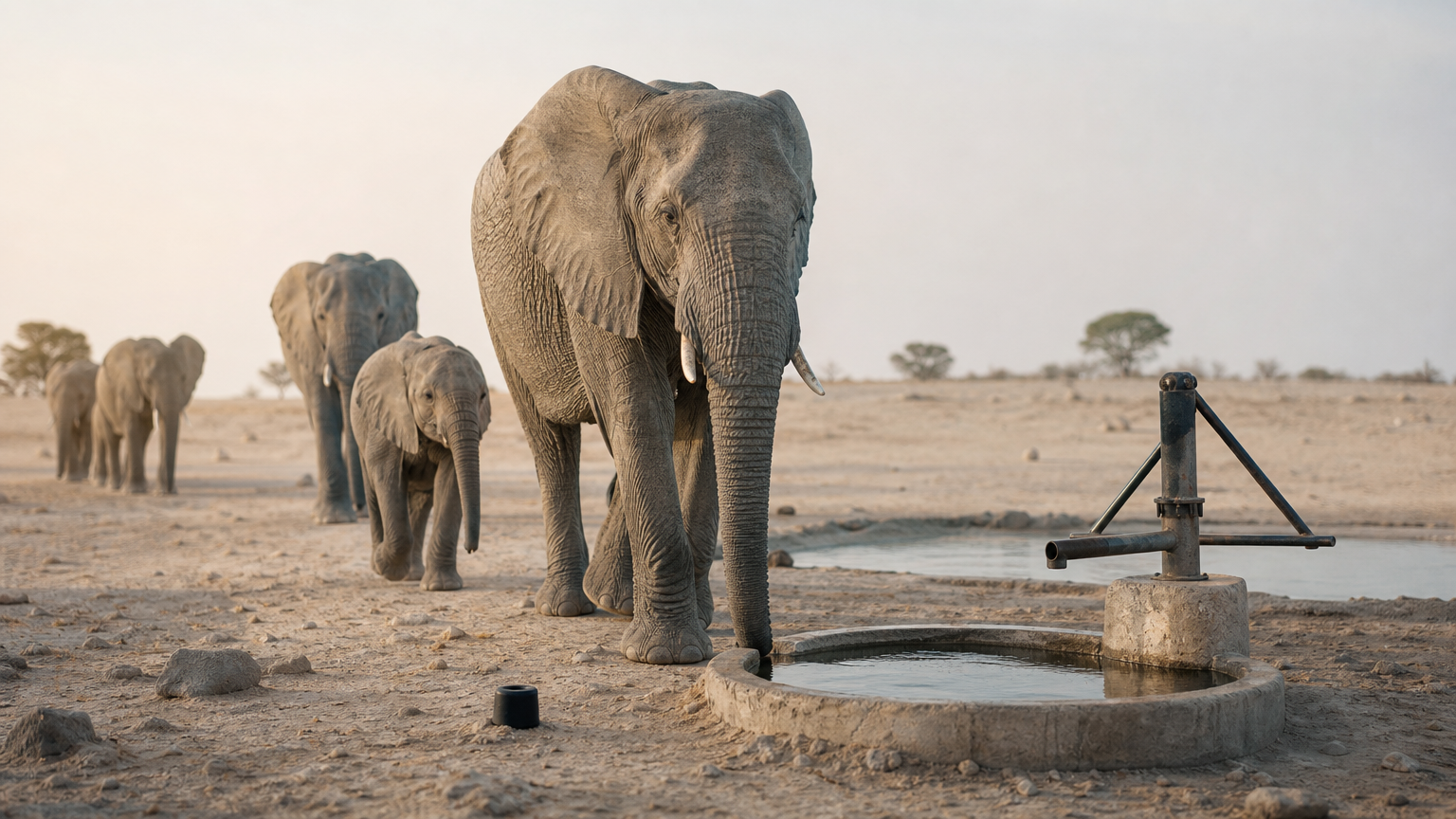
Kalahari sand soaks up rain almost instantly, so the park has almost no permanent rivers. Water collects in seasonal pans, and in the dry months rangers pump groundwater into dozens of waterholes. This is why Hwange works so well for a game drive. Animals have no choice but to gather at a few predictable water points, and you can sit and watch them arrive.
Hwange’s wildlife density comes straight from its geography: sandy ground, little surface water, and animals that must come to the pumped waterholes.
A border position that keeps animals moving
The western side of the park runs toward Botswana, and the wildlife does not recognize the line. Elephants and other herds move across the region between Hwange, northern Botswana, and the Chobe area. Hwange forms one part of the Kavango-Zambezi Transfrontier Conservation Area, a multinational conservation zone that spans five countries, including Zimbabwe and Botswana.
For you, this means Hwange pairs naturally with Chobe National Park. The two feel different. Chobe gives you river and boat time, while Hwange gives you dry-land bush, big herds, and far fewer vehicles. If you only visit one, you miss half the picture.
How the location affects your travel plans
Hwange lies along the main corridor linking Victoria Falls and Bulawayo, so you can reach it by paved road without a bush flight. That makes it one of the easiest big parks in Southern Africa to add on to a Victoria Falls stay. Here are the reference points that matter when you plan:
| Starting point | Approximate road time to the park | Why it matters |
|---|---|---|
| Victoria Falls | 2 to 3 hours | Most common route for short safaris |
| Bulawayo | 3 to 4 hours | Useful if you fly into Zimbabwe’s second city |
| Kasane, Botswana (Chobe) | 4 to 5 hours, including border time | Works for combined Chobe and Hwange trips |
Times vary with the gate you use, road works, and border queues. The park is large, so the camp you choose changes your drive by an hour or more. We cover routes in detail later in this guide.
Why the location should guide your booking
Treat location as a planning tool. Because Hwange is a half-day drive from Victoria Falls, you can fit it into an itinerary that already includes the falls without losing a full travel day. Because it borders Botswana, you can also plan a cross-border loop through Zimbabwe, Zambia, and Botswana instead of backtracking.
So before you pick dates or lodges, decide which neighbor you want to combine it with. That one choice sets your transfers, your trip length, and how much time you get inside the park itself.
How to find Hwange National Park on the map
If you are wondering where is Hwange National Park, open any map of Zimbabwe and look at the far west. The park fills a large block of land between the Victoria Falls corridor and the Botswana border. At roughly 19° south, 26.5° east, it is hard to miss once you know the road that runs along its northeastern edge.
Landmarks that point you to the park
Start with the A8 highway, the main paved road linking Victoria Falls and Bulawayo. Follow it south from the falls and the park opens up on your right-hand side, to the west. The small town of Hwange and the village of Dete sit along this road, and Dete is the junction for the main park gate.
| Landmark | Where it sits relative to the park |
|---|---|
| Victoria Falls | North, about 100 miles (170 km) away |
| Hwange town | Northeast edge, the nearest sizable town |
| Dete junction | East side, turnoff to Main Camp |
| Botswana border | West, with the Kalahari beyond |
| Bulawayo | Southeast, the nearest city |
To find Hwange on a map, trace the A8 south from Victoria Falls, then look west of Dete.
Searching the right name
Type "Hwange National Park Zimbabwe" into your map app, but also search for Hwange Main Camp. The park is too large for a single pin, and the main camp marks the gate most visitors use. Robins Camp in the northwest and Sinamatella in the north are the other camps you will see labeled.
Pronunciation trips up many first-timers. Locals say it roughly "HWAHN-gay," with a soft, breathy "hw" at the start. You will hear visitors say "WANG-ee" too, and guides will not mind. Still, saying it the local way gets a smile at the gate.
Saving the map before you drive
Mobile signal fades quickly once you leave the A8. Before you go, download an offline map of the area, and mark your lodge and the nearest fuel stop. Our guides also suggest screenshotting your gate and camp names, since road signs inside the park can be sparse. If you book a transfer with us, your driver handles the navigation, so you can spend the ride watching for roadside wildlife instead.
How to get to Hwange from Victoria Falls and beyond
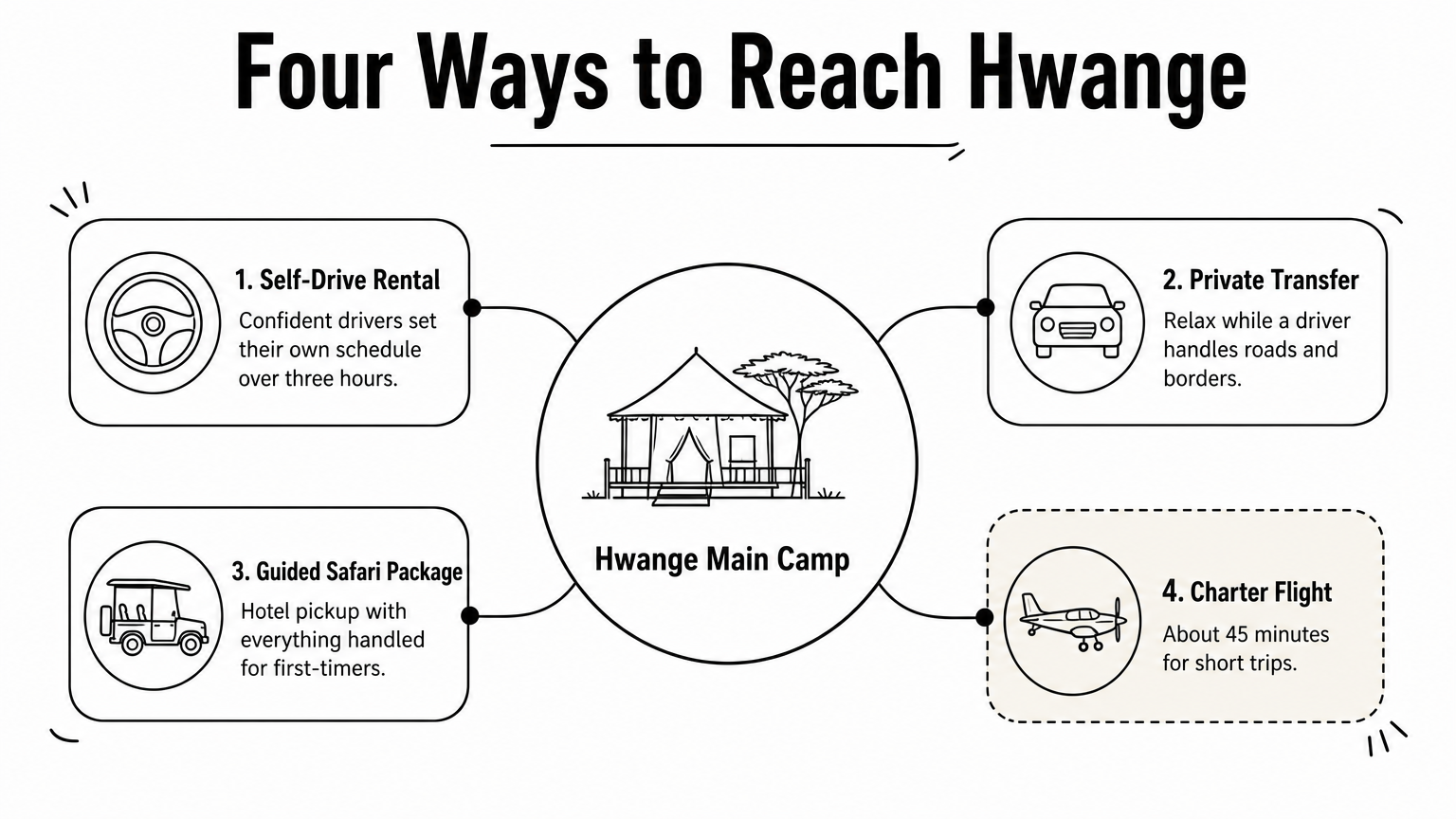
You have four realistic ways to reach the park. Which one fits depends on your budget, your comfort with African roads, and how much time you want to spend inside the park instead of on the way.
Getting there from Victoria Falls
Leave town on the A8, drive south through Hwange town, and turn off at Dete for the Main Camp gate. Expect about 2.5 to 3 hours of paved driving, plus roughly 20 minutes on the park road. Livestock, potholes, and elephants cross the highway near dusk, so never plan to drive after dark.
| Option | Typical time | Best for |
|---|---|---|
| Self-drive rental | 3 hours | Confident drivers with their own schedule |
| Private transfer | 3 hours | Couples and families who want to relax |
| Guided safari package | Pickup at your hotel | First-timers who want everything handled |
| Charter flight | About 45 minutes | Short trips and tight schedules |
From Victoria Falls, Hwange is one paved road and one turnoff away, so you do not need a bush flight to get there.
Coming from Zambia, Botswana, or Bulawayo
Staying in Livingstone? Cross the Victoria Falls Bridge or the Kazungula border, then continue south on the A8. Allow extra time for immigration queues, which can add an hour on busy days. Ask about visa requirements before you travel, since rules differ by passport.
From Kasane, most travelers cross at Kazungula, pass through Victoria Falls, and then follow the same road south. Coming from Bulawayo, you drive north on the A8 for three to four hours, with a fuel stop at Hwange town if you need it. Fill your tank there, because fuel inside the park is scarce.
Self-drive or guided transfer?
Self-driving works if you are comfortable with sand tracks and have a high-clearance vehicle. Inside the park, many routes are soft sand, and a standard rental car can get stuck within a mile. You also need to carry water, spare tire tools, and a paper map.
A guided transfer removes that risk. Your driver knows the gates, the road conditions, and which waterholes are busy that week. Maximum Adventure Trails runs private transfers between Zimbabwe, Zambia, and Botswana, so you can arrive rested and start your game drive without worrying about navigation or border paperwork.
How big is Hwange and what makes it special
People often ask how big is Hwange National Park, and the number surprises them. The park covers about 5,600 square miles (14,600 sq km), which is roughly the size of Connecticut. Even with a good vehicle, you will spend hours crossing it, so a short visit only samples one corner.
Hwange National Park facts at a glance
This short description of Hwange National Park covers what most visitors want to know before they go.
| Fact | Detail |
|---|---|
| Country and province | Zimbabwe, Matabeleland North |
| Area | About 5,600 sq mi (14,600 sq km) |
| Status | Game reserve in 1928, national park in 1961 |
| Elevation | Around 3,300 ft (1,000 m) |
| Mammals | More than 100 species |
| Birds | About 400 species |
| Main camps | Main Camp, Sinamatella, Robins |
What sets it apart
Size alone does not explain the park’s reputation. Hwange holds one of the largest elephant populations in Africa, and in the late dry season you can watch herds of dozens walk to a single waterhole at once. Few places in Southern Africa offer that kind of sighting from a vehicle you can park next to the action.
Hwange is special because it is huge, dry, and crowded with wildlife around a few pumped waterholes.
Habitat adds to the appeal. Within one park you pass Kalahari sand woodland, teak forest, mopane scrub, and open grassland pans. Each zone favors different animals, so a drive from one camp to another feels like visiting different parks. Sable and roan antelope prefer the woodland, while the grassland pans draw zebra and buffalo.
Finally, Hwange is a stronghold for African wild dogs, one of the continent’s most endangered predators. Sightings are never guaranteed, but guides here know where the packs den and hunt. Combine that with lion, leopard, and a rich bird list, and you understand why serious safari travelers keep returning.
Animals you can see in Hwange National Park
The animals in Hwange National Park reflect its position on the edge of the Kalahari. You get savanna giants, desert-adapted antelope, and a full predator lineup in one place. The Hwange National Park location also puts it where northern and southern species overlap, which widens the list.
The big herds
Elephants are the headline act. Estimates run in the tens of thousands, and in the late dry season you can watch breeding herds of 30 or more arrive at pans like Nyamandlovu and Masuma. Buffalo gather in large groups too, and zebra and giraffe are easy to find around the open pans.
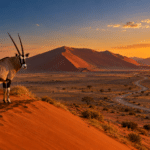
Antelope variety is a real strength. Look for sable and roan in the woodland, plus kudu, eland, impala, and wildebeest. Kalahari species such as gemsbok and springbok show up here, and you rarely see them in Victoria Falls or Chobe.
Hwange is best known for elephants, big herds, and wild dogs, not for ticking off every Big Five animal.
Predators and rare sightings
Lion are common and often active near waterholes at dawn. Leopard are present but secretive, so treat a sighting as a bonus. Spotted hyena and cheetah round out the cats and scavengers. African wild dogs are the prize, and guides who know the den sites in a given season improve your odds a lot. Rhinos live here under heavy protection, but you should not expect to see one on a standard trip.
What you are likely to see
Use this table to set realistic expectations for a two to three day stay.
| Animal | Chance on a typical visit | Notes |
|---|---|---|
| Elephant | Almost certain | Best at waterholes in the dry season |
| Buffalo, zebra, giraffe | Very likely | Open pans and grassland |
| Lion | Likely | Early morning and evening |
| Sable and roan antelope | Likely | Woodland zones |
| Leopard | Possible | Often spotted at dusk |
| Wild dog, cheetah | Lucky sighting | Ask your guide about recent tracks |
| Rhino | Unlikely | Rarely seen by visitors |
Birds worth a look
Birders should not skip this park. Roughly 400 bird species have been recorded, from ground hornbills and secretary birds to kori bustards and bateleurs. Summer, from about November to March, adds migrants and brings the best birding, though the dry months give you better mammal viewing. If you want both, ask your guide to slow down at pans instead of racing between sightings.
How to plan a Hwange game drive
A Hwange National Park game drive is not a quick loop with a checklist. Because of the Hwange National Park location on the Kalahari edge, the park is huge, sandy, and spread out. Your route and your timing matter more than your vehicle, and good planning on those two points lets the animals do the rest.
Pick the right type of drive
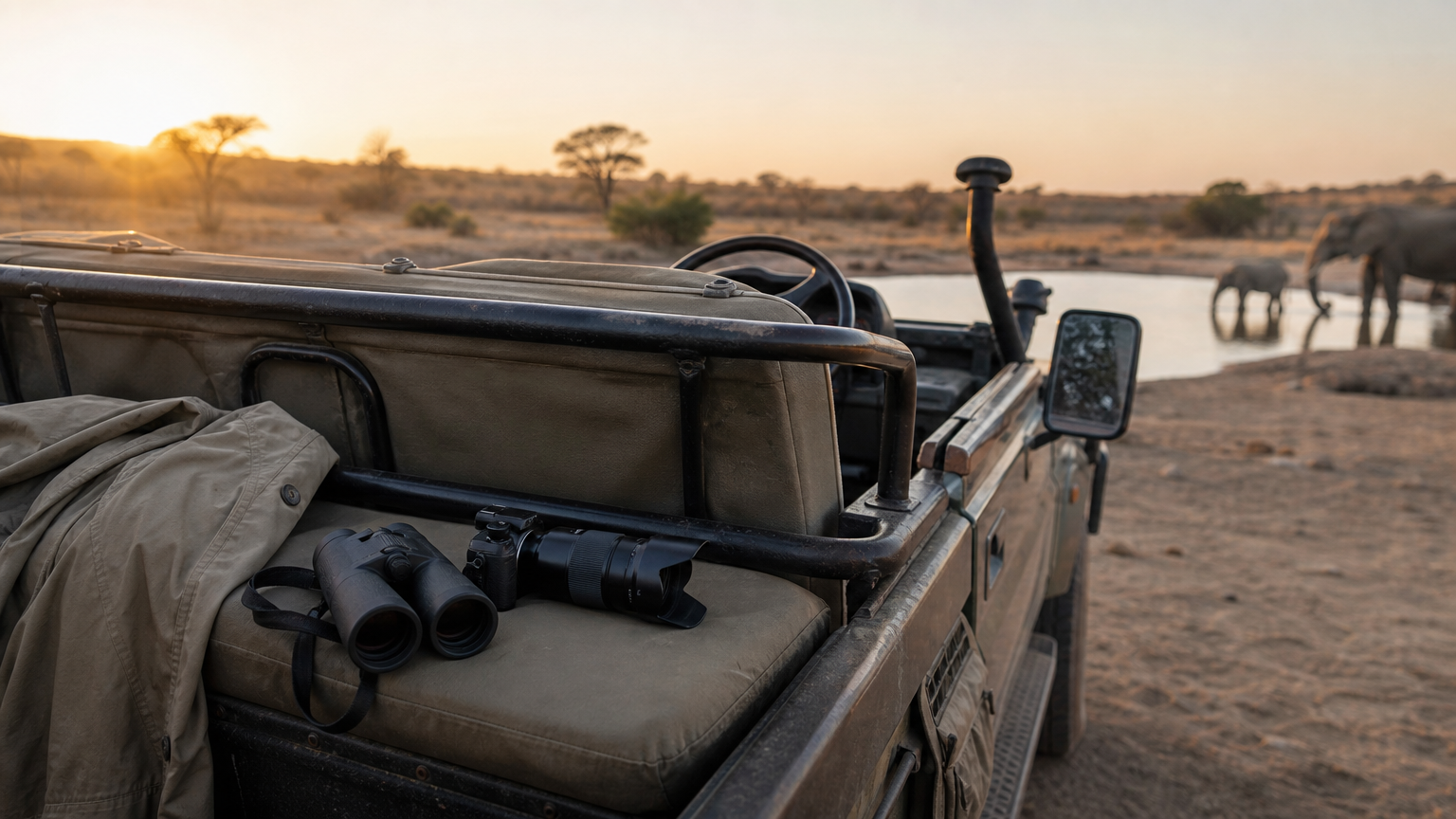
Most visitors choose between three formats. For a first trip, we recommend a guided open vehicle, because the guide reads tracks, knows which pans are active, and handles the soft sand roads for you.
| Format | Typical length | Best for |
|---|---|---|
| Guided open vehicle | 3 to 4 hours | First-timers and photographers |
| Self-drive in your own 4×4 | Flexible | Experienced drivers on a budget |
| Night drive or guided walk | 2 to 3 hours | Repeat visitors staying at lodges that offer them |
Night drives and guided walks are run by some lodges and concessions, not every camp. Ask about them when you book, since slots are limited.
Build your day around the waterholes
Wildlife follows a rhythm. Predators and herds move at first and last light, and midday is for resting at the lodge or in a shaded hide. A sensible day looks like this:
- Leave at sunrise, around 6:00 a.m., for the best cat activity.
- Return to camp by late morning for breakfast and a break.
- Head out again mid-afternoon and settle at a pan for the golden hour.
- Be back at camp by sunset, since self-drivers cannot stay out after dark.
Pick one or two waterholes and wait there, because patience beats distance in Hwange.
Do not chase sightings across the park. Elephants arrive in waves, and an hour parked at one pan often shows you more than three hours of driving. Switch off the engine and let the herds forget you are there.
Pack and prepare
Dust, sun, and cold mornings can all hit in a single day, so pack for each. Bring:
- Layers, since open vehicles feel cold before 8 a.m.
- Binoculars (8×42 works well) and a camera with a zoom lens
- A hat, sunscreen, and at least 2 liters of water per person
- Neutral clothing in tan, green, or khaki
Before you set off, ask your guide about recent wild dog and lion sightings and which pans are currently holding water. That ten-minute chat can save you hours of guesswork on the day.
Best time to visit and how long to stay
Timing shapes what you see in Hwange more than almost any other choice. Because of the Hwange National Park location on the Kalahari edge, rainfall decides where the animals are, so pick your month with care.
Dry season versus green season
The dry season, from May to October, is the best window for a first visit. Surface water disappears, so herds crowd the pumped waterholes, and thin bush makes spotting animals easy. August to October is the peak for big elephant gatherings.
| Period | Conditions | Best for |
|---|---|---|
| May to August | Dry and clear, with chilly mornings near 40°F (4°C) in June and July | Comfortable game drives, first-timers |
| September to October | Hot, up to 95°F (35°C), and driest | Largest elephant concentrations at pans |
| November to March | Hot, humid, with afternoon storms | Birding, green scenery, lower rates |
| April | Lush but drying out | Quiet roads, fewer visitors |
For a first trip, go in the dry season, when the animals come to you.
Wet months suit a different traveler. The park turns green, birding peaks, and lodge rates drop. The trade-off is that animals scatter across filled pans, and some sand tracks turn muddy, so sightings take more work.
How many nights to stay
Plan at least two nights inside or beside the park. A day trip from Victoria Falls costs you roughly six hours on the road, which leaves little time for actual game viewing. Here is how the options compare:
- Day trip: One game drive, a rushed lunch, and a long drive back. Fine if you are short on time.
- Two nights: Around four game drives. This is the sweet spot for a first visit.
- Three to four nights: Time to try two camps, add a guided walk, and give yourself better odds at wild dogs.
If you can spare one more day, spend it here rather than adding another falls activity. Hwange rewards repeat drives at the same pans, and a third night is often where leopard and wild dog luck finally turns up.
Where to stay, park fees, and safety tips
Your base camp decides how much time you spend driving and how much you spend watching. Because of the Hwange National Park location and its sheer size, where you sleep determines which part of the park you actually see.
Choosing a place to sleep
Lodges and camps in Hwange National Park in Zimbabwe fall into three groups. Pick by budget first, then check how far the camp sits from the pans you want to watch.
| Type | Where | Best for |
|---|---|---|
| Park camps (chalets, campsites) | Main Camp, Sinamatella, Robins | Budget travelers and self-drivers |
| Lodges outside the gates | Around Dete and the Main Camp road | Mid-range comfort, easy access |
| Private concession camps | Remote areas inside the wider park | Luxury, fewer vehicles, night drives |
Honeymooners and photographers usually do best in a private concession, where fewer vehicles share each sighting. We also book accommodation alongside your tours, so camp and itinerary get matched in one step.
Park fees and what to budget
Entrance fees are charged per person, per day, plus a vehicle fee if you self-drive. Zimbabwe Parks sets the rates and changes them, so confirm current figures before you travel.
Carry cash as well. Card machines at remote gates can fail, so keep small US dollar bills for fees, fuel, and tips. Guided packages often include entry fees, so check your quote to see exactly what is covered.
Safety tips for the park
Hwange is safe for visitors who follow a few rules. Nearly every problem starts when someone leaves the vehicle or ignores the guide.
In Hwange, the most important safety rule is simple: stay in the vehicle and do what your guide says.
- Never approach elephants, especially mothers with calves. Let them cross the road first.
- Do not walk around camp after dark. Ask for an escort to your room.
- Talk to your doctor about malaria prophylaxis well before you fly, since the region carries risk, mostly in the wet months.
- Use insect repellent and drink bottled or treated water.
- Keep fuel above half a tank if you self-drive, since stations are few.
Sample Hwange itineraries and combinations
Because of the Hwange National Park location between Victoria Falls and the Botswana border, you can fit it into several routes. The three plans below use real driving times, so you spend more hours watching animals and fewer on the road. Treat them as starting templates that you can stretch or trim.
Four days: Victoria Falls and Hwange
This is the plan we suggest most often for first-timers. It gives you the falls and two full days in the bush without a rushed schedule.
- Day 1: Arrive in Victoria Falls, walk the falls, and end with a sunset river cruise.
- Day 2: Drive south on the A8 in the morning, then take an afternoon game drive.
- Day 3: Do a sunrise drive and an afternoon drive, and spend the golden hour at one pan.
- Day 4: Drive back by lunch for your flight or onward transfer.
Six days: Victoria Falls, Hwange, and Chobe
Add Chobe if you want river time as well as dry-land bush. Split the trip into two nights in each place: Victoria Falls, Hwange, then Kasane. Cross at Kazungula on the last leg and book a morning boat cruise and an afternoon drive in Chobe.
Pair Hwange with just one neighbor, and give the park at least two nights.
Resist the urge to add a third country to a six-day trip. Every border crossing costs you an hour or more, and that time comes straight out of your game viewing.
Eight to ten days: the honeymoon or one-way loop
Couples with more time can build a longer route. Start at the falls, spend three nights at a private concession camp in Hwange, then continue to Chobe and finish with a mokoro safari in the Okavango Delta. A scenic flight over the falls makes a good anniversary or honeymoon extra.
If you land in Bulawayo instead, run the route in reverse. Drive north through Hwange to Victoria Falls and skip the backtracking altogether. You can cover one hotel-to-hotel stretch per day and keep every night in a different setting.
We build these curated Zimbabwe safari plans around your dates, budget, and pace, including transfers, lodges, and visas, so you only need to choose how many days you can spare.
Putting Hwange on your Zimbabwe route
The Hwange National Park location is what makes the park so easy to use. It sits in Matabeleland North, about 100 miles from Victoria Falls, with Botswana to the west and a paved road most of the way. That puts Zimbabwe’s largest park within a half-day drive of the falls, and it rewards you with big elephant herds, wild dogs, and quiet dry-land bush.
Plan around a few simple choices. Visit in the dry season, stay at least two nights, and pair Hwange with just one neighbor, either Victoria Falls or Chobe. Pick a camp close to the pans you want to watch, then let your guide read the day while you enjoy the sightings.
If you want someone else to handle transfers, lodges, and visas, plan your Hwange safari with Maximum Adventure Trails and we will build the route around your dates and your pace.