
- 5 Views
- 10 Min Read
- (0) Comment
Is Zimbabwe safe for tourists? For most visitors, yes, provided you take ordinary precautions. The tourist areas around Victoria Falls, Hwange and Mana Pools are the calmest parts of the country. "Safe" here means you are unlikely to meet violence, but you should expect petty theft in cities, patchy infrastructure, wildlife that demands respect and officials who expect you to follow local rules. Governments still advise caution. The U.S. State Department asks travelers to exercise increased caution, citing crime and official harassment of U.S. citizens.
The risk is not spread evenly across the country. A guided morning at the Falls and a late walk through downtown Harare carry very different odds. This article shows what official advisories say, where the real problems occur, and how to prevent them. It also covers safari and health safety, how the picture differs for Americans, women and other travelers, and the local rules that catch tourists out.
We organize tours and transfers out of Victoria Falls, so these are the questions travelers bring to us before they book. Treat what follows as a practical briefing, not a verdict. Conditions can change, so check the current advisory for your country before you pay for anything.
Why safety in Zimbabwe depends on where you go
Zimbabwe is neither uniformly safe nor uniformly risky. Danger follows place, timing and how you move around. Violent crime against tourists is uncommon in the safari circuit and the Falls area. Cities, remote roads and nighttime are where you need to be more careful.
What official travel advisories say
Four governments publish advice that English-speaking travelers read most. Their wording differs, but they agree on the main themes.
| Source | What it flags |
|---|---|
| U.S. State Department | Exercise increased caution. Crime and official harassment of U.S. citizens. Violent crime such as assault, carjacking and home invasion |
| Australia (Smartraveller) | Exercise a high degree of caution. Unpredictable security situation. Possible food, water, medicine and fuel shortages |
| Canada | Regular petty crime such as pickpocketing and purse snatching. Highway robberies are common |
| United Kingdom | Moderate level of crime. Mugging, pickpocketing and bag-snatching are common in city centers. People traveling alone may be more vulnerable |
These notices cover the whole country and plan for the worst case. Read them as a map of risks to manage, not as a reason to cancel. Check the live version on the State Department’s Zimbabwe page before booking and again before you fly.
The risks that matter most
Crime is the most likely problem you will meet. Pickpocketing, bag-snatching and mugging happen in busy parts of Harare and Bulawayo. Carjacking and home invasion mostly affect residents and people who drive themselves. Highway robbery is a reason to avoid long night drives.
Politics is the second theme. Tension rises around elections and during economic stress. Demonstrations are usually local and easy to avoid, but authorities have at times answered them with force. Stay away from any protest and avoid commenting on politics in public.
The third theme is the economy. Fuel, cash, medicine and electricity can all run short. For a tourist, that means plan ahead and carry what you need, not fear for your safety.
Zimbabwe’s risk follows geography: calm in the safari circuit, more demanding in cities and on remote roads.
Why tourist areas feel different
Tourism is a major source of foreign income, so locals and authorities protect the areas visitors use. Victoria Falls has tourist police, and the town is compact and easy to walk in daylight. Hwange and Mana Pools are remote, with visitors staying in lodges and moving with guides, which removes most urban crime from the picture.
Harare is a working capital. Many visitors pass through it without trouble, but it rewards daytime movement and pre-arranged transport. Remote does not mean risk-free, though. Medical care is far away from the parks, which is why insurance matters in the next section.
How to stay safe in Zimbabwe, step by step
Staying safe comes down to five habits: prepare before you fly, keep valuables out of sight, use vetted transport, avoid walking at night and keep your documents in order. Most problems travelers report come from skipping one of these.
Before you go
Do these in order, ideally weeks ahead:
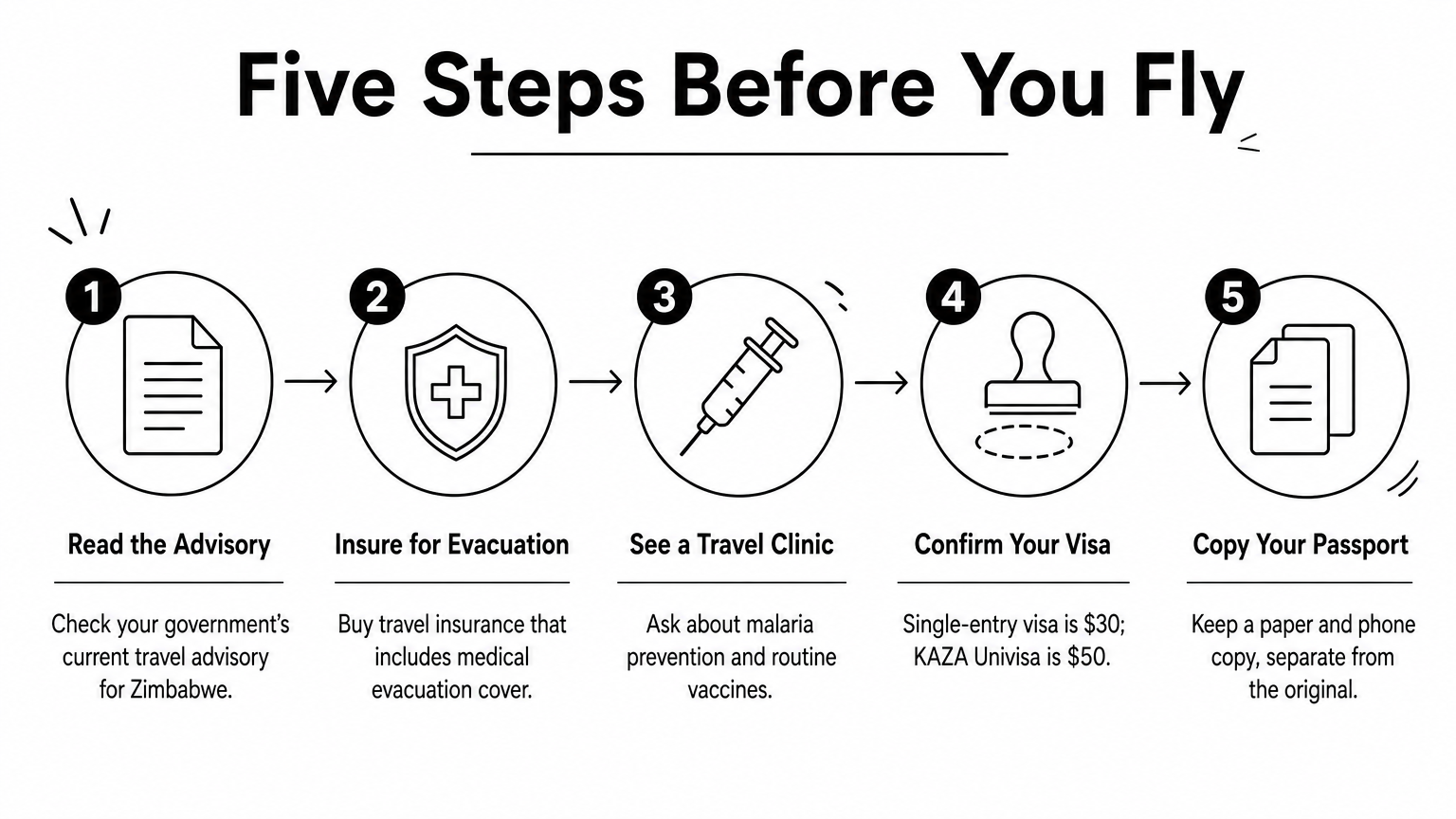
- Read your government’s current advisory. U.S. citizens can also enroll in the State Department’s Smart Traveler Enrollment Program (STEP).
- Buy travel insurance that includes medical evacuation. We also strongly recommend trip cancellation and baggage cover.
- See a travel clinic about malaria prevention and routine vaccines.
- Confirm your visa. The Zimbabwe single-entry visa is $30, and the KAZA Univisa, which covers Zimbabwe and Zambia, is $50. Rules depend on your nationality, so verify yours.
- Keep a paper and a phone copy of your passport, separate from the original.
Checking conditions right now
If you are asking whether it is safe to travel to Zimbabwe right now, the honest answer is to check the live sources. Advisories can change, and no article can replace them. Read the official advisory when you book, again a week before departure, and ask your operator what is happening on the ground. Our team is available around the clock to answer exactly that kind of question.
In cities and with money
City safety is mostly about not looking like an easy target. These habits cover most of it:
- Keep phones, cameras and cash out of sight, and carry only what you need for the day.
- Leave passports and spare cards in the hotel or lodge safe.
- Use ATMs inside banks or hotels, never at night, and stay alert when leaving them.
- Carry small US dollar bills, because cash is widely used and card machines and ATMs can fail.
- Avoid walking after dark and use pre-arranged transport instead of flagging cars.
Transport and border crossings
Roads are the quiet risk. Potholes, livestock, unlit vehicles and frequent police roadblocks make night driving a poor idea, and highway robbery is a reason to stay off remote roads after dark. For most visitors a pre-booked driver is safer and less stressful than self-driving.
Cross-border trips are a good example. Our Victoria Falls to Kasane transfer is $50 per person one way ($90 return) for adults, with door-to-door pickup in an air-conditioned vehicle. It takes about 1.5 to 2 hours including border procedures, and the driver helps you through immigration. Two adults pay $100 one way or $180 return, and the minimum is two passengers. Visa fees and border charges are extra.
Prepare, stay low-profile, and let a vetted driver or guide handle the hard parts.
Wildlife, health and medical care on safari
Safari safety is mostly about listening to your guide, and health safety is about malaria prevention, clean water and insurance. Neither is difficult, but both are easy to neglect.
Respecting the animals
Wild animals are the most predictable danger on a safari. Hippos, elephants and buffalo cause the serious incidents, and they usually involve people who ignored instructions. Stay in the vehicle unless your guide says you may get out, never walk around a lodge at night without an escort, and never feed animals. Baboons and monkeys snatch food and can turn aggressive, so keep snacks out of reach.
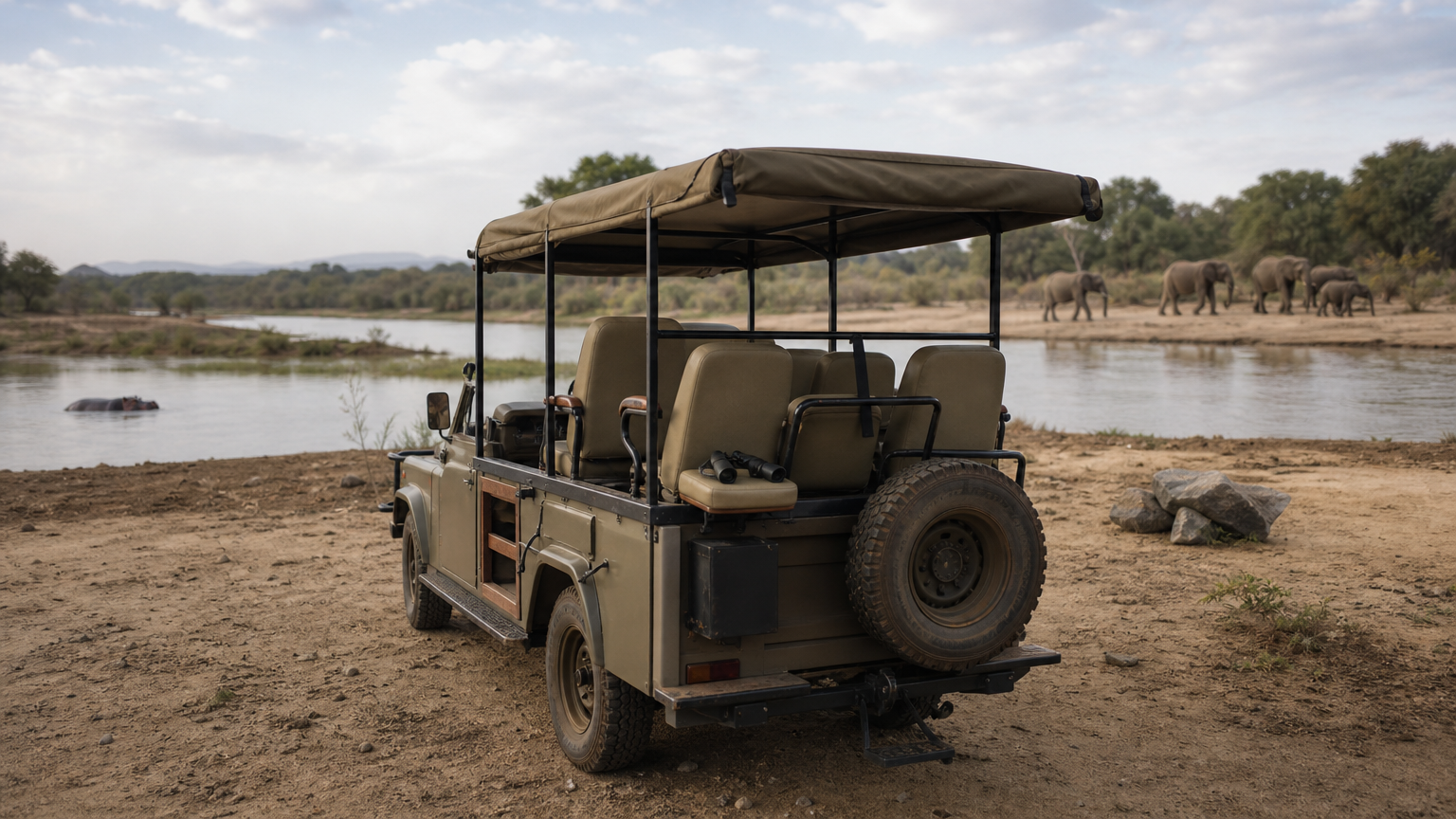
On walking and canoe safaris, your guide’s instructions are your protection. Choose operators with licensed, locally trained guides who know the terrain. Our guides know Victoria Falls, Chobe, Hwange and the Okavango Delta well, and that local knowledge is what you are paying for.
Health and medical care
Malaria risk exists in much of the country, including the safari areas, so ask a travel clinic which prevention suits you. Drink bottled or treated water, because cholera and typhoid outbreaks have occurred in the past. Pack any prescription medicine you need and a basic first-aid kit, since pharmacies can run short.
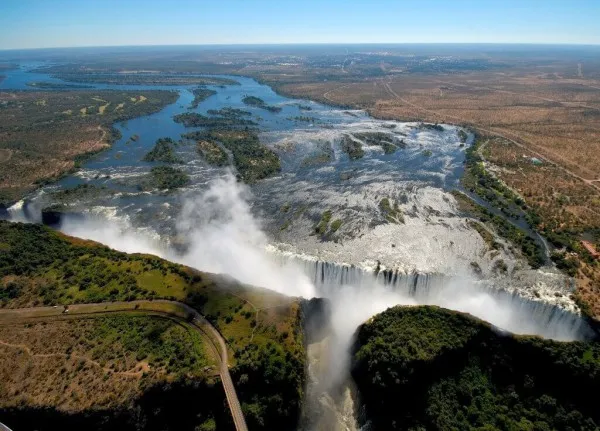
Healthcare is better in major cities than in rural areas, and it is limited near the parks. That makes medical evacuation cover the single most useful insurance feature. At Victoria Falls, paths near the spray can be slippery in the wet season, so wear shoes with grip. A guided walking tour of the Zimbabwean side keeps you on the safe viewpoints. The tour excludes the entrance fee, which is $58 for international guests.
Follow your guide, protect yourself against malaria, and make sure your insurance covers evacuation.
Is Zimbabwe safe for Americans, women and other travelers?
Most of the same precautions apply to everyone, but a few differ by traveler. The table sets out what each group should know.
| Traveler | What to know |
|---|---|
| Americans | The State Department’s advisory mentions official harassment of U.S. citizens. Carry passport copies, avoid political talk and photography of sensitive sites, and consider STEP enrollment. |
| White tourists | No advisory singles out race for visitors. Anyone who stands out as foreign draws touts and opportunistic theft, so the usual precautions apply. |
| Solo women | Solo travelers may be more vulnerable, per UK advice. Avoid walking alone at night, use reputable transfers and dress modestly outside tourist areas. |
| LGBTQ+ travelers | Sex between men is criminalized and public attitudes are conservative. Be discreet about relationships. |
| First-timers | Base yourself in Victoria Falls and book guided, pre-arranged activities. |
What this means for Americans
American visitors are not barred or singled out as targets for violence. The harassment the State Department describes is official, such as aggressive questioning, roadblock demands and sensitivity about photography and politics. Stay polite and calm, carry both your passport and a copy, and do not discuss government criticism with strangers. If you are detained, ask to contact your embassy.
Race, gender and identity
Visitors of every background travel in Zimbabwe, and the day-to-day risks are the ones that apply to every foreigner. Avoid debating land reform or politics with strangers, because it is a sensitive subject. Solo women can travel successfully by arranging transport in advance and keeping evenings inside the lodge or hotel. LGBTQ+ travelers should treat discretion as a safety measure.
Local rules that trip up tourists
Several things that are normal at home can cause problems in Zimbabwe, so a few minutes of preparation prevents most trouble. Most are about clothing, cameras and conversations.
Clothing, cameras and drones
Do not wear camouflage clothing, because civilians are not allowed to. Ask permission before photographing police, soldiers, government buildings and airports. Skip the drone unless you have arranged permission in advance, since flying without it can lead to confiscation or worse.
Reporting or filming for a news outlet requires official accreditation, which is separate from a tourist visa. Ordinary holiday photos are fine in the places visitors normally go. Drug offenses carry severe penalties, so leave anything illegal at home.
Police, politics and money
At roadblocks, stay calm, courteous and patient, show your documents when asked and do not argue. Keep opinions about the president and government to yourself in public. Avoid street money changers, since unofficial currency trading is illegal and a common route to scams.
If an itinerary change is forced by unrest, a good operator will reroute you. Itineraries and sightseeing can shift for unforeseen reasons, so keep plans flexible and read your booking terms.
Dress plainly, ask before you photograph, and keep politics and unofficial money deals out of your trip.
Go, but go prepared
Zimbabwe is safe enough for most travelers who prepare. The real risks are petty crime in cities, driving at night, unpredictable politics, limited healthcare outside major towns and wildlife you have to respect. Advisories are best used as a checklist of those risks. Victoria Falls, Hwange and the other safari areas remain the most secure parts of a trip, especially with a licensed guide and pre-arranged transport.
Keep the basics in mind: check the current advisory, insure for medical evacuation, stay out of cities after dark, avoid sensitive photography and let experienced locals handle border crossings and roads. If you want those details handled for you, you can browse our guided tours and book the one that fits your trip.