

- 9 Views
- 21 Min Read
- (0) Comment
You searched for Hwange National Park pictures because you want to see what the place actually looks like before you commit to a trip. Fair enough. Hwange is Zimbabwe’s largest park, roughly 5,600 square miles of teak woodland, open pans, and dry grassland. Photos do a better job than any description of showing why it stands apart from other safari parks.
Here is what you will find below: 12 photos that show the real Hwange, from elephants crowding a waterhole to lions resting in golden grass. These are scenes you can expect on a normal game drive, not once-in-a-lifetime flukes. Hwange has one of the largest elephant populations in Africa, with well over 40,000 animals, and the dry season from July to October delivers the most dramatic sightings.
Each picture comes with a short note on where it was taken, what to look for, and the best time to see it. Our guides at Maximum Adventure Trails run guided game drives here regularly, so the tips come from the field. Use the gallery for inspiration, then plan your own Hwange safari with confidence.
1. Elephants gathering at a Hwange waterhole
What the photo shows
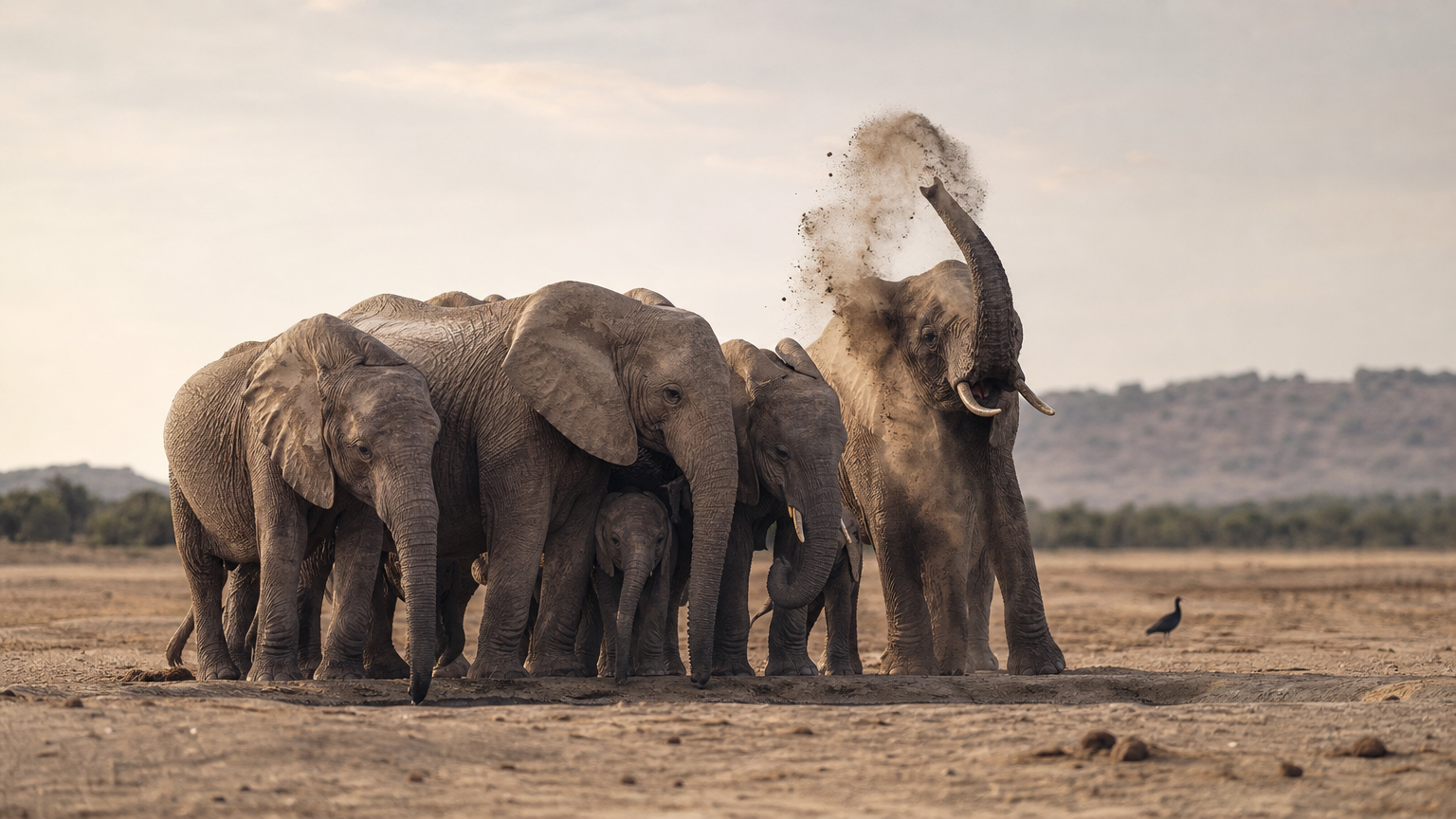
Picture a pan at 4 p.m. in September. Forty or fifty elephants fan out around the water, calves tucked between the legs of the cows, while a bull sprays dust across his back. The air glows copper. This is the classic Hwange frame, and it is the image you will see most often in Hwange National Park pictures for good reason.
Look closely at the details. The matriarch usually drinks first, and the pecking order shows in who waits and who shoves. Young bulls test each other at the edge, and calves splash in the shallows. A single frame can hold a whole family story.
Where and when to see it
Hwange has almost no natural rivers, so the park relies on boreholes that pump water into pans. Elephants come to these in large numbers. Reliable waterholes and game-viewing areas include Nyamandlovu Pan, Masuma Dam, Ngweshla, and the pans around Main Camp. July to October is the window, and September and October are the peak, when natural pools have dried up and herds have nowhere else to drink.
Afternoons are busiest, usually from about 2 p.m. until dusk. In the green season, elephants spread across the park and the waterhole crowds thin out.
In Hwange, the dry season waterhole is the best elephant photo studio in Zimbabwe.
How to capture it
Start with the right gear and safari photography settings. Elephants move slowly, but dust, splashing water, and swinging trunks need a fast shutter to look sharp.
| Setting | Suggested value |
|---|---|
| Lens | 100-400mm or 200-500mm zoom |
| Shutter speed | 1/1000 s for splashes, 1/500 s for walking herds |
| Aperture | f/6.3 to f/8 for sharp faces across a group |
| ISO | Auto, capped at 3200 |
| File format | RAW, to recover highlights in dusty light |
Position matters as much as settings. Ask your guide to park with the sun low and to the side, so the dust lights up and the wrinkles on the skin cast shadows. Stay in the vehicle, switch the engine off, and wait 20 minutes. Elephants relax once they accept you, and the best frames come after that, when calves wander close and the herd behaves naturally.
2. Lions resting on the savannah
What the photo shows
Imagine a pride stretched across pale grass at 9 a.m., bellies full from a night hunt. A lioness yawns, two cubs pile onto her flank, and a male watches the horizon through half-closed eyes. This is the quiet side of the big cats, and it produces some of the most striking pictures of Hwange National Park.
Lions sleep up to 20 hours a day, so resting scenes are your best odds of a close, relaxed portrait. Watch for the small moments: a tail flick, a cub nibbling an ear, a sudden head turn toward a distant herd.
Where and when to see it
Hwange supports a healthy lion population, and prides often work the pans where prey comes to drink. Try the open grassland around Ngweshla, Nyamandlovu, and the Main Camp area. July to October is the best window, because the grass is short and lions stay close to water.
Time of day matters more than the month. Early morning and late afternoon are when lions are visible and active. By midday they vanish into shade, and you will drive past them without noticing.
The best lion photo is the one you wait for, not the one you chase.
How to capture it
Sleeping lions give you time, so use it on composition rather than speed. Ask your guide to approach slowly and stop at a respectful distance.
- Lens: a 200-500mm zoom keeps you back while filling the frame.
- Shutter speed: 1/500 s is plenty for resting cats. Go to 1/1500 s if they start moving.
- Focus: lock onto the eyes, and shoot from window height to avoid looking down on them.
- Light: low, warm sun from the side adds texture to the mane and fur.
Be patient. A yawn or a stretch is the frame you want, and it usually arrives after 15 minutes of quiet waiting.
3. A leopard in the woodland
What the photo shows
A leopard lies along a thick mopane branch, one paw hanging down, its rosettes broken up by dappled light. Its eyes follow something you cannot see. This is the rarest frame in the gallery, and it is the one most people hope for when they browse Hwange National Park photos.
Spotting it takes work. Leopards are solitary and mostly nocturnal, so a daytime sighting usually means a cat resting in a tree or slipping through long grass at first light. Look for a dangling tail, not the spots.
Where and when to see it
Leopards favor woodland and rocky ground over open pans. Try the Sinamatella and Robins Camp areas in the north, where granite outcrops and dense bush give cover. Main Camp’s woodland can produce sightings too. The dry season from July to October helps, because thin foliage and thirsty prey make cats easier to find. Start at first light, since dawn and dusk give you the best odds. Sightings are never guaranteed, so treat a leopard as a bonus.
A leopard sighting in Hwange is earned with patience and a guide who reads the bush.
How to capture it
Light under a tree canopy is tricky, with a bright sky and a dark cat. Use these settings:
- Lens: a 200-500mm zoom, since you will often be 30 yards or more away.
- Exposure compensation: +0.7 to +1 when the sky sits behind the cat.
- Shutter speed: 1/800 s for a resting leopard, 1/1600 s if it climbs down.
- ISO: Auto, capped at 6400, because shaded cats need it.
- Focus: single point on the eye, ignoring branches in front.
Keep the engine off and stay quiet. Silence and stillness let the leopard forget you, and that is when it turns its head toward your lens.
4. Cheetahs on the open plains
What the photo shows
A slim cat stands on a termite mound, spotted coat glowing in early light, eyes locked on impala 200 yards away. This is the lookout pose, and it is the cheetah frame that stands out in Hwange National Park pictures, because the open grassland gives you a clean, uncluttered background.
Notice the black tear lines that run from eye to mouth. They are thought to cut sun glare, and they draw the eye straight to the face in any portrait.
Where and when to see it
Cheetahs are uncommon in Hwange, so go in with realistic hopes. Your best chance is the open grassland around Nyamandlovu and Linkwasha, where the cats can see prey from a distance. July to October helps, since short, dry grass keeps them visible.
Cheetahs hunt by day and avoid the midday heat. Plan for early morning and late afternoon, and scan every termite mound you pass.
With cheetahs, you find the mound first and the cat second.
How to capture it
Standing cats are easy, but a cheetah on the move is a real test. Set up before the action starts:
- Lens: a 200-500mm zoom, since the cats keep their distance.
- Shutter speed: 1/1000 s for a standing cat, 1/2500 s or faster for a run.
- Autofocus: continuous mode with burst shooting, tracking the eye.
- Position: ask your guide to park ahead of the cat’s path, not behind it.
- Height: shoot from window level to keep the horizon low and the cat dominant.
Stay patient and quiet. A cheetah that settles will often climb a mound, and that is your best frame of the day.
5. African wild dogs on the move
What the photo shows
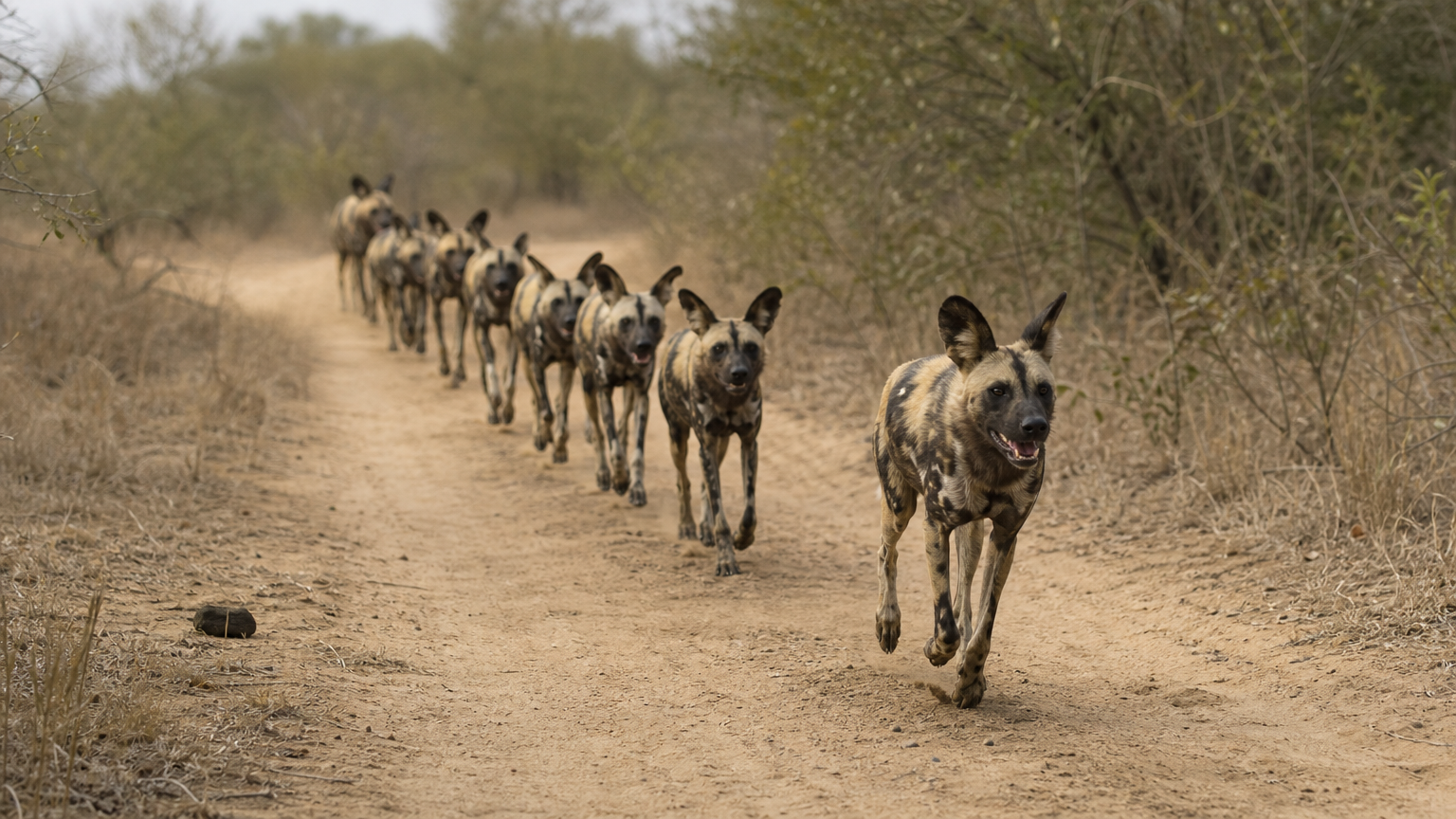
Ten dogs trot single file along a sandy track at dawn. Their coats are patched in black, tan, and white, and their big round ears swivel forward. One breaks into a sprint and the whole pack follows. This is the most energetic frame in the gallery, and among Hwange National Park images it is the one that surprises people most.
No two dogs share the same coat pattern, so every animal is a unique portrait. Watch for the greeting ritual, with squeaks and tail wags, just before a hunt begins.
Where and when to see it
Hwange is one of Africa’s strongholds for wild dogs, a species with fewer than 7,000 left in the wild. Sightings are hit and miss, so treat them as a bonus. Try the Linkwasha and Main Camp areas, and ask your guide about recent den reports.
Packs den roughly June to August, which falls in the dry season. Pups stay near one spot and the adults keep returning to it, so you can find them again. Dogs move at dawn and dusk, then sleep through the heat.
A wild dog pack gives you minutes, so be ready before you see them.
How to capture it
Wild dogs rarely stand still. Set your camera before the pack appears:
- Lens: a 100-400mm zoom, wide enough to keep a running pack in frame.
- Shutter speed: 1/2000 s to freeze a sprint. Try 1/60 s while panning for a blurred, energetic look.
- Autofocus: continuous mode with a zone or tracking area, plus burst shooting.
- ISO: Auto, capped at 6400, since the dogs are most active in dim light.
Finally, ask your guide to position the vehicle ahead of the pack’s path rather than behind it. Dogs often trot straight toward a parked vehicle, which gives you faces instead of tails. Pups playing at a den entrance are worth an unhurried 20 minutes.
6. Giraffes against a sunset sky
What the photo shows
Two giraffes stand in silhouette against an orange and pink sky, necks crossed, while thorny acacia branches frame the top of the shot. This is the postcard frame of Hwange, and it looks as good on a wall as it does on a screen. The shapes do all the work, so the picture needs no detail.
Watch for the drinking pose. A giraffe splays its front legs wide to reach the water, which leaves it exposed, so it does this warily. A giraffe at the water’s edge is a rare, graceful moment, and the herd usually keeps one animal on lookout.
Where and when to see it
Giraffes live throughout Hwange and browse along woodland edges and around the pans. Try the areas around Main Camp, Nyamandlovu, and Sinamatella, where tall acacias and open sky sit side by side. You can see them year-round, but July to October gives the clearest, driest skies. Dust haze in September and October often deepens the colors.
Sunset falls around 5:30 to 6 p.m. in the dry season. Ask your guide to plan the afternoon so you are already positioned at a pan 30 minutes before the sun drops, not driving toward one.
How to capture it
Exposure decides this shot. Meter for the bright sky, not the animal, and the giraffe turns into a clean, dark shape.
For a giraffe silhouette, expose for the sky and let the animal go dark.
- Lens: a 100-400mm zoom lets you tighten on one or two animals.
- Exposure compensation: -1 to -1.7 stops to keep the sky rich.
- Aperture and shutter: f/8 and 1/500 s for sharp edges on a slow walker.
- Position: shoot from a low angle so the necks rise cleanly into open sky.
Shoot in RAW so you can pull back color in the clouds later. Then wait for the pair to line up with a gap between their bodies, because clear separation makes the silhouette read at a glance.
7. Zebras and plains game in golden grass
What the photo shows
A dozen zebras stand shoulder to shoulder in grass the color of honey, heads turned in different directions, while a few impala graze at the edge of the frame. This is the pattern frame, and it appears in many Hwange National Park pictures because black and white stripes against gold look striking at any size.
Zebras stand close together so their stripes blend and confuse predators. Look for a foal tucked against its mother, and for mixed herds where wildebeest, kudu, or sable antelope join the group.
Where and when to see it
Plains game is easy to find in Hwange. Zebras and impala gather around Nyamandlovu, Ngweshla, and the pans near Main Camp. May to July is the best window for golden grass, because the rains have ended and the grass stands tall and dry. Sable and roan antelope are rarer, so ask your guide where herds were seen recently.
Timing matters more than location. Go out in early morning or late afternoon, when low sun turns the grass to gold. Midday light flattens the stripes and bleaches the color out of the scene.
Golden grass needs low sun, so plan your game drives around the edges of the day.
How to capture it
Zebras are patient subjects, so spend your effort on light and separation. Backlight does most of the work.
- Lens: a 100-400mm zoom, which lets you pick out a small group or a single face.
- Light: place the sun behind the herd so the grass glows and the manes get a bright rim.
- Aperture: f/5.6 to f/8 keeps the nearest zebra sharp while the background melts away.
- Shutter speed: 1/800 s handles grazing animals and sudden head turns.
- Focus: pick one eye on the closest zebra, since stripes can confuse autofocus.
8. A white rhino with oxpeckers
What the photo shows
A white rhino grazes with its head low in short grass. Two oxpeckers ride its back, one probing an ear while the other watches the bush. This is the partnership frame, and it rewards anyone who looks past the big animal to the small details.
The birds eat ticks and other parasites, and they hiss when danger comes close. That gives the rhino an early warning system. Look for the wide, square lip built for grazing, and for the red or yellow bills of the oxpeckers against gray skin.
Where and when to see it
Rhinos are rare in Hwange. Poaching has hit Zimbabwe’s rhinos hard, so the survivors are closely protected and sightings are never guaranteed. Guides often keep exact locations private for the animals’ safety, so ask what has been reported recently rather than where to find them.
The dry season from July to October gives you the best chance, since rhinos keep near water and the bush is thin. Rhinos rest in shade at midday, so plan for early morning or late afternoon.
A rhino with oxpeckers is a gift from the bush, so treat it as a bonus and not a promise.
How to capture it
You will likely be far away, and the birds are tiny. Prepare for a tight crop and quick movement.
- Lens: a 200-500mm zoom. Stay in the vehicle and keep the engine off.
- Shutter speed: 1/1000 s, because oxpeckers hop and flick without warning.
- Aperture: f/8 keeps both the birds and the rhino’s face sharp.
- Focus: single point on the nearest oxpecker’s eye, then check the rhino’s eye.
- Light: side light shows the skin folds and makes the bills glow.
Finally, shoot a few wide frames before you zoom in. The habitat shot shows the rhino in context, and the tight one shows the story. Keep your composure and let the animal settle.
9. Buffalo herds and the Big 5 question
What the photo shows
A herd of several hundred buffalo files toward a pan, dust hanging in the late light. Out front stands an old bull, his horns fused into a heavy boss across the forehead, staring straight at you. This is the weight frame, and it answers a question many visitors ask while browsing Hwange National Park photos: can you really see the Big 5 here?
Yes, in theory. Hwange holds lion, leopard, elephant, buffalo, and rhino, so all five live in the park. Buffalo are the easy one. The rhino is the hard one, and it decides whether you complete the set.
Where and when to see it
Buffalo favor the grasslands and pans around Main Camp, Sinamatella, and Robins Camp. Herds of 200 or more are common from July to October, when they stay close to water and the grass is short enough to see across. Afternoons are best, because herds come to drink and stir up the dust that makes the picture.
In Hwange, buffalo are the sure bet, and the rhino decides whether you complete the Big 5.
Old bulls often live apart from the herd and wallow in mud during the heat of the day. Ask your guide to check the muddy edges of pans for these "dagga boys" at midday.
How to capture it
Bulk and dust reward simple settings. Keep the lens long and the vehicle still.
- Lens: a 100-400mm zoom, wide enough for a moving herd.
- Shutter speed: 1/1000 s for walking animals, 1/500 s for a staring bull.
- Aperture: f/8, so several rows of animals stay sharp.
- Exposure: -0.7 stop when the sun backlights the dust, which protects the glow.
- Focus: single point on the lead bull’s eye.
Finally, remember that buffalo are unpredictable and can charge without warning. Stay inside the vehicle, leave the engine off, and let the herd decide how close to come.
10. Hippos and crocodiles at Masuma Dam
What the photo shows
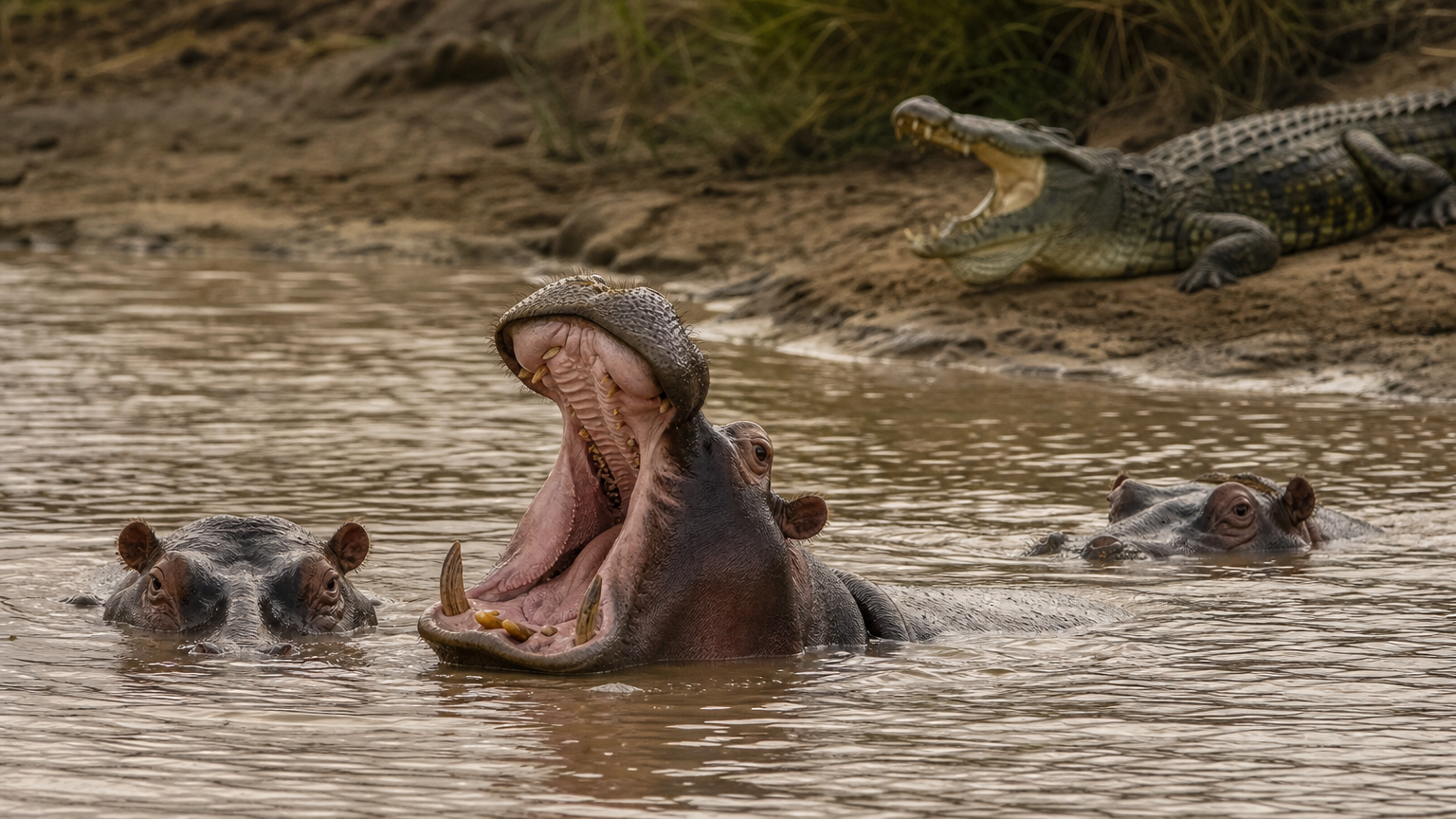
Three hippos wallow in brown water, ears flicking, eyes just above the surface. On the bank behind them, a Nile crocodile lies with its jaws open to cool off. This is the waterline frame, and it adds a different mood to Hwange National Park pictures after so many dry plains.
Wait for the yawn. A hippo opening wide shows tusks up to 20 inches long, and it is a warning display, not boredom. Crocodiles gape to shed heat, so an open mouth does not always mean a threat.
Where and when to see it
Masuma Dam sits in the heart of the park and holds water long after the natural pans have dried up. A raised viewing platform overlooks the dam, so you can watch from a safe height. From July to October, hippos crowd into the shrinking water, which packs more animals into each frame.
At Masuma Dam, patience at the waterline pays off in yawns, splashes, and crocodile teeth.
Timing works differently here. Hippos stay submerged through the midday heat, so aim for early morning or late afternoon, when they surface, grunt, and yawn. Crocodiles start sunning on the banks by mid-morning.
How to capture it
Water adds glare and contrast, so set up before the action starts.
- Lens: a 200-500mm zoom, since the animals stay mid-dam.
- Shutter speed: 1/1000 s to freeze a yawn or a splash.
- Metering: spot metering on the hippo’s skin, because bright water fools the camera into underexposing it.
- Filter: a circular polarizer cuts glare and brings out the color in the water.
- Height: shoot from the lowest rail of the platform for a more intimate angle.
Stay on the platform or in the vehicle. Hippos are among Africa’s most dangerous animals, and crocodiles blend into the bank. Never walk down to the water’s edge for a closer shot.
11. Birdlife from kori bustards to saddle-billed storks
What the photo shows
A kori bustard stalks across short grass, crest raised and tail fanned. It is the heaviest flying bird in Africa, at up to 40 pounds, and it would rather walk than fly. That ground-level strut makes one of the most characterful Hwange National Park pictures of birdlife.
Near the water, a saddle-billed stork wades through the shallows. Its red-and-black bill with a yellow saddle makes it one of Africa’s most colorful birds, and it stands almost five feet tall. Watch for the sudden stab at a frog or fish.
Where and when to see it
Hwange has more than 400 recorded bird species, so you never need a special trip to find subjects. Scan the open grassland near Nyamandlovu for bustards. Check the edges of Masuma Dam for storks, herons, and fish eagles. Bateleurs and secretary birds also work the open ground.
The dry season concentrates birds at the water, but November to March brings migrants and breeding plumage. Birds are most active in the first two hours after sunrise.
In Hwange, the green season brings the bird variety and the dry season brings the easy access.
How to capture it
Birds are small and wary, so reach and speed matter more than anything else.
- Lens: a 200-500mm zoom, or longer if you own it.
- Shutter speed: 1/1000 s for walking birds, 1/2000 s or faster for takeoffs.
- Autofocus: continuous mode, with eye detection if your camera offers it.
- Angle: shoot from window level so the bird’s eye lines up with your lens.
Finally, ask your guide to approach at an angle and switch off the engine. A bird that ignores the vehicle will keep feeding, and a patient 10 minutes often gives you the stork’s strike or the bustard’s full display.
12. Green season landscapes and dramatic skies
What the photo shows
A storm builds over an open pan at 3 p.m. Charcoal clouds stack up on the horizon, and one shaft of sun lights a patch of emerald grass where a lone elephant walks through. This is the contrast frame, and it looks nothing like the dusty, copper scenes from the dry season.
The green season adds details you will not find in July. Newborn impala wobble beside their mothers, pans fill with reflections, and the sky does half the work. Many of the best Hwange National Park pictures of landscapes come from this time of year.
Where and when to see it
The rains run from about November to April, and the heaviest falls come between December and March. Any open ground works, but the wide pans near Nyamandlovu and Ngweshla give you the longest horizons. Storms usually build in the afternoon, so late afternoon is when the sky turns dramatic.
Expect trade-offs. Wildlife spreads out once water is everywhere, and some tracks turn muddy, so ask your guide which routes are open. In return you get fewer vehicles and lush, clear light after each shower.
The dry season gives you the animals, and the green season gives you the sky.
How to capture it
Skies fool the meter, so take control of exposure. Keep your wide and mid-range lenses handy, because the landscape rewards a different kit from the one you used for wildlife.
- Lens: a 24-70mm or 70-200mm zoom for scenery, with the long lens ready for animals.
- Exposure compensation: -0.7 to -1 stop to hold detail in bright clouds.
- Filter: a circular polarizer deepens blue gaps and cuts glare on wet grass.
- Composition: keep the horizon low so the sky fills two thirds of the frame.
Wait for a break in the clouds and then shoot. Stay inside the vehicle when lightning is close, because no photo is worth a strike. Carry a rain cover or a plastic bag for your camera body.
Turning these pictures into your own trip
These Hwange National Park pictures all teach the same lesson: timing and patience decide the shot. The dry season from July to October gives you crowded waterholes, resting lions, and golden light. The green season rewards you with storm skies and birdlife. Some frames, like the leopard, the wild dogs, and the rhino, are bonuses you cannot promise yourself, and a good guide improves your odds more than any lens does.
Ready to see it in person? Maximum Adventure Trails handles the bookings, transfers, and itinerary, with experienced local guides who know where the herds gather. Plan your Hwange safari with Maximum Adventure Trails and start building your own gallery. Pack a long lens, bring an extra memory card, and let the park do the rest.