

- 9 Views
- 23 Min Read
- (0) Comment
You're probably looking at two wildlife experiences on your screen right now. One promises a close elephant encounter, the kind with camera-ready moments and language like “up close” or “once in a lifetime.” The other talks about quiet game viewing, trained guides, distance rules, and time limits at sightings. The first feels vivid. The second can sound restrictive.
That's where many ethical decisions in travel happen. Not in a park office, and not in a policy document. They happen when a traveller chooses what to book.
Responsible wildlife tourism isn't just a feel-good label. It's a practice you can test. It has visible signs on the ground, and it has hidden signs in the animals themselves. A calm-looking scene can still be stressful for a herd, a pride, or a denning pack. That's why the science of stress matters so much here. It helps explain why rules about distance, noise, feeding, and group size exist in the first place.
In southern Africa, those choices carry real weight. A safari around Victoria Falls, Hwange, Chobe, Moremi, or the Okavango Delta can support livelihoods, reinforce the value of keeping land under wildlife, and reward operators who manage sightings carefully. It can also do the opposite if the experience is built around pressure, handling, crowding, or constant access.
If you want a broad planning foundation before narrowing down wildlife activities, this Africa safari guide gives helpful regional context. What follows goes a step further. It translates welfare science into booking decisions you can use.
The framework is simple. Ask four questions before you book. Does the experience protect animals from stress and disturbance? Does it protect habitat rather than wear it down? Does money reach local livelihoods? Can the operator explain its rules in practical, verifiable terms? If you can answer those well, you're already travelling more responsibly than those who rely on marketing language alone.
Table of Contents
- Setting the Scene for Responsible Wildlife Tourism
- What Responsible Wildlife Tourism Really Means
- Why Africa Carries So Much of the Weight
- Core Principles and the Regulations Behind Them
- Reading an Operator Across Victoria Falls, Hwange, Chobe, Moremi, and the Okavango
- The Hidden Stress Behind the Lens
- A Traveler's Pre-Trip, On-Trip, and Post-Trip Checklist
- Bringing It Together and Booking with Confidence
Setting the Scene for Responsible Wildlife Tourism
The easiest mistake travellers make is assuming that the most memorable wildlife experience must also be the most intimate one. That sounds reasonable until you compare it to watching a shy animal at a waterhole. If every visitor pushed closer for a better look, the waterhole would still be there, but the animal's use of it might change.
That's the heart of responsible wildlife tourism. It isn't about making wildlife invisible to people. It's about structuring tourism so animals can keep behaving like wild animals.
Why the rules exist at all
A lot of travel advice stops at “don't touch animals.” That's useful, but it's not enough. The more important question is what your presence changes. A vehicle that cuts off an elephant family on a road, a boat that lingers too long beside feeding birds, or a guide who keeps restarting the engine to improve the viewing angle can all alter behaviour even without direct contact.
Researchers physiological indicators often reveal harm more reliably than behaviour alone, because animals may appear tolerant while still showing stress responses. The USDA-reviewed synthesis also notes that tourist activity isn't uniformly harmful, which is why careful management matters more than blanket slogans about all tourism being good or bad. The practical implication is straightforward. Responsible programs should monitor validated stress indicators alongside behaviour, not rely only on what tourists can see from a seat in a vehicle, as outlined in this USDA-reviewed synthesis on wildlife tourism disturbance.
Practical rule: If an operator can only talk about how close you'll get, and not about how they limit disturbance, that's a warning sign.
What this looks like in safari country
In southern Africa, this becomes very concrete. In Hwange, it may mean waiting your turn at a busy sighting instead of edging into a better angle. In Chobe, it may mean a boat guide keeping a respectful line rather than drifting directly into an animal's path. In Moremi or the Okavango, it may mean accepting a distant but undisturbed view over a dramatic close pass.
A good safari often feels quieter than people expect. Less chasing. Less crowding. More patience. [The skill lies in reading the setting, not dominating it.] Good birding or good fishing shares this approach.
What Responsible Wildlife Tourism Really Means
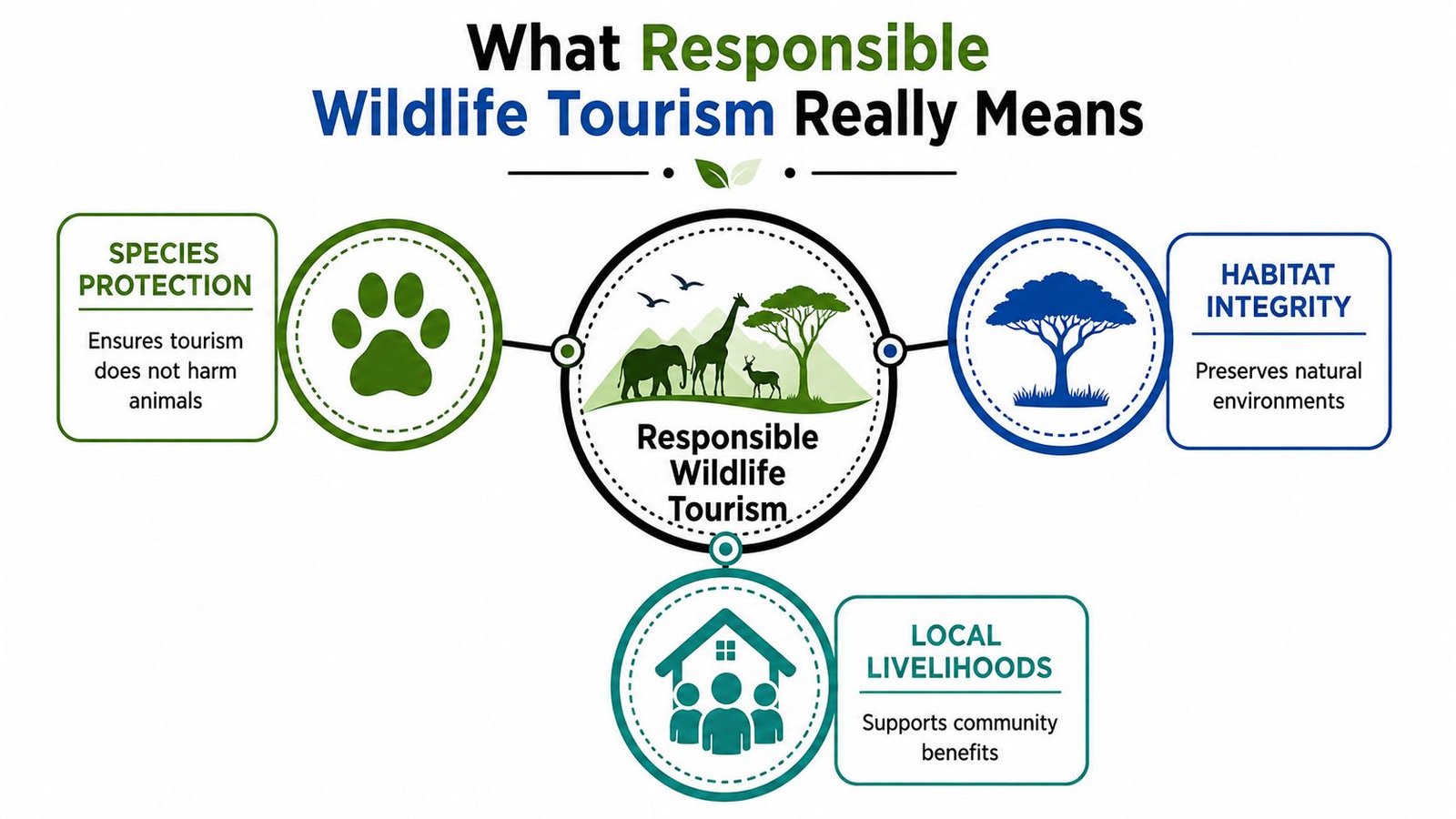
Responsible wildlife tourism means travel that supports species protection, preserves habitat integrity, and contributes to local livelihoods while avoiding unnecessary harm to animals. That sounds broad, so it helps to break it into parts you can test when you book.
Species protection
Wildlife tourism isn't a side issue in conservation economics. It's large enough to shape land-use decisions. The World Travel & Tourism Council estimated that global wildlife tourism generated $343.6 billion annually and supported 21.8 million jobs worldwide, equal to 3.9% of the global travel and tourism sector. The same source states that in 2018, wildlife tourism directly contributed $120.1 billion to global GDP and was valued at 5.2 times the revenue attributed to the illegal wildlife trade. In Africa, wildlife accounted for 36.3% of direct tourism GDP and supported 3.6 million jobs according to the WTTC economic impact of global wildlife tourism report.
That matters because species protection often depends on whether wildlife is worth more alive than exploited or displaced. For a traveller, this translates into simple booking behaviour. Choose operators whose fees clearly sit inside regulated park access, conservation levies, or concession systems rather than vague “animal encounter” experiences detached from wild habitat.
Habitat integrity
A region can look vast and still be overused at key points. A floodplain crossing, den area, riverbank, or watering site can take heavy pressure long before an entire park looks crowded. Habitat integrity in tourism means guides use tracks correctly, rotate sightings, respect closed areas, and avoid turning fragile ground into a maze of tyre marks.
If you're comparing options, look for operators that explain how they manage time at sightings, off-road restrictions, and vehicle conduct. Broad eco-language isn't enough. You want operational detail.
For a related travel planning lens, this guide to a sustainable safari is a useful complement to the wildlife-specific questions in this article.
Local livelihoods
The third pillar is where many travellers get fuzzy. They'll ask whether the camp is “eco-friendly,” but not whether nearby communities gain from keeping wildlife on the land. In practice, local livelihood support can show up through employment, community concession structures, local procurement, and levies that don't vanish into vague marketing copy.
Ask direct questions such as:
- Who benefits locally: Are guides, trackers, camp staff, and polers hired from nearby communities?
- Where fees go: Are park fees, concession fees, or community levies separated clearly in the quote?
- What the trade-off is: If wildlife sometimes damages crops or competes for space, what makes conservation worth defending for local residents?
Responsible wildlife tourism sits inside a tougher ethical test than generic sustainable tourism. It must answer not just “Is this lower impact?” but also “What does this do to the animal in front of me?”
How it differs from adjacent terms
Ecotourism and sustainable tourism overlap with responsible wildlife tourism, but they aren't identical. A lodge may run on solar power and reduce plastic use, yet still offer poorly managed wildlife interactions. A tourism business may support community projects while tolerating crowding at sightings.
Wildlife tourism has extra ethical tests. How close are visitors allowed to get? Are animals captive or free-ranging? Is there direct interaction? Are welfare impacts monitored, not just assumed? Those questions are specific to encounters with living animals, which is why this category needs sharper scrutiny than a general green travel label.
Why Africa Carries So Much of the Weight
You book a river cruise in Chobe or a game drive near Hwange because the wildlife is still free-ranging, still behaving like wildlife, and still living in places large enough to support migration, breeding, hunting, and refuge. That freedom is part of the product. It is also the fragile part. In southern Africa, tourism often helps decide whether land stays compatible with wildlife or shifts toward uses that leave less room for animals.
That is why this region carries unusual responsibility. A booking here can do more than buy a memorable sighting. It can support operators, concessions, and communities that keep habitat connected and keep tolerance for wildlife financially realistic.
The region's outsized responsibility
Southern Africa holds some of the continent's best-known safari areas, but the core issue is not fame. It is concentration. In places such as Hwange, Chobe, Moremi, and the Okavango Delta, large numbers of visitors focus on the same water, roads, channels, and predator zones because those are the places animals also need most.
A map may make these areas look spacious. Animal use is much more specific.
Elephants return to reliable water. Predators work productive hunting routes. Herds favor certain crossings, floodplain edges, and grazing patches. Tourism pressure gathers in those same places, which means a rule that seems minor to a guest, such as how many vehicles stop at a sighting or how long a boat idles near a bank, can change the quality of an animal's day in very practical ways.
This is also why southern Africa needs more than a generic eco label. The welfare question is sharper here because the wildlife encounters are so good, so frequent, and so marketable. Strong demand creates funding for conservation, but it also rewards operators who chase closeness, speed, and spectacle unless parks, concessions, and guests push in the other direction.
Why the same safari rule looks different by place
The principle may be simple. Do not add stress. The way that principle shows up on the ground changes by destination.
Around Victoria Falls, the pressure often comes from volume and convenience. Many travellers are based in one hub, mixing sightseeing, adventure activities, and short wildlife outings. That setting can produce wildlife products designed for easy access and dramatic photos, which is exactly why travellers should examine animal welfare claims carefully there.
Hwange poses a different test. Waterholes, pumped water points, and road access can create repeated contact between vehicles and animals using limited resources. If a guide keeps returning to the same elephant group at the same water source, the issue is not just one close sighting. It is repeated interruption at a place the animals cannot avoid.
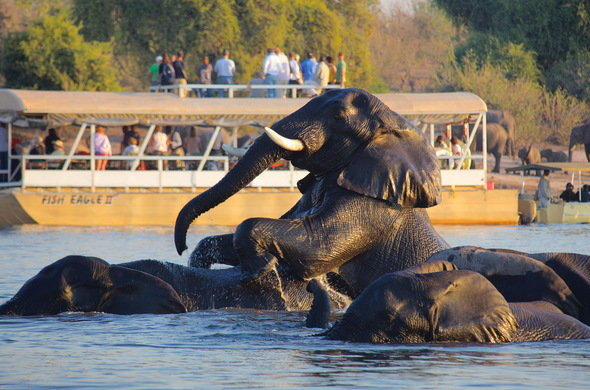
Chobe often brings the river into the ethical picture. Boats can cluster at appealing sightings, especially along busy stretches of bank. A calm elephant crossing or a resting hippo pod can become a crowd scene fast if operators compete for angle and proximity.
Moremi and the Okavango ask a different kind of discipline. Woodland, channels, walking routes, and mokoro trips can feel intimate and low impact, but that depends heavily on the guide, skipper, or poler reading animal signals early and backing off before stress becomes visible. Quiet does not always mean harmless.
The lesson for travellers is practical. Responsible wildlife tourism is local. A good operator in one area proves quality by handling that area's pressure points well, not by repeating broad sustainability language.
Southern Africa's Wildlife Tourism Footprint at a Glance
| Country | Wildlife Tourism Share | Key Parks/Areas | Conservation Pressure Point |
|---|---|---|---|
| Botswana | Wildlife tourism is a major part of the regional safari economy, with high-value viewing concentrated in a small number of ecosystems | Chobe, Moremi, Okavango Delta | River and channel crowding, sensitive habitat use, viewing pressure at popular sightings |
| Zimbabwe | Wildlife tourism supports livelihoods around flagship protected areas and mixed-use buffer zones | Victoria Falls area, Hwange | Attraction quality variation, fence-line conflict, concentrated waterhole viewing pressure |
| Zambia | Wildlife-based travel contributes to destination appeal in key river and park systems | Livingstone area and wildlife circuits | Balancing access with disturbance in mixed tourism zones |
| Namibia | Wildlife tourism helps sustain conservation-compatible land use across protected and communal conservancies | Conservancies and park networks | Managing access across fragile arid environments |
A safari area may look open and endless, but pressure gathers where animals must feed, drink, breed, or move.
Core Principles and the Regulations Behind Them
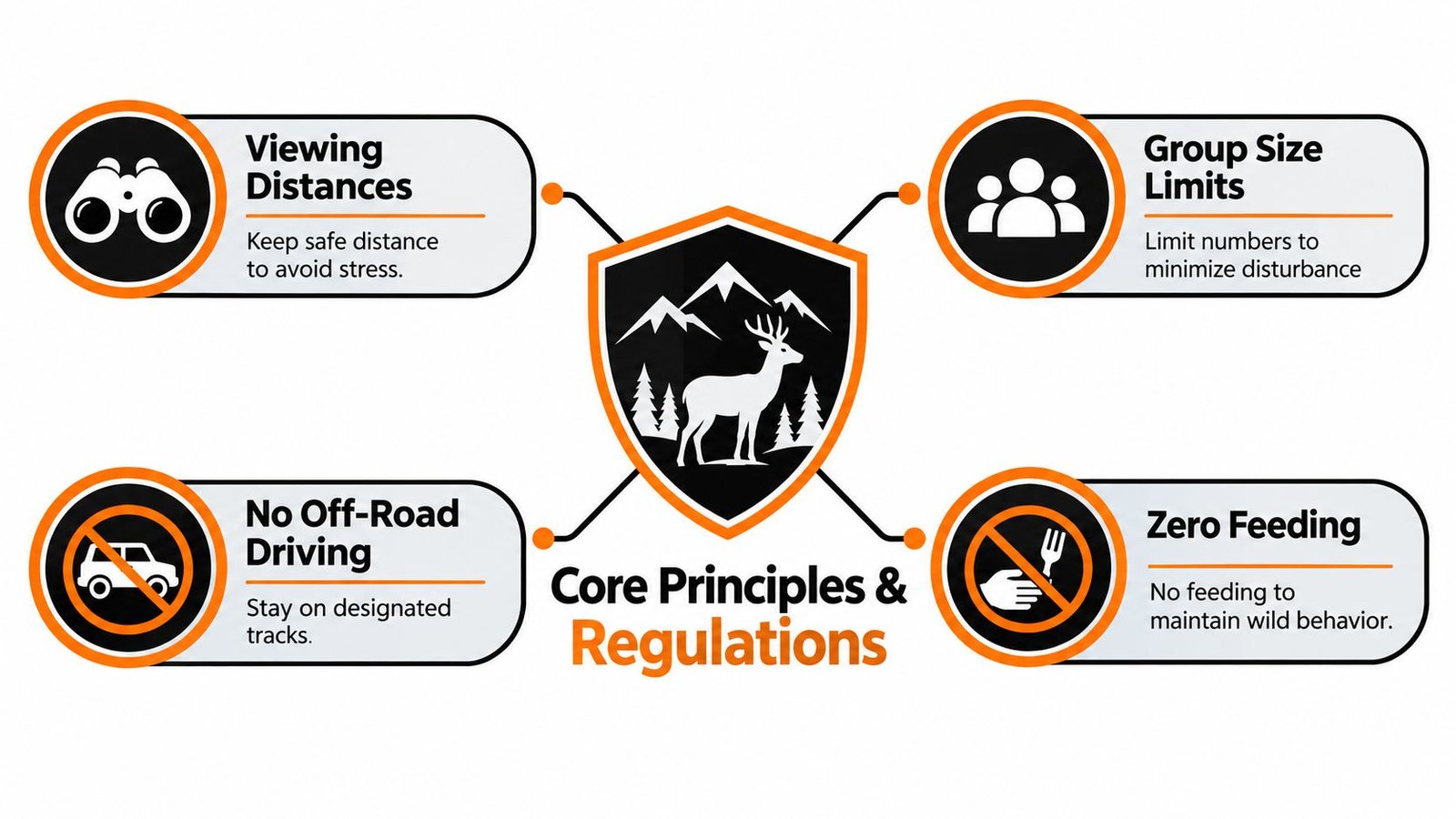
Most wildlife-viewing rules sound simple when printed on a lodge note or park sign. Keep your distance. Don't feed animals. Stay on designated routes. Limit crowding. What makes them powerful is that each one translates a welfare concern into something guides, drivers, skippers, and travellers can follow.
Viewing distance
Distance is the most visible welfare tool a traveller can judge in real time. If a guide closes in until an elephant bunches, a lioness stops what she's doing, or a herd keeps changing direction to avoid the vehicle, the line has probably been crossed.
This principle exists because disturbance can interrupt feeding, breeding, resting, and social behaviour. The World Bank summary of wildlife tourism impacts notes that poorly managed tourism can lead to disturbance of feeding and breeding, altered social behaviour, disease transmission, injury, and mortality, and that effective control depends on active capacity management and monitoring rather than site choice alone, as described in this World Bank summary of wildlife tourism impacts.
Group size limits
Many travellers underestimate group size because one vehicle can seem harmless. The better analogy is a restaurant. One table speaking softly doesn't change the room. Pack too many tables too close together and the atmosphere shifts for everyone.
Wildlife reacts the same way. A single vehicle at a sighting may be tolerable. Several vehicles circling, leapfrogging, and idling create a completely different level of stimulus. Ask operators how many guests they place per vehicle, how many vehicles they allow at a sighting, and whether they rotate viewing time.
No off-road driving outside designated areas
Off-road driving can sound exciting because it suggests privileged access. Sometimes it's lawful and carefully managed in specific concessions. Sometimes it's just habitat damage sold as exclusivity.
The rule matters for two reasons. First, repeated off-road use scars sensitive ground and can degrade habitat around frequently viewed species. Second, it often encourages a chase mentality. A guide trying to cut distance by leaving established routes may increase pressure exactly when an animal needs space.
Zero feeding and zero harassment
Feeding is one of the clearest red lines in responsible wildlife tourism. Once food enters the encounter, animal behaviour can shift quickly. Harassment can be subtler. It includes blocking movement, provoking a reaction for photographs, crowding a den, or using sound and motion to keep an animal visible.
CITES trade restrictions also matter in the wider wildlife tourism picture, because tourism can intersect with wildlife handling, display, and commercial exploitation. At destination level, travellers should also expect operators to follow the local park and conservation rules set by authorities such as ZimParks, the Botswana Department of Wildlife and National Parks, and transfrontier frameworks such as KAZA TFCA.
What to verify before you pay
- Ask for operating rules: A serious operator can explain viewing distance, time limits, and off-road policy plainly.
- Ask who sets them: You want references to park authority rules, concession rules, or written codes of conduct.
- Ask what happens when guests push: Good guides know how they refuse unsafe or unethical requests.
Reading an Operator Across Victoria Falls, Hwange, Chobe, Moremi, and the Okavango
The fastest way to assess an operator is to stop listening to adjectives and start watching behaviour. “Ethical,” “responsible,” and “wildlife-friendly” are easy words to print on a webpage. They become meaningful only when they show up in how guides drive, where boats stop, how radios are used, and what happens when a guest asks for a closer approach.
The field signals that matter
A strong operator usually looks calm in action. Vehicles approach slowly. Engines are switched off when appropriate. Guides avoid boxing animals in. They don't crowd other vehicles for a sighting, and they don't treat radio calls as a race.
A weaker operator often feels more performative. The guide chases reports, squeezes between vehicles, nudges for movement, or promises unusually close encounters. Tipping can also reveal a lot. If staff compensation is murky and guests feel pushed into rewarding risky behaviour with cash, the incentive system is already wrong.
If you're comparing actual itineraries and day trips, this collection of guided safari tours is the kind of place where these operator questions become practical rather than theoretical.
Operator Signals by Destination
| Destination | Ethical Signal | Red Flag |
|---|---|---|
| Victoria Falls | Clear separation between sightseeing activities and wildlife experiences, plus plain rules on distance and handling | Elephant-back rides, captive handling, or attractions built around selfies and direct animal control |
| Hwange | Patient waterhole viewing, conservative vehicle positioning, and guides who prioritise elephant space | Pushing close to breeding herds, blocking road movement, or lingering when animals show agitation |
| Chobe | Boat skippers who hold a respectful line and avoid surrounding wildlife on the river | Repeated repositioning for photos, crowding near shoreline animals, or noisy jockeying among boats |
| Moremi | Quiet approach in wooded areas and restraint around predators, especially when cover is dense | Excessive radio chasing, noisy vehicles, or pressure around hidden breeding areas |
| Okavango Delta | Trained polers and guides who move softly through channels and read animal distance well | Splashy, intrusive approach in mokoros or pressure to force close encounters in sensitive channel systems |
Five questions to ask before booking
Use these in an email, live chat, or phone call. The answers usually tell you more than the brochure does.
How do your guides handle distance at sightings?
Listen for specifics, not vague reassurance.How many vehicles or boats do you allow at one sighting?
You want an answer that suggests limits and rotation.What's your policy on feeding, touching, or provoking animals for photographs?
This should be immediate and unequivocal.How are guides trained and supervised on wildlife conduct?
Better operators can describe training, briefings, and standards in practical terms.How do local communities benefit from this activity?
The answer shouldn't be hand-waving. It should mention employment, levies, partnerships, or concession arrangements.
If a sales team responds with polished slogans but can't answer these five questions directly, keep looking.
The Hidden Stress Behind the Lens
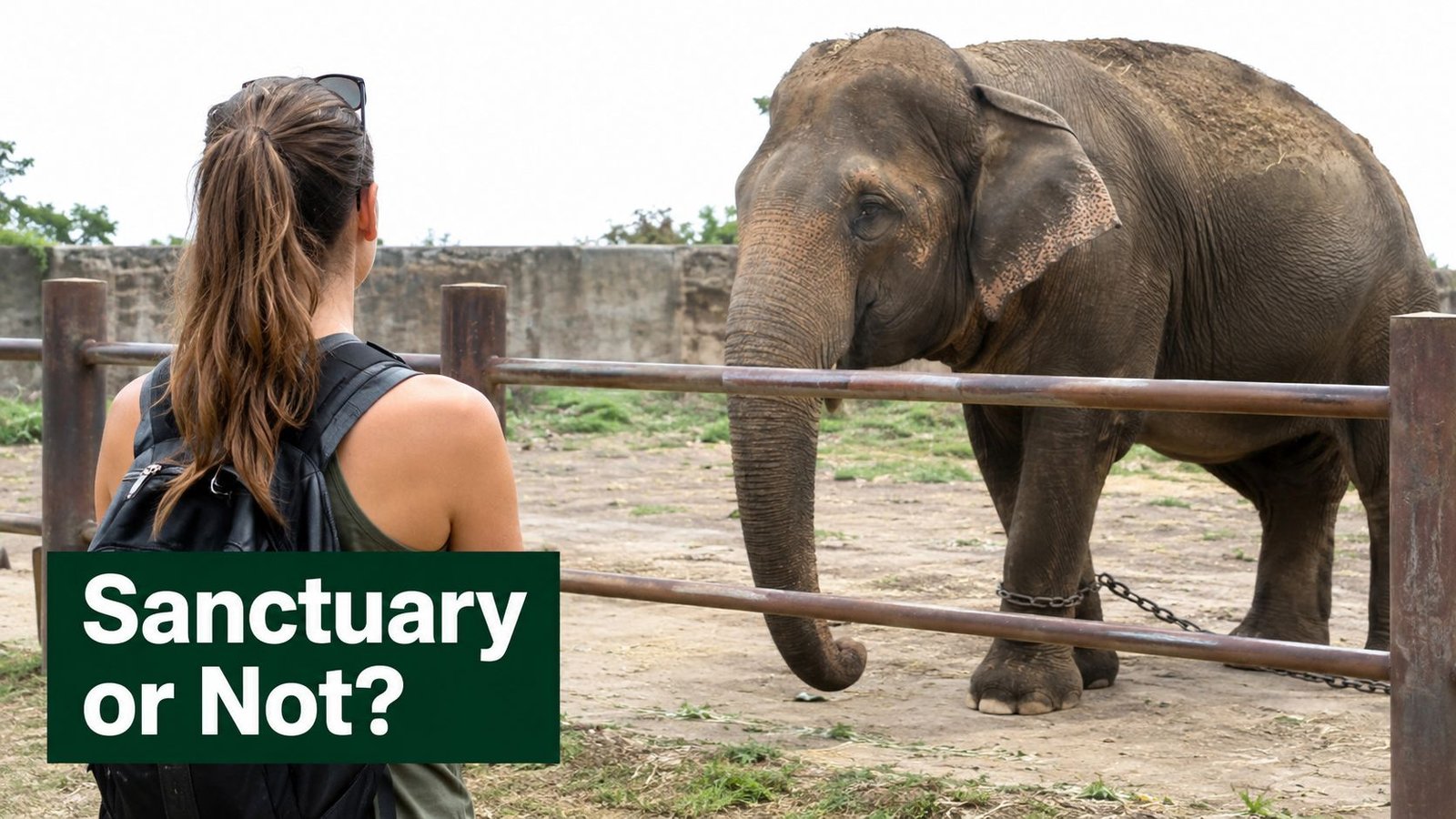
The common shortcut is simple. Don't touch wildlife. Choose a sanctuary. Move on. That advice is better than nothing, but it leaves out a lot of what travellers need to know.
Why “sanctuary” isn't a guarantee
Some venues use the language of rescue, sanctuary, or conservation even when visitor access remains the central product. That's why the evidence matters. A major Oxford-led study cited by World Animal Protection found that at least 4 million tourists visiting wildlife attractions were likely contributing to large-scale animal welfare abuses, while 230,000 to 550,000 animals were being held in attractions that negatively affected their welfare. The same research found that only six attraction types, involving just 1,500 to 13,000 animals, were likely to have net positive effects on welfare and conservation, according to this World Animal Protection summary of the Oxford-led research.
That's a striking gap between what the market offers and what appears beneficial.
A newer review adds another layer. It describes a “sanctuary gap,” where sanctuaries stand out as a notable exception while most captive non-zoo attractions produce negative welfare and conservation outcomes. The same paper discusses a visitor survey of over 1,000 people in which respondents rated a panda base's governance and conservation efforts favorably, even though those perceptions were influenced by social media exposure and welfare knowledge, as reported in this 2025 review on captive attractions and sanctuary gaps.
What stress can look like to a traveller
Stress doesn't always present as obvious panic. Sometimes it shows up as interruption. A lioness stops stalking. An elephant family bunches tightly and changes route. A painted dog pack becomes less cohesive near pressure points. A bird colony lifts repeatedly because boats won't hold position.
That's why photographers, in particular, need a sharper standard than “I didn't touch it.” Strong wildlife images often come from patience, long lenses, silence, and allowing behaviour to unfold. These safari photography tips are most useful when you treat animal welfare as part of the craft, not an obstacle to it.
The same idea comes through clearly in this short video.
A better question than “Is it ethical”
Instead of asking whether a venue calls itself ethical, ask what evidence supports the level of visitor access. No-touch policies matter. So do low-density viewing, refuge space for animals, trained staff, and clear boundaries on interaction. A place can prohibit touching and still allow patterns of crowding, confinement, or chronic disturbance that undermine welfare.
That's the hidden lesson behind responsible wildlife tourism. The issue isn't only obvious cruelty. It's repeated stress that a visitor might miss unless they know what to look for.
A Traveler's Pre-Trip, On-Trip, and Post-Trip Checklist
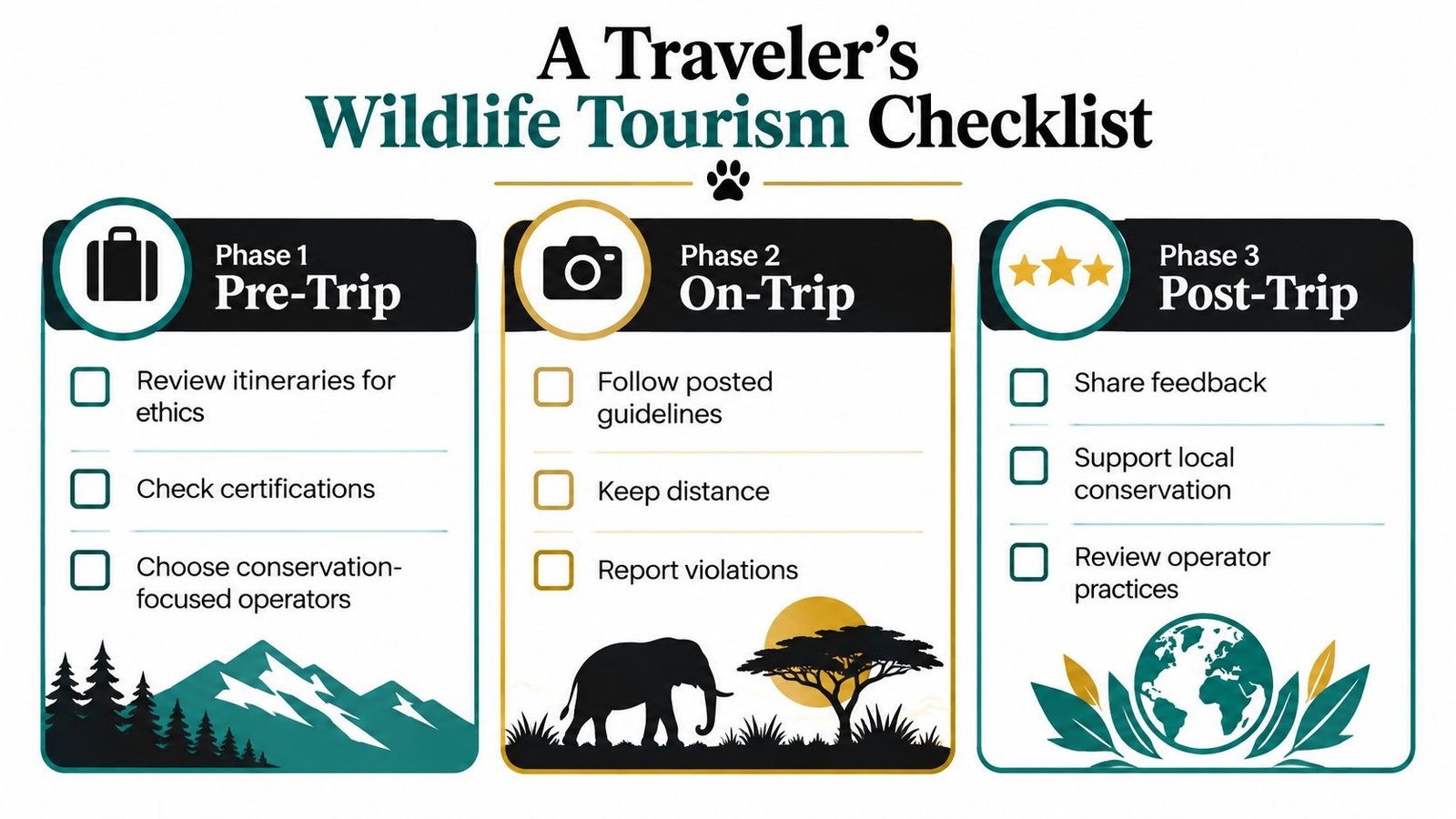
A good safari decision doesn't happen once. It happens in phases. You screen before you travel, you observe while you're there, and you follow through after you return.
Pre-trip
Before you pay a deposit, read the itinerary as if it were an operating manual rather than a dream board. You're looking for clues about crowding, interaction, and control.
- Check the wildlife activity itself: Does the itinerary involve wild viewing, or does it lean on handling, captive display, or vague “encounters”?
- Ask about limits: Find out how vehicles, boats, or walking groups are managed at sightings.
- Scrutinise interaction language: “Close encounter,” “touch,” “walk with,” and “behind the scenes” often deserve extra scrutiny.
- Review certifications and policies: If an operator mentions standards or welfare commitments, ask to see how those translate into guest conduct.
- Pack for distance, not intrusion: A decent zoom, neutral clothing, and patience are more useful than expecting access to be engineered for you. This safari packing list helps with the practical side.
On-trip
Once you're in the field, treat yourself as part of the management system. Your guide leads the outing, but your choices still matter.
Watch for these signs:
- Distance discipline: Does the guide hold position when animals show unease?
- Noise control: Are voices, radios, and camera behaviour kept low and deliberate?
- Feeding and baiting policy: There should be none.
- Track and route conduct: Are vehicles respecting park rules and habitat limits?
- Fair tipping culture: Reward professionalism, restraint, and interpretation. Don't reward reckless proximity.
Keep short notes on standout sightings or concerns. Memory gets fuzzy after a long travel day, but details matter if you need to report a problem later.
Post-trip
Many travellers stop at the photo upload. That's a missed chance to improve future practice.
- Report serious concerns: If you saw feeding, harassment, unsafe crowding, or improper animal handling, notify the relevant park authority or operator management.
- Leave precise feedback: “Great safari” doesn't help much. “Guide kept strong distance discipline with elephants and rotated sightings well” does.
- Support follow-up conservation action: If your trip offers a legitimate survey, levy, or conservation channel, engage with it.
- Share carefully: When posting online, avoid glamorising poor practice just because the photo came out well.
Responsible wildlife tourism works best when travellers act like informed participants rather than passive consumers. One good booking helps. Repeated good decisions by thousands of travellers help much more.
Bringing It Together and Booking with Confidence
By the time you compare a few safari options, the decision usually feels less mysterious than it did at the start. You don't need to be a wildlife biologist to book well. You need a usable lens.
That lens comes back to four checks. Keep distance. Limit crowding. Stay within habitat rules. Refuse feeding, handling, and harassment. Then add the regional reading skills that matter in southern Africa. Be extra alert around captive-style attractions near Victoria Falls. Look for disciplined elephant viewing in Hwange. Watch river etiquette in Chobe. Expect quiet restraint in Moremi. Ask about guide and poler standards in the Okavango.
Maximum Adventure Trails Trust Signals at a Glance
| Trust Signal | Detail | Why It Matters |
|---|---|---|
| Regional focus | The platform lists safari, activity, and accommodation options across Victoria Falls, Hwange, Chobe, Moremi, and the Okavango Delta | Regional focus makes it easier to compare experiences within the same wildlife ethics framework |
| Wildlife and sustainability content | The publisher's own sustainable safari material describes minimizing impact on animal behaviour and habitats, guide training in responsible viewing, and support for conservation initiatives | Public-facing standards give travellers concrete questions to test against actual bookings |
| Community and stewardship emphasis | The publisher materials also describe community empowerment and environmental stewardship as part of its safari approach | Wildlife ethics is stronger when livelihoods and habitat stewardship are considered together |
One practical option in this space is Maximum Adventure Trails, which functions as a booking website for safari, activity, and accommodation options across these destinations. That matters because a platform that concentrates regional products in one place gives travellers a clearer basis for comparing operator rules, activity types, and destination-specific red flags before committing.
Useful onward resources
A smart next step is to keep building your own filter, not just your itinerary.
- Regional operator vetting guide: Build a short question sheet from the five operator questions in this article and use it every time.
- Wildlife welfare reading list: Keep a few welfare-science sources saved so you can spot weak claims dressed up as ethics.
- Credible conservation organisations: Follow NGOs and park-linked conservation groups that discuss habitat protection, welfare, and tourism management in practical terms.
The most important point is also the most reassuring one. Responsible wildlife tourism isn't a secret club and it isn't a perfect label. It's a series of decisions. Each decision can be checked against animal stress, habitat impact, local benefit, and operator discipline. Once you start booking that way, the marketing fog thins out quickly.
If you want help turning these principles into an actual safari plan, Maximum Adventure Trails offers bookable options across Victoria Falls, Hwange, Chobe, Moremi, and the Okavango Delta. It's a useful place to compare activities against the welfare and operator signals covered here, especially if you want an itinerary that treats wildlife viewing as something to manage carefully rather than consume casually.