

- 2 Views
- 9 Min Read
- (0) Comment
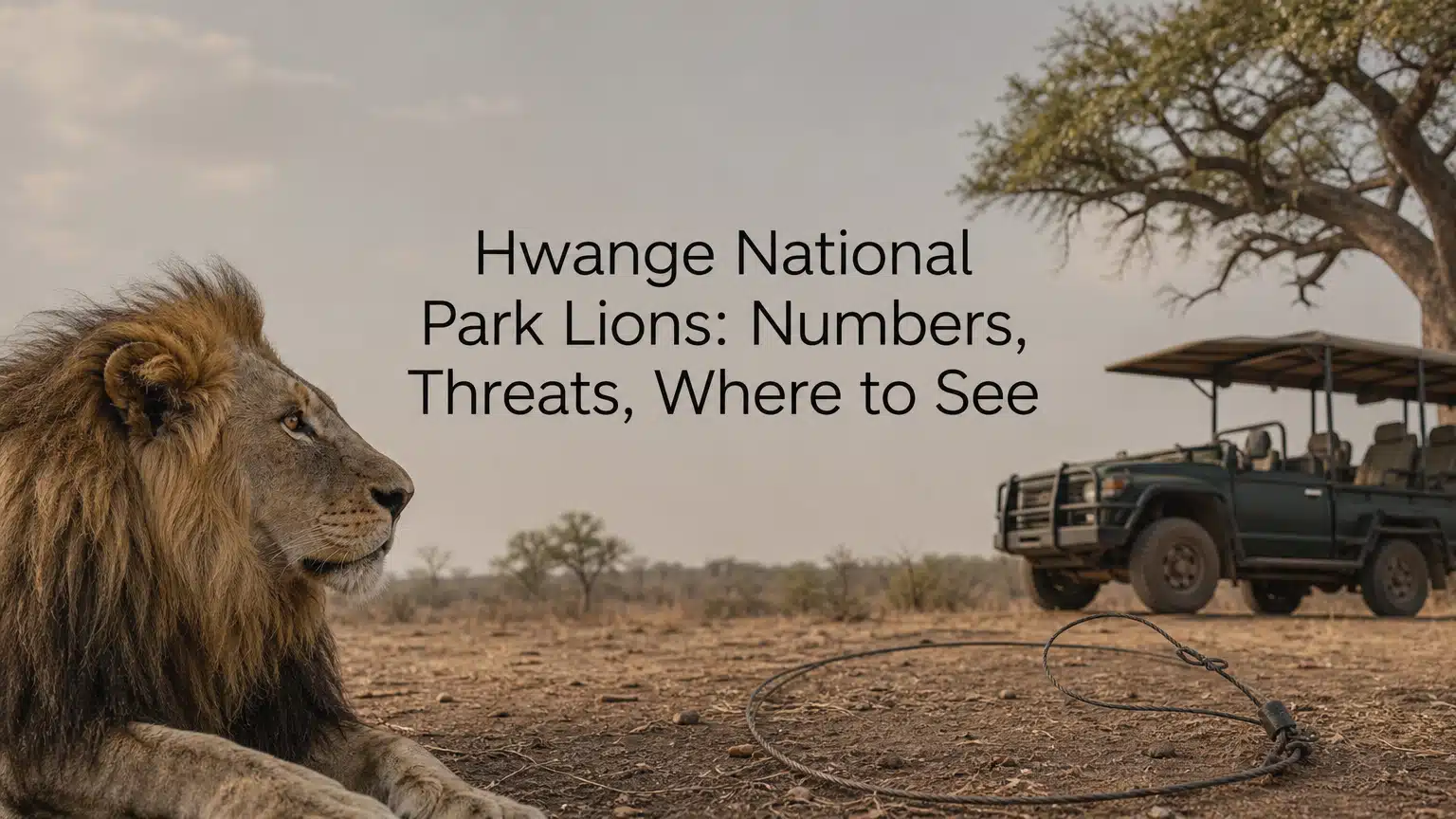
Hwange National Park lions are the wild African lions that live in Zimbabwe’s largest national park and on the unfenced land around it. Most estimates put the greater Hwange ecosystem at 500 to 700 lions. That makes it one of the strongest lion populations in Southern Africa and one of the more reliable places to see lions on a safari.
The population is more than a headcount. Researchers and lodge guides have followed individual males and prides here for years. That is why lions like Cecil, Mopane, Humba and Netsai are known by name far beyond Zimbabwe, and why the story of who rules which territory keeps changing.
This article covers why Hwange’s lions matter and how many remain, the dynasties that shaped the park, and the threats they face. It then shows how to see them on safari, including what a trip costs and how to behave on a drive. We run guided Hwange trips from Victoria Falls, so the practical details come from the way these trips actually work.
Why Hwange’s lions matter and how many remain
Hwange’s lions matter because they form one of Africa’s best-studied and best-connected lion populations, in a park that still lets them move across a huge open system. The numbers below show how they compare.
How many lions live in Hwange
Exact counts are hard in a park of roughly 14,600 square kilometers, so you will see ranges rather than one figure. The greater Hwange ecosystem holds about 500 to 700 lions, counting the national park and its surrounding buffer zones. Some sources give "around 500" for the park and adjacent land.
| Area | Commonly cited estimate |
|---|---|
| Hwange ecosystem (park plus buffer zones) | 500 to 700 lions |
| Zimbabwe, whole country | 1,000 to 1,700 lions |
| Africa, wild lions | Roughly 22,000 lions |
These are estimates, not census results. The IUCN lists the African lion as Vulnerable, so a population of this size is significant. Read the Hwange national park lion population as a range, not a promise.
Why this population is conservation-critical
Hwange is recognized by the IUCN as a Lion Conservation Unit, and its lions are part of a long-running monitoring project. Researchers use it to track pride composition, movements and survival. That data is rare for a free-roaming population.
The lions also shape the ecosystem. They are known for regularly preying on elephants, which is unusual in Africa. In the dry season, elephants weakened by lack of food become targets, and the pride’s kills feed hyenas and vultures. Hwange is also part of a connected system that stretches toward Victoria Falls and the Okavango Delta, so lions here link to wider populations.
Hwange’s lions matter because they are numerous, studied, and free to roam, and each of those strengths depends on the others.
The prides and dynasties that define Hwange
Hwange’s lion story is a long power struggle between male coalitions, and a few named males explain most of what you will hear from guides.
How lion dynasties work here
A dynasty is a male or a coalition of males that holds a prime territory and sires the cubs of the resident prides. Males usually hold on for a few years, until a stronger coalition pushes them out. When new males take over, they often kill the existing cubs. Humba and Netsai did exactly that to the cubs of a rival male after they moved to a new area.
Territory matters as much as strength. The grasslands around Ngweshla have good numbers of buffalo, kudu, zebra and elephant, and can support a pride of 20 or more lions. Males fight hard for that ground, and the best-known dynasties all passed through it.
The lions guides still talk about
Five names come up again and again. Cecil and his brother Leander took over the Spice Girls pride around Ngweshla in 2008. After Leander died, Cecil teamed up with Jericho, and the pair held the area until Cecil was killed in 2015 by a trophy hunter on neighboring Antoinette Farm, which is separated from Hwange only by a railway line.
| Lion | Known for | Fate |
|---|---|---|
| Cecil | Led the Ngweshla area with Jericho | Killed by a trophy hunter in 2015 |
| Jericho | Cecil’s coalition partner | Died of natural causes in 2016 |
| Mopane | Ruled the Somadada and Guvalala prides, chased vehicles | Killed by a bowhunter in 2021 |
| Humba and Netsai | Brothers from the Nora pride, tolerant of vehicles | Netsai vanished in 2023 and was reported hunted. Humba was reported hunted in 2024, without full confirmation |
| The Baggage Handlers | Trio that challenged for Ngweshla in 2022 | Expanded their territory |
Cecil’s son Xanda was also killed by a trophy hunter near the park border in 2017. Many of Cecil’s descendants still live in the park. Humba alone left about 20 surviving cubs, and some of that bloodline remains in the area.
A Hwange male can rule for a few years, but his cubs and his coalition decide whether his line survives him.
Threats facing Hwange’s lions
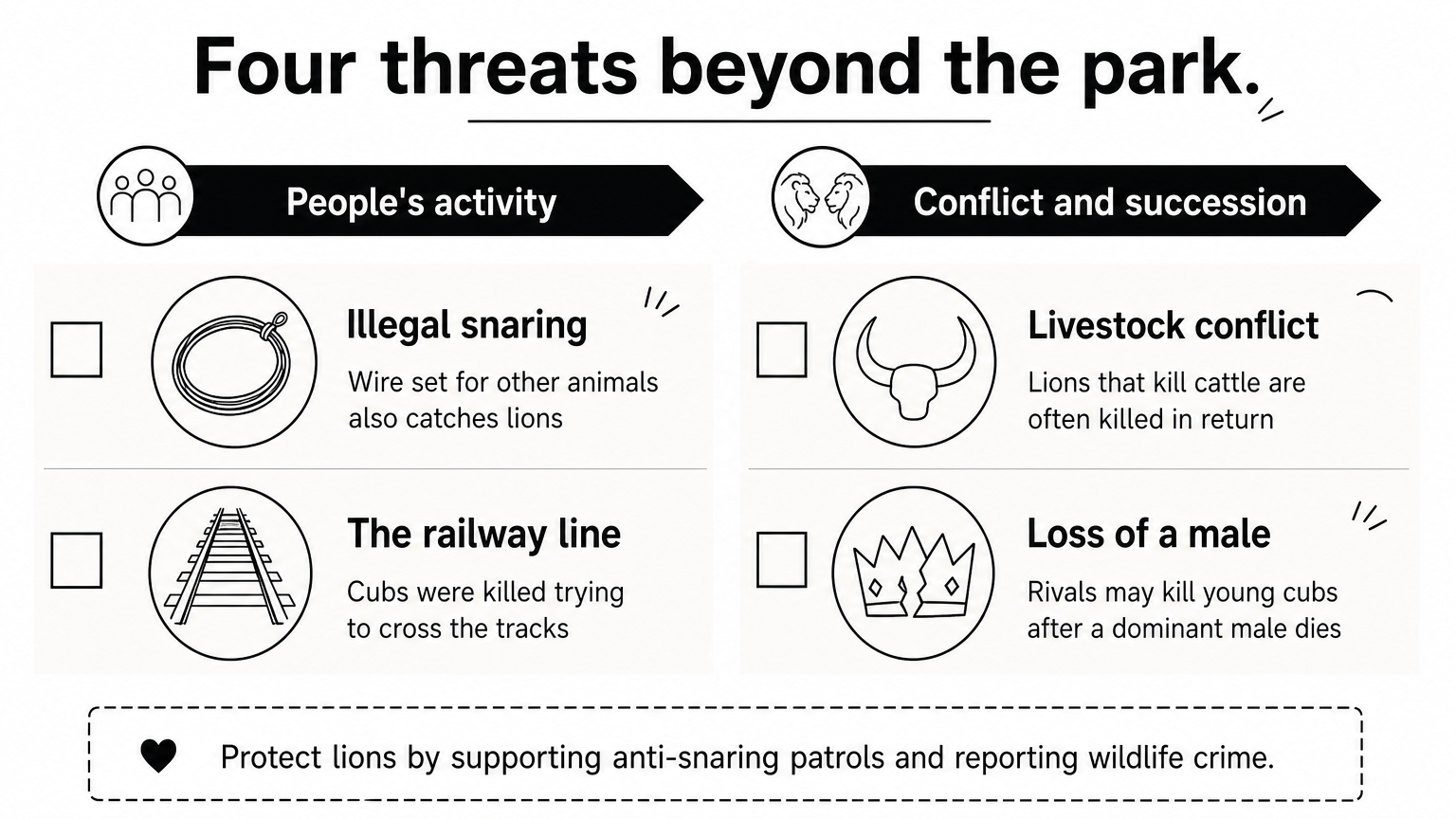
The main threats to Hwange’s lions come from outside the park: hunting on the border, snares, conflict with livestock owners, and a railway. The park is unfenced, so lions cross these lines every week.
Trophy hunting on the park’s edge
Several of the park’s best-known males were killed just beyond its boundary. Cecil, Kakori (2018) and Mopane (2021) all died on Antoinette Farm, and hunting concessions border the national park. Because territories do not follow park lines, a dominant male who walks a few kilometers out becomes legal prey.
There is a hopeful development. Landholders on a former portion of Antoinette Farm have formed the Silwane Conservation Area. They want to replace trophy hunting with photographic tourism and create a buffer zone for lions moving in and out of Hwange. Tourism revenue is what makes that switch possible, so where you book matters.
Snares, livestock conflict and the railway
Outside the park, lions face smaller and more constant dangers:
- Illegal snaring set for other animals, which also catches lions.
- Livestock conflict. Lions that kill cattle or goats on communal land are often killed in return, sometimes by poison.
- The railway line. Two cubs of Mopane’s were killed by a train while trying to cross the tracks.
- Loss of a male. When a dominant male dies, rival males may move in and kill young cubs, and the lionesses may move into communal lands.
Predator-proof enclosures for livestock, with opaque walls, strong poles and secure gates, are one practical fix used around the park. Fewer nighttime livestock losses mean fewer reasons to retaliate against lions.
The park protects Hwange’s lions only as long as they stay inside it, and they do not.
How to see lions in Hwange on safari
You see lions in Hwange from an open safari vehicle on guided game drives, and the odds improve with more drives and the right season. No operator can guarantee a sighting, because these are wild, free-roaming animals.
Best time and best way to look
The dry season, roughly May to October, is the best time. Hwange is a dry park, and animals depend on waterholes, many of them pumped. Lions hold territories all year, so they do not migrate, but in the dry season they pass through the same waterholes and pans where you can wait for them.
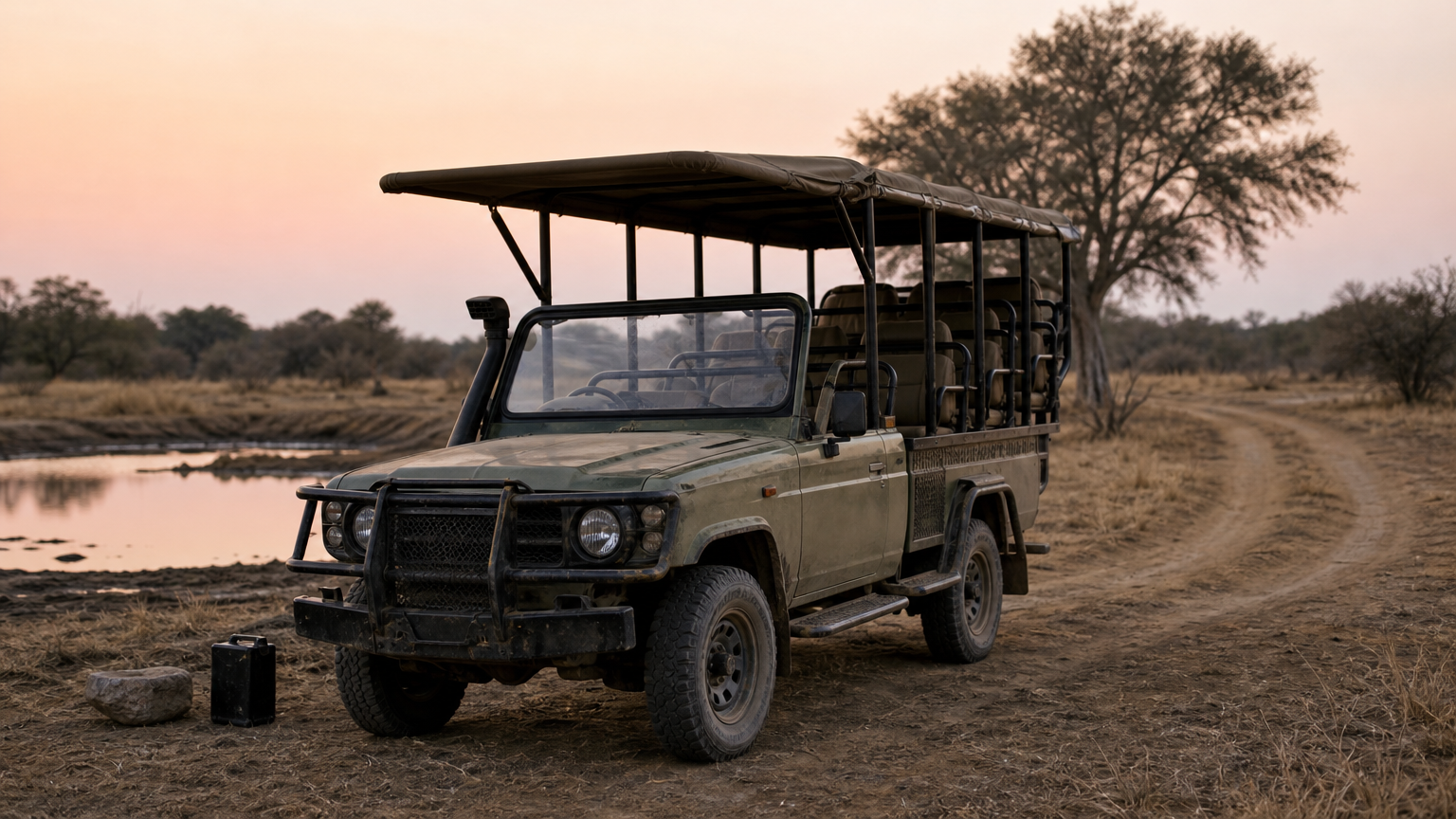
Dawn and dusk are the best hours, because lions rest through the heat of the day and become active as it cools. Plan at least two nights if lions are your priority. Four drives give you far more chances than two, and tracks from the previous night are easier to follow in the morning. A guide who knows the area also knows which pride is using which waterhole.
Trip options and what they cost
Our trips from Victoria Falls cover three ways to do it. The day trip and safari prices are per person, and park entry is paid at the gate.
| Option | Price | What you get |
|---|---|---|
| Full day trip from Victoria Falls | $290 (children 5 to 11: $160) | About 13 hours, two game drives in open vehicles, lunch in the park, plus $24 entry |
| 2-night safari | From $800 | 3 days, 2 nights at Gwango Heritage Resort, four game drives in an open 4×4, all meals, plus $48 entry for two days |
| Victoria Falls to Hwange transfer | USD 75 | To Hwange Safari Lodge or Main Camp, four-passenger minimum, subject to availability |
Here is a worked example for a couple. The day trip to Hwange costs 2 × $290 = $580, plus 2 × $24 = $48 in entry fees, so $628 for two. The 2-night safari costs 2 × $800 = $1,600, plus 2 × $48 = $96 in entry fees, so from $1,696 for two. The overnight option costs about 2.7 times as much, but gives you four drives instead of two and dawn and dusk access.
What about walking with lions?
Wild lions in Hwange are seen from vehicles, not on foot. Walking encounters with lions elsewhere in Africa usually involve captive-bred animals, which conservationists widely criticize. If you want an ethical lion experience, choose a wild sighting. You support the same research and tourism economy that gives lions value alive.
Book two nights or more, travel in the dry season, and spend your drives at waterholes at dawn and dusk.
Staying safe and getting good lion photos
Lions in Hwange are dangerous on foot and calm around vehicles, so the rule is simple: stay in the vehicle and follow your guide.
Are Hwange lions dangerous?
Lions are wild predators, and the "Hwange national park lions attack" searches are worth taking seriously. Most visitors are never at risk, because open safari vehicles are read by lions as one large object. The danger starts when someone stands up, leans out or steps down. Never leave the vehicle except where your guide says it is safe, such as at a designated spot.
Individual lions also differ. Mopane was known for his dislike of vehicles, and visitors were warned to keep their distance. Humba and Netsai were relaxed around vehicles. Your guide reads each animal’s mood, so ask before you assume.
Photography and sighting etiquette
A few habits improve both safety and photos:
- Bring a telephoto lens, ideally 200 mm or longer, so you never need to ask the vehicle to move closer.
- Shoot in the first and last hour of light, when lions are active and the light is warm.
- Stay quiet and still. Wait for behavior such as stalking, greeting or cubs playing, instead of chasing the closest pose.
- Keep your arms and camera inside the vehicle’s frame.
- Let the guide decide how long to stay, and move on when the lions show stress.
Our photographic safaris give photography more time and attention, with waiting and choosing compositions built into the drive.
Stay in the vehicle, keep quiet, and let the lions decide how close the sighting gets.
Seeing Hwange’s lions for yourself
Hwange’s lions are a population of roughly 500 to 700 animals, shaped by famous dynasties and pressured by hunting, snares and conflict beyond the park boundary. They are best seen in the dry season, on guided open-vehicle drives at dawn and dusk, ideally over at least two nights. Your visit also helps make live lions worth more than hunted ones.
If you want to see them, join a 2-night Hwange safari experience with Maximum Adventure Trails. We handle the transfers, the game drives and the itinerary, so you can focus on watching the pride.