





- 158 Views
- 19 Min Read
- (0) Comment
Victoria Falls International Airport handled 159,527 passengers in Q2 2025, a 48.4% increase from the previous quarter, making it Zimbabwe's fastest-growing airport during that period, according to independent 2025 transport reporting. That surge changes how you should plan a safari. The airport is no longer the place where you land to see the falls. It's becoming the hinge between Victoria Falls, Hwange, Chobe, and wider southern African itineraries, but headline capacity doesn't guarantee a dependable connection.
I've planned enough safari arrivals to know where the itinerary usually breaks. It isn't always the aircraft. A delayed regional flight, a slow immigration queue, an unplanned border transfer, or a driver who isn't tracking your arrival can turn a carefully built multi-country trip into a chain of missed check-ins. Victoria Falls International Airport is now capable of supporting ambitious itineraries, but travelers still need to plan around its practical limits.
Table of Contents
- Why Victoria Falls International Airport Matters for Your Safari
- Airlines and Flight Routes to Victoria Falls
- Arrival and Departure Procedures Explained
- Transport and Transfer Options from the Airport
- Airport Facilities and Luggage Tips
- Essential Pre-Trip Planning Checklist
- Booking Transfers and Activities Before You Arrive
Why Victoria Falls International Airport Matters for Your Safari
The 48.4% passenger surge in Q2 2025 is more than an airport statistic. It signals a destination attracting enough demand to function as a serious regional gateway, not merely a local access point. For travelers arriving from the UK, US, EU, or Israel, that distinction matters because Victoria Falls can serve as the opening or closing point for a journey that crosses Zimbabwe and Botswana.
The airport's modernization was substantial. A $150 million project, funded through a China Exim Bank loan, began in 2013, and the upgraded airport officially opened in November 2016, according to the Victoria Falls Airport project overview. The project was intended to widen tourism access to Victoria Falls and the surrounding region, and it transformed the facility from a regional airport into a much larger international gateway.
That gateway now makes geographic sense for a combined itinerary. You can begin with Victoria Falls, continue by road toward Chobe National Park in Botswana, or arrange a Zimbabwe safari in Hwange. You can also use the airport as the exit point after a longer route through Zimbabwe. The airport's value lies in that flexibility, not just in the terminal itself.
Capacity is not the same as connection reliability
The upgraded runway was extended to 4,000 metres and widened to 60 metres, allowing the airport to handle wide-body aircraft including the Airbus A340, Boeing 747, and Boeing 777. Annual passenger-handling capacity rose from about 500,000 to 1.5 million, while some descriptions give a design ceiling of 1.7 million, as detailed in the Victoria Falls International Airport presentation.
Those figures are encouraging, but they describe infrastructure, not your experience at the immigration desk or the reliability of a same-day onward transfer. A larger terminal can process more people, yet a safari itinerary can still fail when several services depend on one regional flight arriving on time.
Planner's rule: Treat Victoria Falls International Airport as a capable gateway, not a frictionless hub. Build your itinerary around transfer protection, not terminal capacity.
For a high-comfort trip, use a luxury safari planning guide to shape the overall route before booking flights. Then check the practical arrival sequence in this guide to getting to Victoria Falls, particularly if your plan includes Botswana or Hwange.
Victoria Falls Airport Passenger Growth Snapshot
| Metric | Value | Traveler Impact |
|---|---|---|
| Q2 2025 passengers | 159,527 | More demand for transfers, guides, and onward seats |
| Q1 2025 passengers | 107,500 | Q2 growth created greater pressure on arrival logistics |
| Q2 increase from Q1 | 48.4% | Same-day connections require more careful planning |
| Annual capacity after upgrades | 1.5 million | The terminal can support larger international flows |
The airport now supports multi-country safari planning in a way it previously could not. My recommendation is straightforward. Use it confidently, but avoid an itinerary that depends on a narrow connection between an international arrival, immigration, a road transfer, and a cross-border activity.
Airlines and Flight Routes to Victoria Falls
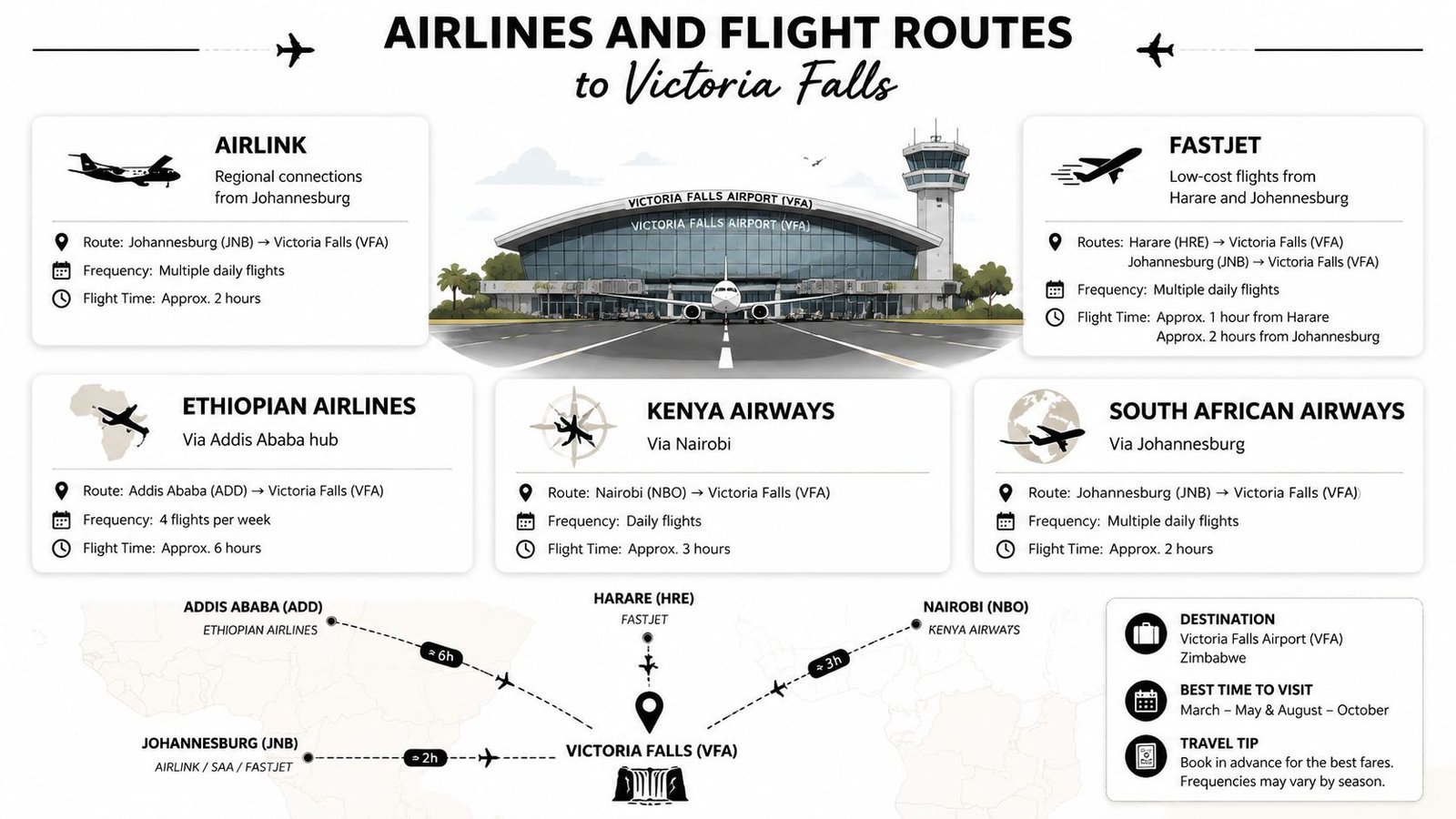
The right flight into Victoria Falls International Airport is the one that protects the rest of your day. Travelers often focus on the lowest fare or the shortest advertised layover, then discover that a small delay at an intermediate hub has erased the time needed for immigration, baggage collection, and the drive to a lodge or border post.
Airlink is often the practical choice for regional connections through Johannesburg. If you're connecting from a long-haul arrival, favor a morning regional departure when the schedule gives you a generous margin. That timing usually offers more recovery options than a late-day connection, especially when winter fog or congestion affects Johannesburg.
Fastjet can be useful for regional travel from Harare and Johannesburg, particularly when the fare structure works for a separate-ticket itinerary. Separate tickets need discipline. If the first flight is delayed, the second airline may not protect your reservation, and you may need to collect and re-check luggage at the intermediate airport.
Ethiopian Airlines provides access through Addis Ababa, while Kenya Airways connects through Nairobi. These routes can suit travelers arriving from Europe, the Middle East, or other international markets, but the most important question is whether your baggage is checked through and whether the entire journey sits on one protected booking. A clean-looking itinerary can still contain an operational gap if the regional sector is issued separately.
South African Airways remains relevant for Johannesburg routing. Compare the full itinerary, not only the headline travel time. A connection with a longer layover is usually preferable to an attractive but fragile afternoon transfer.
How I'd choose the routing
Start with the international ticket, then build the safari around the confirmed regional arrival. Don't reverse that order unless you're prepared to spend the first night near the airport.
- For Johannesburg connections: Choose the morning regional option when available, and avoid a tight afternoon layover. Johannesburg is a common transfer point, so a small delay can affect the onward sequence.
- For Addis Ababa: Confirm whether the Victoria Falls sector is on the same booking and ask the airline how luggage is handled.
- For Nairobi: Use the route when it creates a clean connection from your long-haul flight, not because it appears shorter on a search engine.
- For Harare: Fastjet or another regional service can work well for a Zimbabwe-focused trip, but allow time for luggage handling if the flights are separate.
- For multi-city tickets: Consider arriving at Victoria Falls and departing from another regional airport, or reverse the order, if that removes a backtrack.
Seasonal charter services and frequency changes can alter the best routing during high and low safari periods. Reconfirm every sector before departure, especially when a lodge transfer or light-aircraft connection follows your arrival.
The key planning distinction is protected versus unprotected travel. One booking gives the carrier more responsibility for a disrupted connection. Separate tickets give you more control over price and routing, but they also transfer the risk to you.
For travelers still deciding whether Victoria Falls should be the entry point for a Zimbabwe itinerary, this practical guide on where to fly into for a Zimbabwe safari helps compare the routing logic before you commit.
Arrival and Departure Procedures Explained
The arrival process at Victoria Falls International Airport is straightforward when your documents are ready and your driver knows your flight number. It becomes slower when several international passengers reach immigration together, when a traveler needs to resolve a visa question at the desk, or when checked luggage arrives in waves rather than all at once.
You'll disembark, walk or transfer into the terminal, and follow signs to immigration. Passport control is the first serious variable. During the busy safari period from June through October, multiple wide-body arrivals can create a queue that outlasts the comfortable margin built into a same-day transfer.
Arrival sequence
Keep your passport, accommodation confirmation, onward itinerary, and any required visa documents together in your hand luggage. Visa-on-arrival procedures can vary by nationality and current immigration policy, so verify the latest requirements with an official Zimbabwean diplomatic or immigration source before flying. Don't rely on a social media post or an old booking email.
The KAZA Uni-Visa can be relevant to travelers combining Zimbabwe and Zambia, and sometimes to wider regional plans involving Botswana. Confirm eligibility and current availability before departure. If your route includes a Zimbabwe to Botswana transfer, ask specifically whether the visa you hold covers the border movements you've planned.
After immigration, collect your luggage and proceed through customs. Officials can inspect bags, and agricultural restrictions apply, so don't pack food, plants, or animal products casually. A traveler carrying safari equipment should keep invoices or supporting documents for expensive camera bodies, drones, and other specialist gear where they can be accessed quickly.
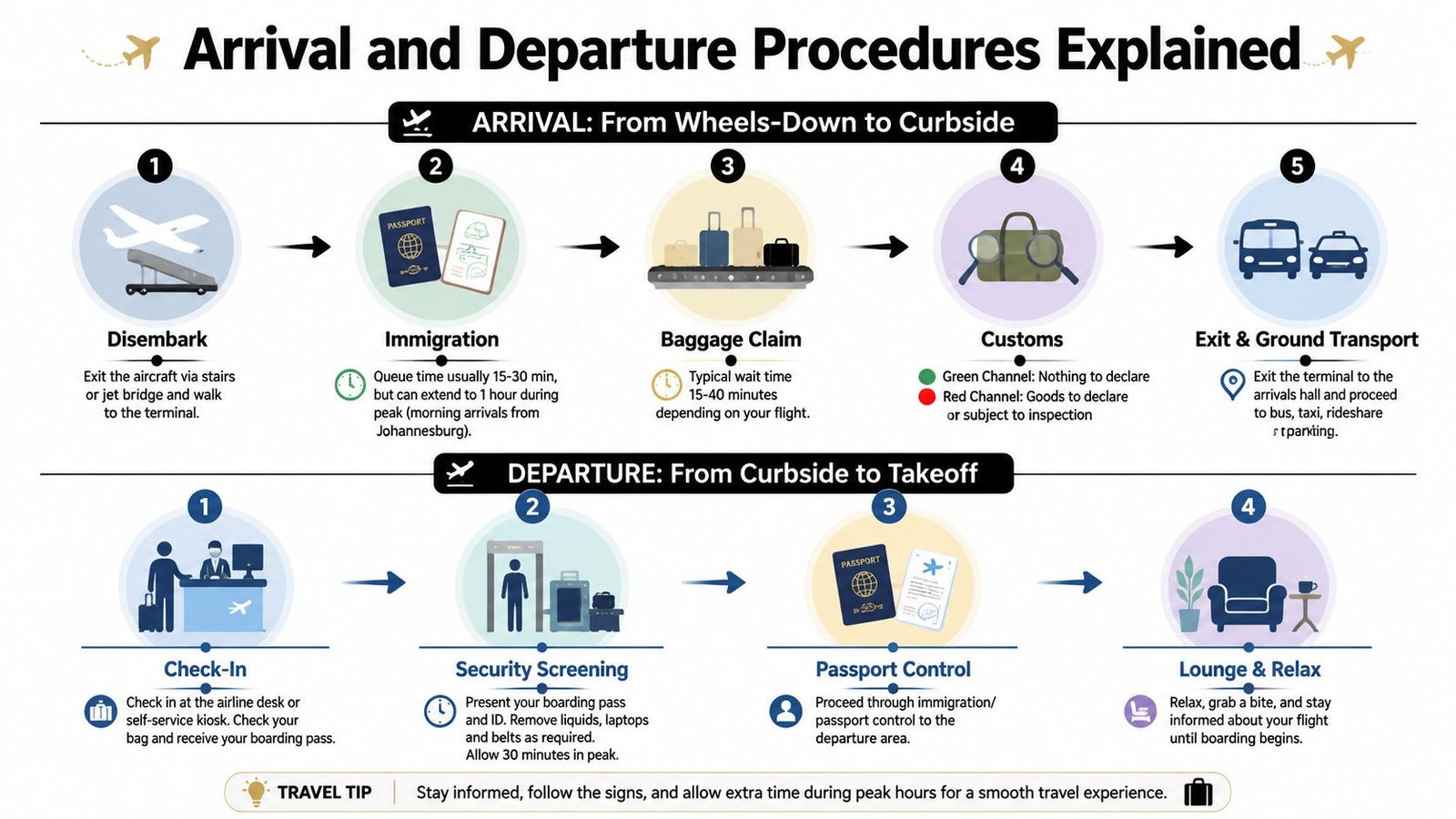
Once you exit customs, look for the driver or lodge representative in the public arrivals area. Don't leave the terminal to search for a vehicle without first calling the operator. A properly booked transfer should have your flight number, passenger name, accommodation, and a clear meeting point.
Arrival safeguard: Send your driver the final flight itinerary, then ask the operator what happens if the aircraft lands early, late, or diverts. A meeting plan is only useful if it includes those three possibilities.
Departure sequence
For departure, allow enough time for check-in, baggage acceptance, security, and passport control. The departure lounge is not designed for an endless wait, so arriving extremely early doesn't necessarily improve the experience. Arriving too late is worse, particularly when several flights are being processed at once.
Check whether your airline permits online check-in, but don't assume that a boarding pass removes the need to visit the counter. Oversized luggage, safari equipment, visa checks, and onward documentation can still require staff attention.
A major check-in system upgrade was reported as underway in 2025, while the Airports Company of Zimbabwe reported that the airport had already reached 1.5 million annual capacity after its upgrades, according to 2025 reporting on Victoria Falls airport operations. That investment should help passenger processing, but you should still plan for a busy departure rather than assume the system will eliminate queues.
The best departure plan is simple. Confirm the flight the day before, arrange transport in advance, keep essential documents accessible, and avoid booking a cross-border activity that returns to the airport immediately before check-in.
Transport and Transfer Options from the Airport
Victoria Falls International Airport is outside the town, so your ground transfer should be treated as part of the itinerary, not as an afterthought. A private vehicle is usually the safest choice when you're connecting to a lodge, joining a Chobe trip, or arriving after a long-haul journey with heavy luggage.
A pre-booked private transfer gives you the most control. The operator can track the flight, meet you at arrivals, and take you directly to your hotel or onward meeting point. It also makes the border plan clearer when you're heading toward Botswana or Zambia, where the vehicle and driver's cross-border permissions matter.
Hotel-arranged transport can work well, particularly when the property uses a known transfer partner. Ask for the driver's name, meeting point, vehicle description, and emergency number before departure. Don't assume that a hotel shuttle runs at every arrival time.
Compare the realistic choices
| Transfer Type | Cost (USD) | Time to Town | Time to Chobe | Reliability (Peak Season) | Best For |
|---|---|---|---|---|---|
| Private pre-booked transfer | Confirm at booking | Direct | Border-dependent | High when flight-tracked | Tight schedules and families |
| Hotel-arranged shuttle | Confirm with hotel | Direct or scheduled | Usually requires a separate arrangement | Moderate | Guests staying at established hotels |
| Shared minibus | Confirm at booking | Variable | Often involves a connection | Lower when full | Flexible travelers |
| Airport taxi | Confirm at terminal | Direct if available | Not always suitable for cross-border travel | Variable | Simple town transfers |
| Rental car | Confirm with provider | Self-directed | Cross-border permission required | Depends on driver and road conditions | Experienced self-drivers |
Shared shuttles are economical, but they can wait for other passengers, luggage, or late arrivals. That makes them unsuitable for a fragile connection, a prepaid Chobe departure, or a lodge with a fixed check-in window.
Airport taxis may be available, but don't build a complex safari around an assumption that the first driver you meet can cross a border or carry you efficiently into Botswana. Cross-border transfers may require approved vehicles, paperwork, and a separate handover.
Match the vehicle to the itinerary
Choose private transport if you're carrying camera cases, soft safari bags, or specialist equipment. It's also the right choice when your flight arrives late, when children are traveling, or when you need to reach a scheduled activity without waiting for other passengers.
For a Chobe connection, confirm whether the operator takes you all the way to the border, through the border process, or only to a transfer point. Some itineraries require a change of vehicle after immigration. A written confirmation should state exactly who handles each leg.
Hwange requires a different approach. Road transfers can be lengthy, while some lodges arrange onward flights from Victoria Falls International Airport to nearby airstrips. Don't book an airport taxi and expect the driver to solve a remote-camp transfer at the curb.
A useful option for a specific cross-border route is the Kasane airport to Victoria Falls transfer service. Whether you use that provider or another operator, insist on the same details: flight number, pickup time, passenger count, luggage type, border responsibilities, and a contact number that works after landing.
Airport Facilities and Luggage Tips
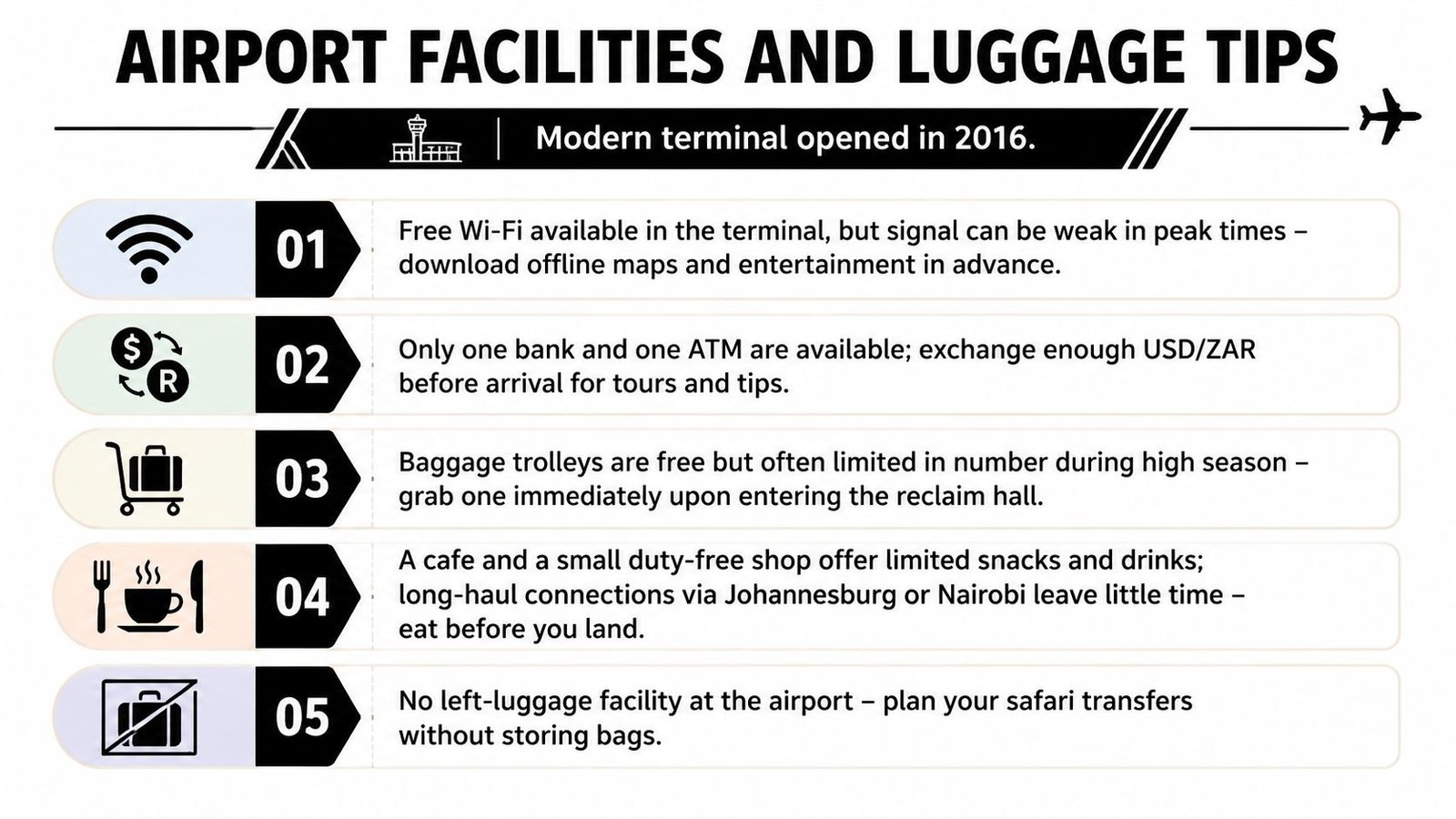
The 2016 expansion gave Victoria Falls International Airport the scale needed for international arrivals, but it remains a focused safari gateway rather than a major shopping or dining destination. You'll find the essential functions, including check-in, immigration, baggage reclaim, customs, and ground transport access, but you shouldn't plan a long airport layover around extensive retail or restaurant choices.
International travelers arriving through Johannesburg, Nairobi, or Addis Ababa should prepare before landing. Eat during the earlier part of the journey, download entertainment and maps, and keep a power bank accessible. Airport Wi-Fi and payment services can be useful, but connectivity and availability can vary when passenger volumes rise.
Pack for the next aircraft, not only the first one
Your luggage strategy should reflect the whole safari. International baggage allowances may be generous, while onward bush flights to remote camps can impose much stricter limits on weight, size, and bag construction. Confirm the rules with the camp or flight operator before you leave home, especially if you're carrying long camera lenses, drones, tripods, or hard-sided cases.
Use a soft-sided safari bag where possible. A rigid suitcase may fit the international aircraft but fail on a smaller charter aircraft. Keep medicines, valuables, camera batteries, travel documents, and one change of clothing in your hand luggage in case a checked bag arrives later.
Delayed baggage needs immediate action. Report it at the airline's baggage desk before leaving the airport, retain the reference number, and give a copy to your safari operator. Your driver can't recover a missing bag without the airline's file details.
Services worth planning around
Currency exchange, ATMs, cafés, duty-free retail, and Wi-Fi may cover immediate needs, but don't depend on the airport for every purchase. Carry a practical amount of accessible money for transfers, tips, and small expenses, while keeping larger funds secure.
There may be limited seating during a busy departure period. If you're considering premium air travel, compare the entire itinerary and baggage rules rather than assuming the most expensive cabin solves every transfer problem. Travelers who enjoy comparing unusual fare strategies can also browse this discussion of business class cheaper than coach PNG, but the same principle applies here, verify the actual fare conditions before booking.
Packing decision: If your itinerary includes a light aircraft, pack to that aircraft's limits first. Excess luggage is harder to fix at a remote airstrip than at an international check-in counter.
Don't expect airport left-luggage storage to rescue an overpacked itinerary. Arrange luggage storage with your hotel or operator if you need it, and confirm the service before arrival.
Essential Pre-Trip Planning Checklist
Most airport problems begin before the flight leaves. A traveler arrives without the correct visa plan, assumes a card will work everywhere, or gives a lodge an outdated flight number. Those mistakes are avoidable.
Documents and health
Check passport validity and empty-page requirements with the relevant official authority for your nationality. Visa rules differ by passport, and UK, US, EU, and Israeli travelers shouldn't assume that a friend's experience applies to them.
If your route involves Zimbabwe and Zambia, investigate the KAZA Uni-Visa before departure. If you're entering from or transiting through a country affected by yellow fever requirements, carry the appropriate certificate. Ask a travel-health professional about malaria prevention and insect protection, particularly if your itinerary includes safari areas during the rainy season.
Keep these documents together:
- Passport and visa evidence: Store digital and printed copies separately.
- Accommodation confirmations: Include lodge names, addresses, and contact numbers.
- Onward transport details: Save domestic flights, road transfers, and border arrangements.
- Health certificates: Carry originals where an official may request them.
- Travel insurance information: Make sure the policy covers the activities you've booked.
For current nationality-specific guidance, use this Zimbabwe visa requirements resource as a starting point, then verify the information with an official source before travel.
Money and communications
Carry usable cash in small denominations for tips, transfers, and incidental purchases. Cards may work at major hotels and established operators, but local markets and smaller services may require cash. Don't wait until you land to discover that your bank has blocked an unfamiliar transaction, notify your card provider and keep a backup payment method.
Arrange your phone strategy before departure. An eSIM can be convenient if your device supports it, while a local SIM may be available after arrival. Download offline maps and your operator's contact details because airport connectivity isn't something I'd trust as the only communication method.
Flight and transfer control
Confirm every flight 24 hours before travel, especially regional sectors. Send the updated itinerary to your transfer operator and lodge, including the airline, flight number, arrival date, and expected landing time.
For a multi-country itinerary, write down who handles each movement. One company may collect you at Victoria Falls International Airport, another may manage the Chobe excursion, and a third may arrange a Hwange camp transfer. If you don't identify the handoff points, you may discover the gap only after landing.
The final pre-departure check
Before leaving home, verify the following:
- The booking names match your passports.
- Your luggage suits any onward bush flight.
- Your driver has the latest flight details.
- Your border route and visa plan are compatible.
- Your first night remains practical if the regional connection changes.
That last point protects the itinerary. A flexible first night near Victoria Falls is often more valuable than forcing an immediate transfer deep into the safari circuit.
Booking Transfers and Activities Before You Arrive
Pre-booking isn't about adding unnecessary administration. It removes the decisions most likely to go wrong when you've just completed a long international journey and are standing beside your luggage at Victoria Falls International Airport.
Book the airport transfer first. Your confirmation should include the flight number, pickup location, passenger names, luggage description, accommodation, payment terms, and an emergency contact. Ask whether the driver monitors delays or whether you must send a message after landing.
Then secure the time-sensitive activities. Sunset cruises, guided falls visits, helicopter flights, and Chobe day trips all depend on transport timing and availability. Walk-up arrangements may leave you with a poor departure time, a long wait, or no suitable space at all. The same applies to Hwange pickups, particularly when a lodge or airstrip transfer operates on a fixed schedule.
What reputable operators confirm
A reliable transfer company answers practical questions clearly:
- Who meets you: You should know whether the driver carries a name board and where they'll stand.
- What happens after a delay: The operator should explain flight monitoring and the missed-flight procedure.
- Which vehicle is used: Confirm passenger capacity, luggage space, and cross-border eligibility.
- Where the handover occurs: Border transfers need a precise meeting point and responsibility for each leg.
- How you communicate: Save a phone number, messaging contact, and booking reference.
Don't rely entirely on a hotel concierge for last-minute logistics. Hotel staff can be helpful, but they may have fewer choices during busy periods, and a late request can produce a transfer that fits availability rather than your safari plan.
For excursions, compare the activity's start time with your arrival, immigration, luggage, and road transfer requirements. A tour that looks possible on paper may be too tight after a delayed flight. I prefer booking the first major activity after a genuine arrival buffer, then placing fixed-time cross-border movements only once the airport and accommodation sequence is secure.
Protect the itinerary from small disruptions
Send flight changes immediately. Don't assume the airline has told your driver or lodge. If you're traveling on separate tickets, notify every provider because one carrier's delay protection won't automatically reach the next operator.
Use a written itinerary that shows each transfer, border crossing, pickup point, and contact number. Keep it offline as well as in your email. This matters when Wi-Fi is weak, your phone switches networks, or you're moving between Zimbabwe and Botswana.
You can review available Victoria Falls excursions before choosing the activities that fit your arrival day. My clear recommendation is to reserve airport transport and any fixed-time safari connection before departure, then leave the first day spacious enough to absorb normal travel friction.
Maximum Adventure Trails arranges airport transfers, Victoria Falls activities, and safari connections across Zimbabwe and Botswana, including routes involving Hwange and Chobe. Visit Maximum Adventure Trails to compare transport and activity options, confirm the handoff details, and build a multi-country itinerary that doesn't depend on luck at the airport.