

- 10 Views
- 22 Min Read
- (0) Comment
Etosha National Park Safari: The Complete Guide to Namibia’s Waterhole Wilderness
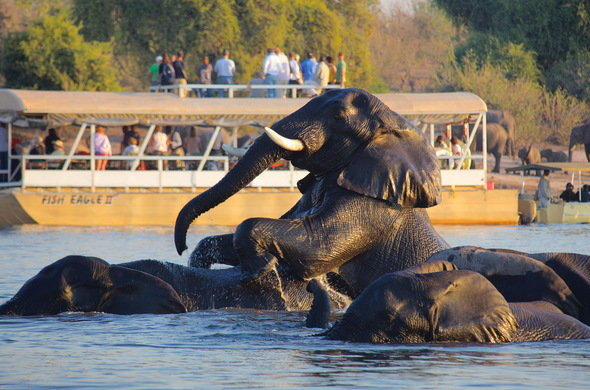
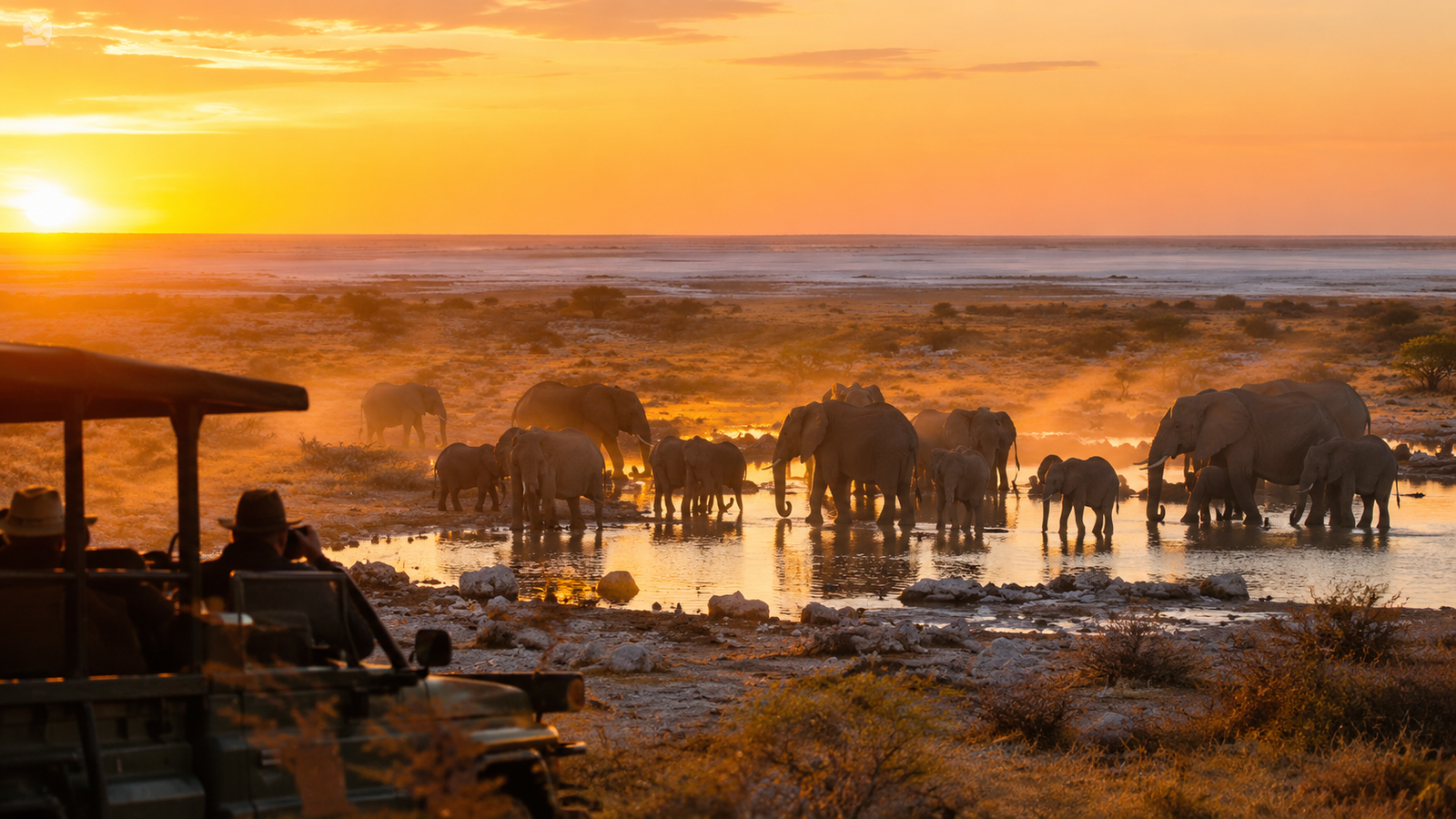
Most safari destinations ask you to chase animals through thick bush. An Etosha National Park safari works the other way around. You park beside a waterhole, switch off the engine, and let the wildlife come to you. Elephants arrive in single file, a black rhino steps out of the dusk, and zebra and springbok take turns at the water’s edge.
I’ve spent years in the travel and outdoor-gear niche, writing about and recommending products for people planning trips like this one. Etosha is one of the few destinations where your planning decisions change the quality of the trip. That’s when you go, how you drive, where you sleep, and what’s in your bag. Readers who get them right come home with the best wildlife photos of their lives. Readers who get them wrong spend an afternoon staring at an empty waterhole.
This guide covers the landscape, wildlife, best time to visit, gates, camps, self-drive advice, park rules, itineraries, budgeting, and the gear I’d put in your bag.
Affiliate disclosure: Some links in this article are Amazon affiliate links. If you buy through them, I may earn a small commission at no extra cost to you. I only recommend gear I’d tell a friend to buy. Prices and availability change, so check the listing before you purchase.
Table of Contents
- Etosha National Park at a Glance
- Why Choose an Etosha National Park Safari?
- The Etosha Pan and Landscape
- Etosha Wildlife: What You’ll See
- Why Waterholes Matter So Much
- Best Time for an Etosha Safari
- How to Get to Etosha and Which Gate to Use
- Self-Drive vs. Guided Etosha Safari
- Where to Stay: Etosha Camps and Lodges
- Best Waterholes in Etosha
- Sample Etosha Safari Itineraries
- How Many Days Do You Need?
- Birdwatching in Etosha
- Etosha Photography Tips
- What to Pack: Gear I Actually Recommend
- Park Rules, Safety and Health
- Costs, Fees and Permits
- Conservation: Why Etosha Matters
- Common Mistakes to Avoid
- Frequently Asked Questions
- Final Thoughts
Etosha National Park at a Glance
| Quick Fact | Details |
|---|---|
| Location | Northern Namibia |
| Size | Approximately 22,935 km² |
| Proclaimed | 1907 |
| Famous for | Etosha Pan, waterholes, black rhino, floodlit night viewing |
| Recorded wildlife | Around 114 mammal species and more than 400 bird species (official Namibian park profile) |
| Big Five? | Elephant, lion, leopard and rhino are present. Buffalo is not a regular park species |
| Best months for game viewing | May to October (dry season) |
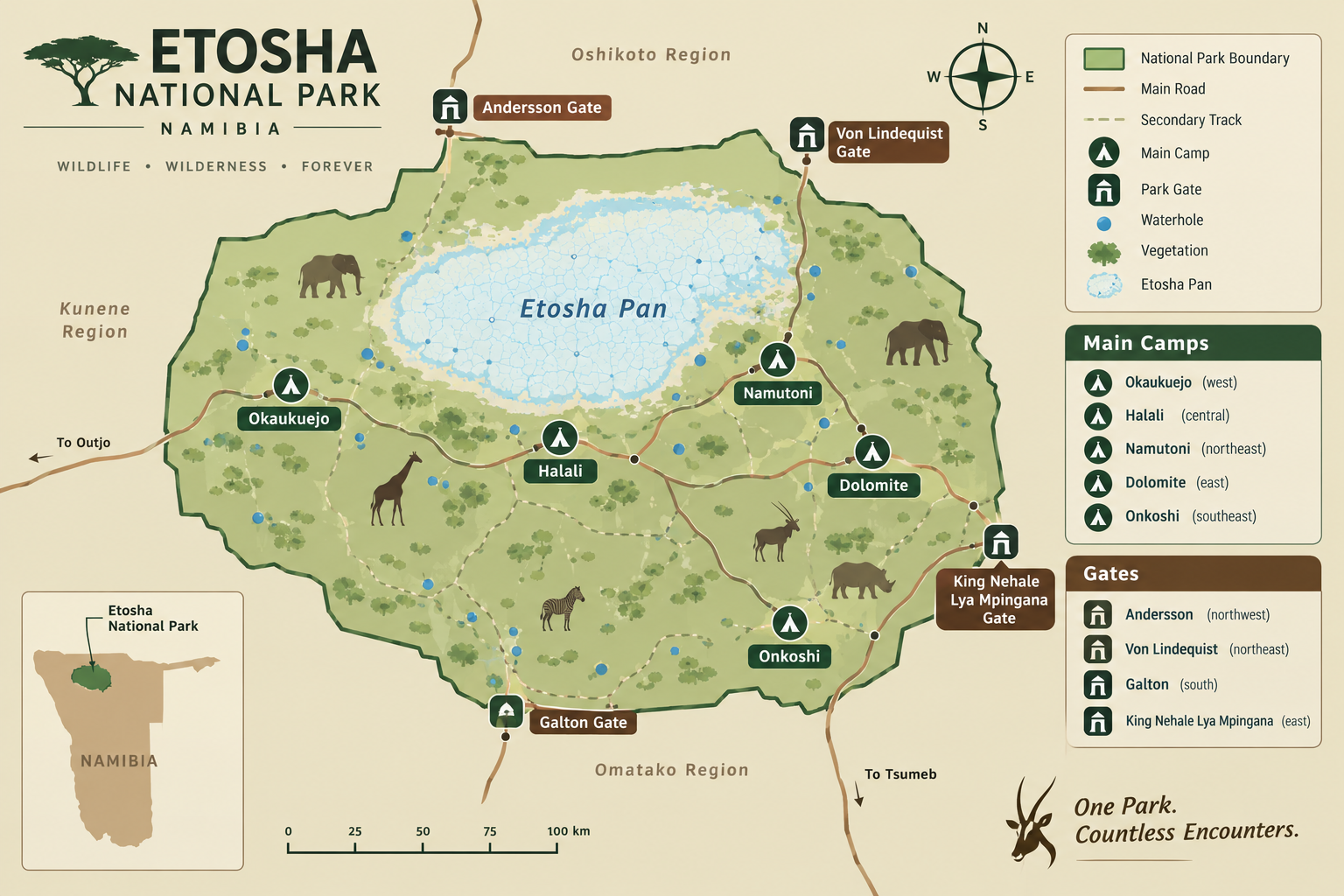
| Main gates | Andersson, Von Lindequist, Galton, King Nehale Lya Mpingana |
| Main camps | Okaukuejo, Halali, Namutoni, Dolomite, Onkoshi |
| Self-drive friendly? | Yes, but treat it as wilderness, not an ordinary road trip |
Why Choose an Etosha National Park Safari?
Africa has plenty of famous parks. Etosha stands out for four reasons.
1. Waterhole-based game viewing
In a dry environment, water drives animal movement. That makes sightings far more predictable than in dense bush. You can choose a good waterhole, settle in, and watch different species arrive, drink, interact and leave.
2. Floodlit night viewing
Okaukuejo’s floodlit waterhole is the most famous, and the official Namibian tourism profile specifically notes the possibility of seeing black rhino, lion and elephant there at night. Halali and Namutoni also have floodlit waterholes.
3. Accessibility
Etosha is one of the easiest big safaris to do independently. The camps are well established, the road network is straightforward, and you can combine self-driving with guided drives.
4. Landscape drama
Few savannah parks have a salt pan this large, giving Etosha a look you won’t find on a typical river-and-woodland safari.
From years of working with traveller content, I’ve noticed that Etosha is the destination readers most often want to do themselves. They search for self-drive routes, camp booking tips and gear lists far more than luxury lodges. This guide is built for that reader, with guided and lodge options included too.
The Etosha Pan and Landscape
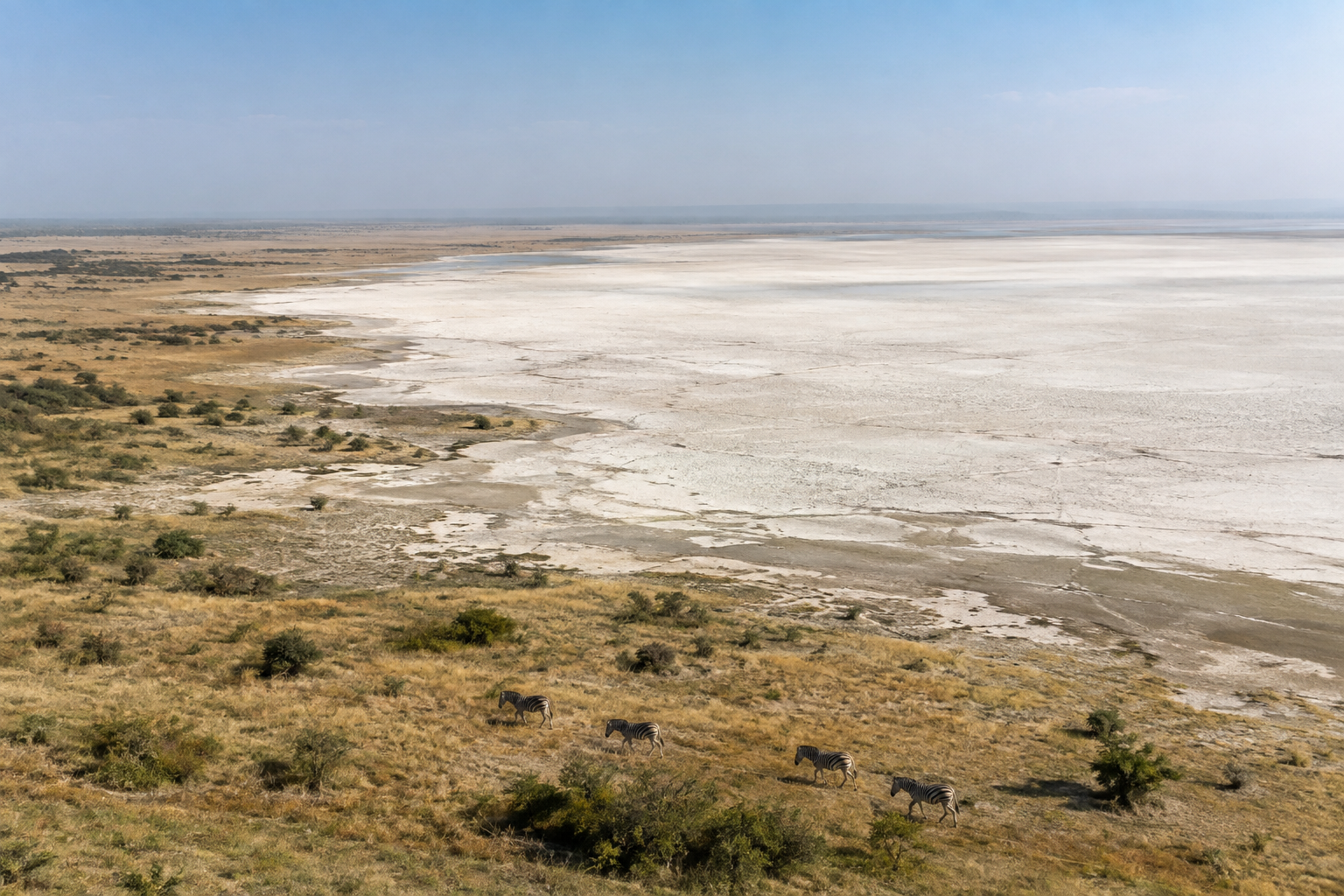
The defining feature of the park is the Etosha Pan, an enormous, pale salt pan that forms part of a much larger system of pans. The name comes from the Oshindonga word Etotha, traditionally interpreted as a place where no plants grow. The pan is the remnant of a much wetter ancient environment associated with the Kunene River, and fossil evidence shows the region looked very different in the distant past.
The landscape changes as you move through the park:
- Salt pans and smaller pans dominate the open central areas.
- Open grasslands make wildlife easier to spot from a vehicle.
- Mopane woodland and thorn scrub appear in different sections.
- Around Halali, the terrain becomes rockier and more elevated, with a dolomite hill near the camp.
- Western Etosha has a different vegetation character from the central and eastern sections.
After particularly good rains, parts of the pan can hold shallow water temporarily. That can attract waterbirds, including flamingos and pelicans. It depends entirely on rainfall, and the timing and extent vary, so never plan a trip around it.
Etosha Wildlife: What You’ll See
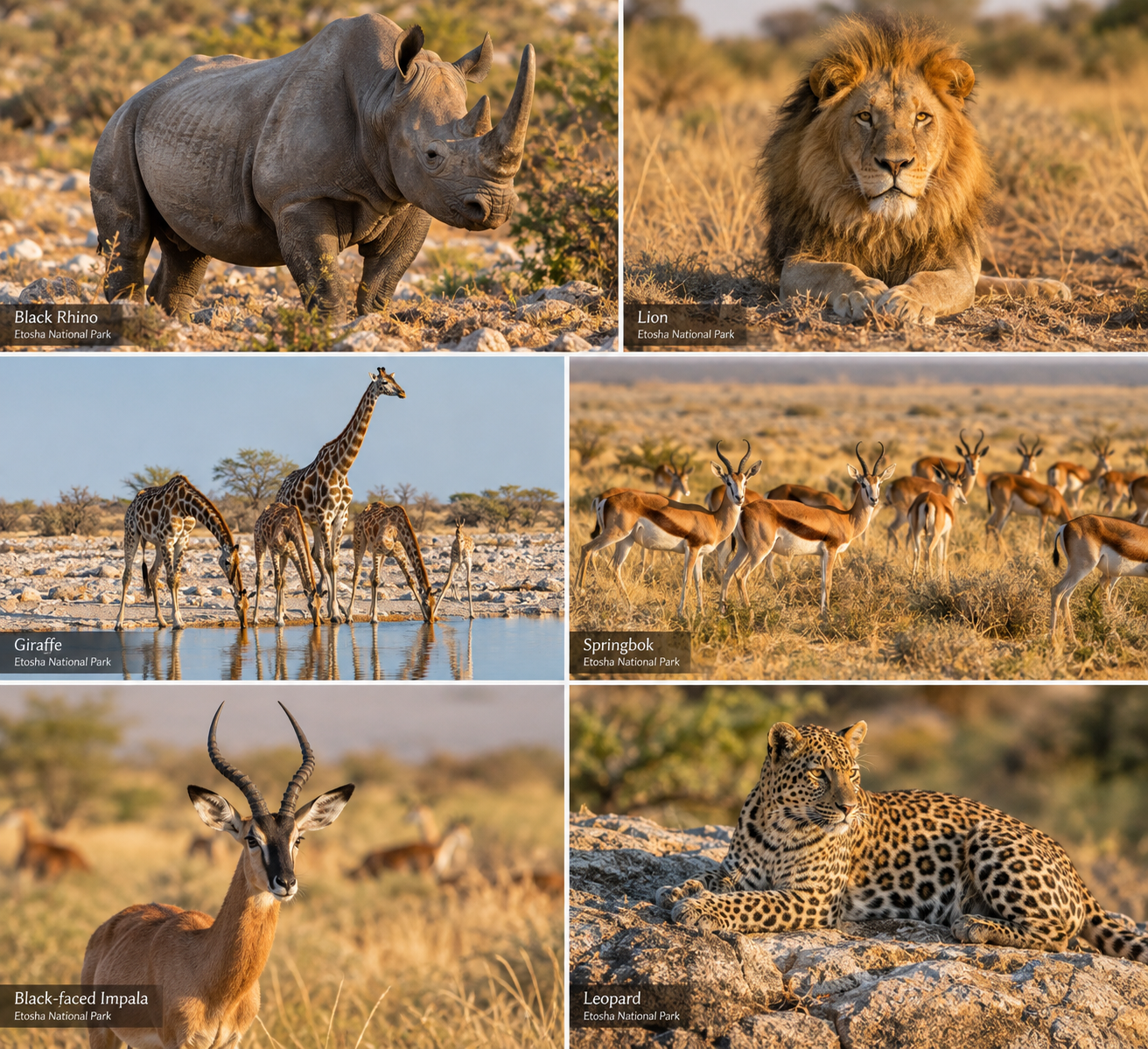
The official park profile lists African elephant, black and white rhino, lion, leopard, giraffe, Burchell’s zebra, springbok, blue wildebeest, gemsbok (oryx), eland, Damara dik-dik and the endemic black-faced impala among the wildlife.
Large Mammals
- Elephants: Often seen at waterholes, especially in the dry season.
- Black rhino: One of Etosha’s most important conservation species. The park has a long history of black-rhino protection, and rhinos are often seen at water sources. The floodlit Okaukuejo waterhole is particularly well known for them.
- White rhino: Also present in the park.
- Giraffe, zebra, blue wildebeest, eland, kudu: Reliable at most waterholes.
Predators
- Lions: Among the main predators visitors hope for. Waterholes at first light give you your best chance.
- Leopards: Present but secretive, and usually the hardest big cat to find.
- Cheetahs, spotted hyenas and black-backed jackals: All occur in the park.
Etosha Specialities
- Black-faced impala: Endemic to the broader region and a conservation success story within Etosha.
- Damara dik-dik: A tiny antelope often seen in thicker vegetation.
- Gemsbok (oryx) and springbok: Perfectly at home on the open plains.
A Note on the “Big Five”
Lions, leopards, elephants, and both rhino species are present, but buffalo are not listed as a regular park species. Don’t expect to tick off the conventional Big Five here. I make a point of telling readers this, because accuracy builds trust, and a traveller who knows what to expect enjoys the trip more.
No Guaranteed Sightings
No honest operator can promise a particular animal on a particular drive. Wildlife moves freely, and conditions change constantly. A good Etosha safari comes from reading habitat, tracks, water availability and animal behaviour, not from fixed promises.
How to Spot More Wildlife
After years of reading what travellers report back, the same habits come up among the people who see the most:
- Go early. Be at the gate when it opens. Dawn is the best time for predators.
- Pick a waterhole and wait. Thirty minutes of stillness often beats thirty minutes of driving.
- Watch other animals. A zebra or springbok staring in one direction usually signals a predator.
- Use binoculars. Animals often look tiny on the open plains.
- Talk to other visitors and camp staff. Recent sightings are the best intelligence you’ll get.
Why Waterholes Matter So Much
Waterholes are at the heart of the Etosha safari experience. Elephants, antelope, zebra, giraffe, and rhino may all appear at the same water source at different times. Instead of constantly driving through dense vegetation, you can position yourself near water and quietly observe.
This is why Etosha is rewarding for photographers and first-time safari visitors. It also explains why water management is so important. According to Namibia’s official park information, apart from a limited number of natural springs, many of the park’s waterholes are artificial and need maintenance.
Best Time for an Etosha Safari
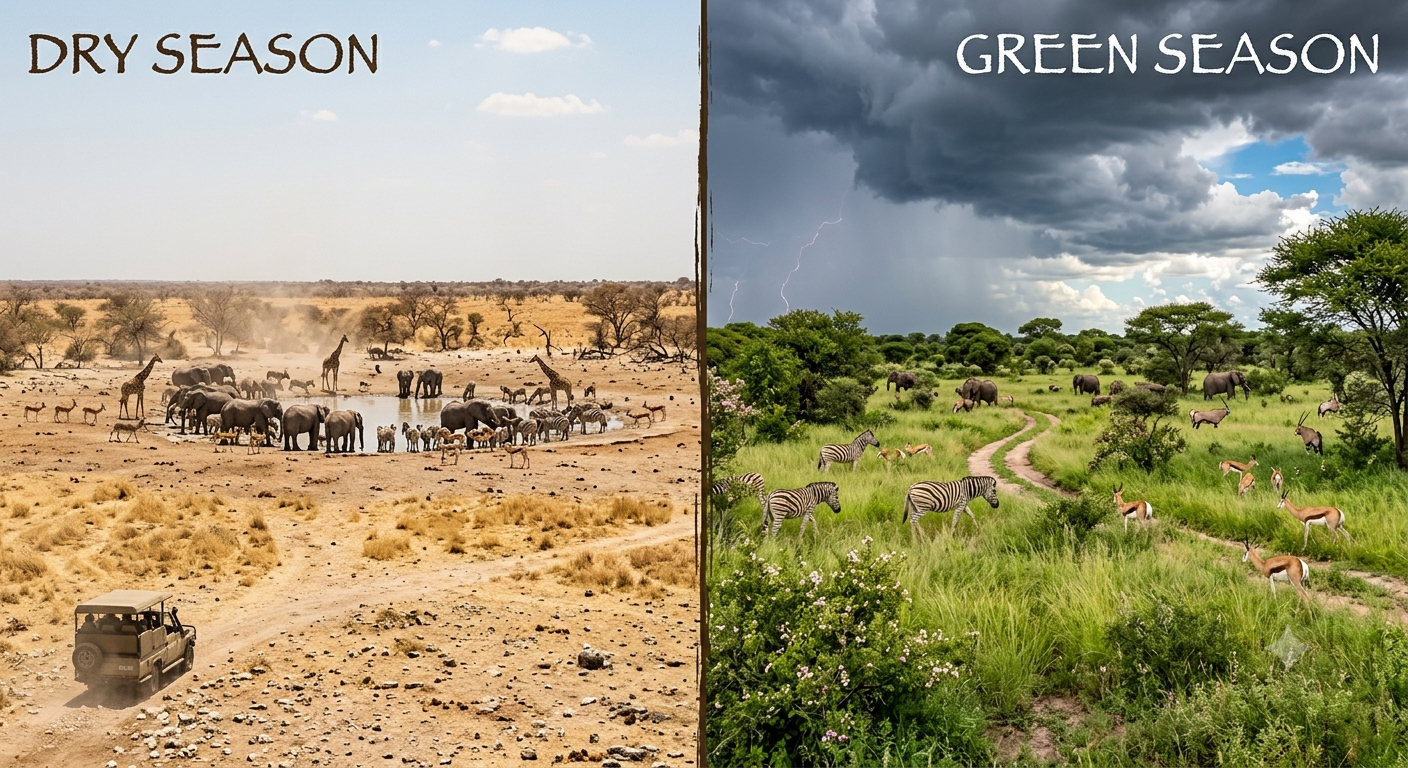
You can visit Etosha all year, but the season shapes the safari you get.
Dry Season (May to October): Best for Game Viewing
Namibia’s official tourism information identifies this as a strong period, and it’s the window I recommend to most first-timers.
- Animals concentrate at reliable water. As natural water becomes scarce, wildlife gathers around the available sources.
- Vegetation is less dense. Visibility is generally better.
- Cooler months. Long daytime drives are more comfortable than in the hottest part of the year.
- Nights and early mornings can be properly cold, so pack layers.
The trade-off is more visitors. Book early, especially for camps with good waterholes.
Green Season (November to April): Best for Birds and Scenery
- Greener landscapes and dramatic skies. Photographers love the storm light.
- Higher temperatures.
- More dispersed wildlife. Water is available in more places, so animals don’t depend on waterholes as heavily.
- Birding comes into its own. Migratory species arrive, and breeding activity increases.
- Temporary water on the pan. When rainfall is sufficient, flamingos and other waterbirds may appear.
Month-by-Month Cheat Sheet
| Month | What to Expect |
|---|---|
| January–March | Hot and green, with rain. Good for birds and scenery; wildlife dispersed |
| April | Rains ease; landscape still green |
| May–June | Dry and cooler; game viewing improves |
| July–August | Cold mornings, clear days, strong waterhole sightings |
| September–October | Driest period, with busy waterholes |
| November–December | First rains, changing skies, birds arriving |
My Recommendation
If it’s your first Etosha National Park safari and mammals are the priority, go between May and October, with the later months being the driest. If you’re a birder or a photographer chasing green landscapes and summer bird activity, the wetter season has real appeal.
How to Get to Etosha and Which Gate to Use
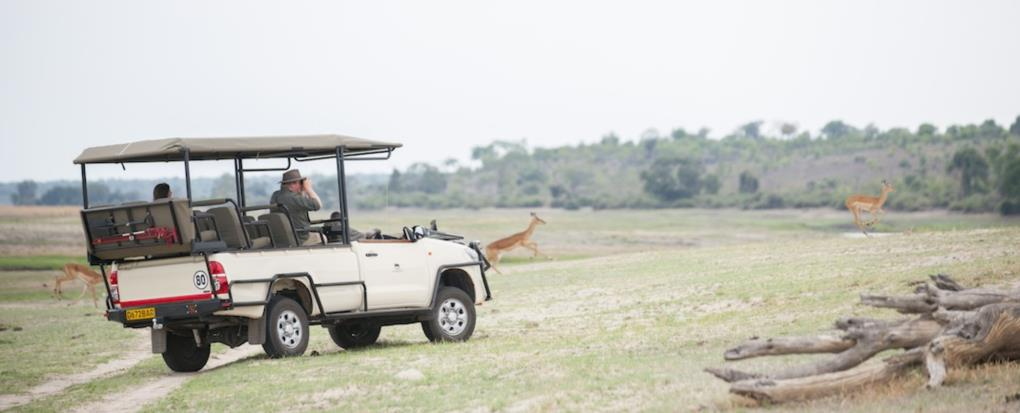
Most international visitors fly into Windhoek and drive north. It’s a long day, so start early and consider breaking the journey. Which gate you use depends on your direction of travel and the part of the park you want to explore.
The Four Main Gates
- Andersson Gate: The main entrance for visitors approaching from the Outjo direction, and the usual route to Okaukuejo.
- Von Lindequist Gate: Gives access to the eastern side near Namutoni.
- Galton Gate: Opens onto the western section, which has its own landscapes and habitats.
- King Nehale Lya Mpingana Gate: The northern entrance.
Check Current Conditions Before You Go
MEFT (Namibia’s Ministry of Environment, Forestry and Tourism) has reported renovation work at the Andersson, Von Lindequist and King Nehale entrance gates, so temporary disruptions may occur. In 2026, road construction has also affected sections between Okaukuejo and Halali. Rely on current signs and park instructions rather than an old itinerary or map.
Practical Driving Notes
- Namibia drives on the left.
- Gate and camp times matter. Plan to be inside a camp before closing.
- Livestock and wildlife wander onto roads, especially around dusk. Avoid driving at night.
- Gravel sections can be slippery, and punctures are common.
Self-Drive vs. Guided Etosha Safari
An Etosha National Park safari works well either way, and the best choice depends on your confidence and your goals.
Self-Drive Safari
Pros
- Total flexibility to stay at a waterhole as long as you like.
- Usually lower cost, especially if you share a rental car.
- A strong sense of independence.
Cons
- You find the animals yourself, which takes patience.
- Less knowledge on hand about behaviour and ecology.
- You carry the responsibility for navigation, fuel, and vehicle problems.
Guided Safari
Pros
- Experienced guides understand behaviour, tracks, waterholes, and local geography.
- They spot camouflaged animals you’d drive straight past.
- Less logistical stress.
Cons
- Higher cost.
- Fixed schedules and, sometimes, group dynamics.
Inside the main camps, guided morning, afternoon, and night game drives are available. The official park information specifically lists these at Okaukuejo and Halali.
My Hybrid Recommendation
If you’re unsure, self-drive most of your trip and book one or two guided drives. You keep the flexibility and savings, and a guide teaches you what to look for once you’re back behind the wheel.
Night drives are especially worth it, since some species are more active after dark. Don’t assume a night drive or waterhole visit guarantees a rhino, lion, or elephant, because wildlife stays wild.
Self-Drive Essentials
- Fuel: Arrange fuel before entering the park. Don’t assume it will be available all along your route.
- Supplies: Carry drinking water, food, vehicle equipment and emergency supplies.
- Time: Distances look short on a map, but waterhole stops, sightings, road conditions,s and diversions can make a journey much longer than planned.
- Roads: Park roads include gravel routes, and conditions vary with weather and maintenance.
- Connectivity: Don’t rely on mobile signal as your only safety plan. Keep reservations, emergency contacts, and route details available offline.
Where to Stay: Etosha Camps and Lodges
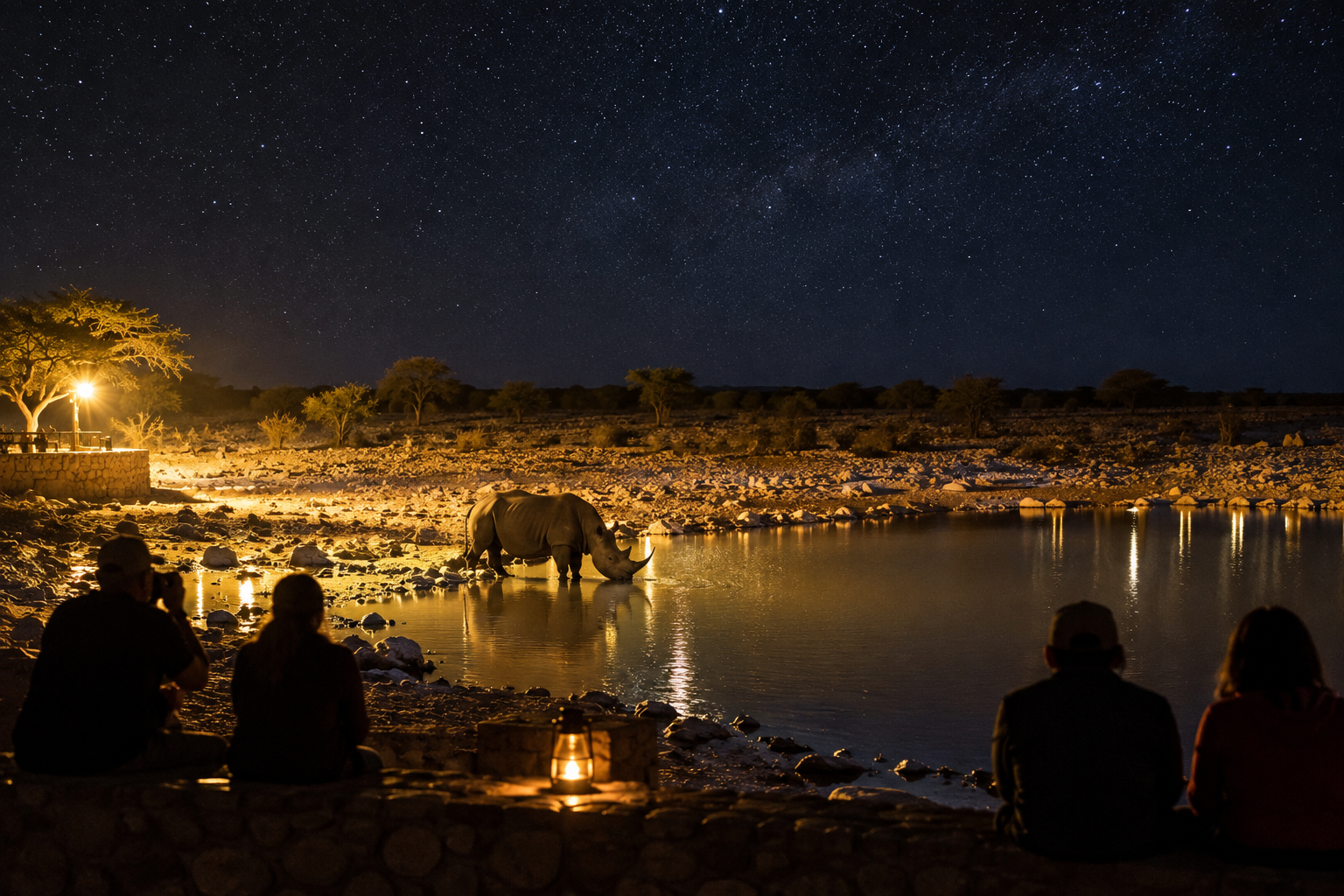
The main camps divide the park into practical areas for exploration. You can choose camps inside the park or private lodges outside it.
Camps Inside the Park
Okaukuejo (western-central). One of the best-known camps, famous for its floodlit waterhole. It offers different accommodation types, camping, food and basic visitor services, plus guided morning, afternoon and night drives.
Halali (central). Set near a dolomite hill and mopane vegetation, so the surroundings feel different from the open plains elsewhere. It has accommodation, camping, a restaurant and a floodlit waterhole. It also works as a useful midway base, so you’re not crossing the whole park in a day.
Namutoni (eastern). Built around the historic German fort originally constructed in 1897. Its position near Fischer’s Pan makes it especially interesting for birdwatchers. The resort offers accommodation, camping, and a floodlit waterhole.
Dolomite Camp (western). A more exclusive option on the western side of Etosha, using permanent luxury tents.
Onkoshi Resort (near the pan). A low-impact accommodation option positioned near the pan environment, good for travellers who want a calmer base.
Private Lodges Outside the Park
Lodges near the park boundaries are a more comfortable option, often with meals and guided drives included. They suit travellers who want some polish after long driving days.
Booking Advice From Experience
- Book early. Accommodation inside and around Etosha can fill during popular travel periods, particularly if you want to move between several camps.
- Spread your stay. Use at least two camps so you cover different areas without long daily transfers.
- Prioritise floodlit waterholes if night viewing matters to you.
- Check inclusions. Rest camps and lodges differ on meals and drives.
Best Waterholes in Etosha
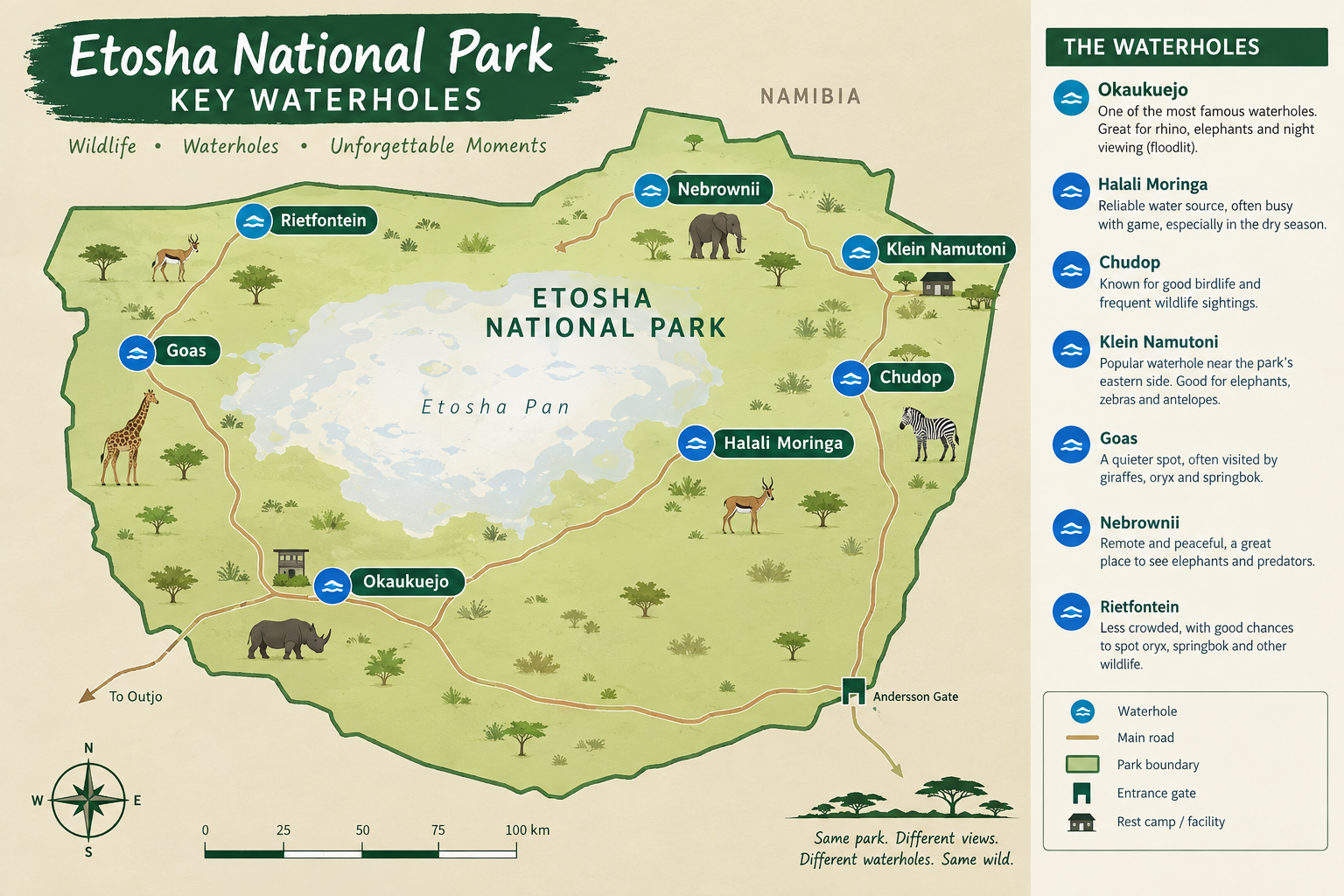
- Okaukuejo waterhole: The most famous, with floodlit night viewing.
- Halali (Moringa) waterhole: Close to the camp, and a good spot for rhino and leopard.
- Chudop: A scenic spot for elephants and general game.
- Klein Namutoni: Good for birds and mixed species near Namutoni.
- Goas: Often rewarding for elephants and big herds.
- Nebrownii and Rietfontein: Reliable classics for varied wildlife.
Conditions change, and animals move on, so ask camp staff or check sightings boards, then adjust.
Because of the 2026 road works, confirm which routes are open before committing to a long loop.
Sample Etosha Safari Itineraries
3-Day Etosha Safari (Quick Visit)
- Day 1: Drive from Windhoek to Okaukuejo. Afternoon drive and evening at the floodlit waterhole.
- Day 2: Dawn drive, then travel to Halali with waterhole stops.
- Day 3: Head toward Namutoni and exit via Von Lindequist Gate.
4-Day Etosha Safari (Balanced)
- Day 1: Arrive at Okaukuejo, short afternoon drive, night at the waterhole.
- Day 2: Full day of waterhole hopping, overnight at Halali.
- Day 3: Explore the eastern side toward Namutoni and Fischer’s Pan.
- Day 4: Morning drive, then exit east.
5-Day Etosha Safari (Best for Photographers and Birders)
- Days 1–2: Okaukuejo, with dawn and dusk sessions at multiple waterholes.
- Day 3: Halali, focusing on rhino and leopard spots.
- Days 4–5: Namutoni or Onkoshi, taking in the pan edge, birds, and quieter eastern routes.
If you add the west, spend a night at Dolomite Camp for a different landscape.
Tip: Don’t try to cover every road. Longer stops at fewer waterholes usually beat racing around.
How Many Days Do You Need?
- 2 nights / 3 days: Workable if you’re passing through Namibia and want an introduction.
- 3 to 5 nights: Best for covering more than one section, spending real time at several waterholes, and doing photography or birding without rushing.
- More than 5 nights: Ideal for photographers and anyone adding the west or north.
The advantage of a longer stay isn’t covering more kilometres. It’s having time to slow down, revisit productive areas and let sightings happen naturally.
Birdwatching in Etosha
Etosha isn’t only a mammal destination. The official park profile records more than 400 bird species across waterbirds, raptors, woodland birds and dry-country specialists.
- Habitats: The variety of habitats supports a wide range of species.
- Fischer’s Pan near Namutoni: An area of interest for dedicated birdwatching.
- Green season: Migratory species arrive, and temporary water on the pan may attract flamingos, pelicans, and other waterbirds.
Bring binoculars, a telephoto lens if you shoot, and a field guide or reliable bird-identification app.
Etosha Photography Tips
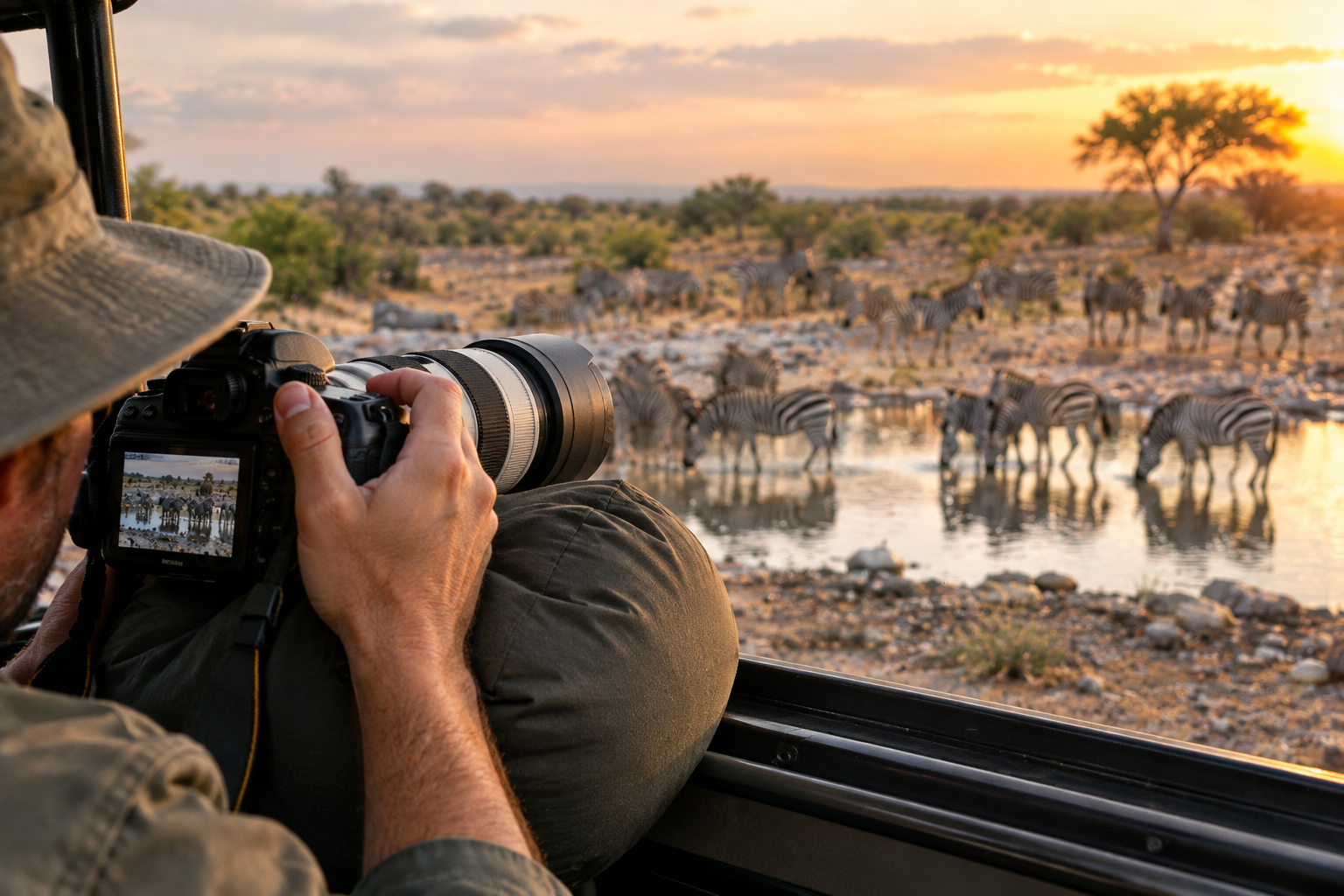
Etosha offers a different look from lush river-based parks. The pale salt pan, dry grasses, distant horizons, and dusty roads make striking landscapes, while waterholes give you wildlife portraits and behaviour shots.
- Shoot at golden hour. Early morning and late afternoon give softer light and better shadows.
- Use a beanbag. It steadies your camera on a car window.
- Use fast shutter speeds for moving animals.
- Focus on the eyes.
- Include context. In the dry season, the contrast between pale ground, wildlife, and blue sky is dramatic.
- Be patient. The best frames often come after long waits.
- Put safety first. Getting closer is never worth stressing an animal or breaking park rules.
What to Pack: Gear I Actually Recommend
This is where my affiliate marketing background is useful. I’ve watched which gear pages travel readers click, buy, and later thank me for. The pattern is consistent: readers regret cheap binoculars, dust-clogged cameras, and dead batteries. They rarely regret spending on good optics.
Prepare for strong sun, dust, and big temperature swings between morning and afternoon.
1. Binoculars (the Most Important Item)
Animals often look tiny on the open plains. 8×42 or 10×42 binoculars are the sweet spot for big game and birds. Choose waterproof, fog-proof models, and check eye relief if you wear glasses.
Check Safari Binoculars on Amazon – AFFILIATE LINK
2. Camera and Telephoto Lens
A 100–400mm or 150–600mm zoom suits waterhole photography. If you’re not a serious photographer, a bridge camera with a long zoom is a lighter alternative.
Check Telephoto Lenses – AFFILIATE LINK
Check Bridge Cameras for Safari – AFFILIATE LINK
3. Camera Beanbag
Cheap, light, and a real help to sharpness when shooting from a vehicle window.
Check Camera Beanbags – AFFILIATE LINK
4. Dust Protection
Bring a dust-resistant camera bag, lens-cleaning materials, a blower, and a protective cover.
Check Camera Dust Covers – AFFILIATE LINK
5. Spare Batteries, Memory Cards and Power Bank
You’ll shoot more than you expect. Pack spares and a high-capacity power bank, plus a car charger for between camps.
Check Power Banks – AFFILIATE LINK
6. Clothing
Pack lightweight layers, a warm layer for cold early mornings, a hat, sunglasses, and comfortable closed shoes. Neutral tones like khaki, olive and beige are a safe choice.
Check Safari Clothing – AFFILIATE LINK
7. Water and Health Basics
Bring a reusable water bottle, sunscreen, insect repellent, and a basic first-aid kit.
Check Travel First-Aid Kits – AFFILIATE LINK
8. Field Guides
A Southern Africa mammal and bird guide makes drives far richer.
Check Southern Africa Field Guides – AFFILIATE LINK
A note on buying: In my experience, readers who spend on binoculars and a stable camera setup are the happiest. Buy for the trip you’re actually taking.
Park Rules, Safety and Health
Safety rules matter in Etosha. Namibia’s Ministry of Environment, Forestry and Tourism states that visitors may not:
- Leave the indicated roads
- Leave the vehicle outside authorised areas
- Disturb game
- Travel with pets
- Use motorcycles inside national parks
Open vehicles and certain firearms and hunting equipment are also restricted.
Staying in the Vehicle
This is especially important for self-drivers. Distances are deceptive, and dangerous wildlife can move quickly. Leave your vehicle only at authorised camps, picnic sites, viewpoints or other clearly designated areas.
Respecting Wildlife
- Give animals space.
- Avoid shouting and unnecessary engine revving.
- Never chase animals for photos or block their access to water.
- Keep a respectful distance from elephants, and never get between a mother and calf.
- Take your litter with you.
Health
- Malaria: Speak to a doctor or travel clinic before you go, especially for the wet season.
- Sun and heat: Hydrate and wear a hat.
- Water: Drink bottled or treated water unless the camp confirms tap water is safe.
- Insurance: Make sure your cover includes medical evacuation.
Costs, Fees and Permits
Visitors must pay the relevant entrance and conservation fees. MEFT states that national park permits can generally be obtained at the park gates, though requirements differ between parks.
Fees, accommodation prices and procedures change, so I won’t quote figures here. Check the latest Namibia Wildlife Resorts and MEFT information before you travel.
Budget categories:
- Park entry and vehicle fees
- Accommodation (camps are generally the budget option; lodges cost more but often include meals and drives)
- Car rental and fuel
- Food and drinks (self-catering saves money)
- Optional guided drives
- Travel insurance and medical prep
Budget tips:
- Consider shoulder months for lower rates.
- Share vehicle and room costs.
- Self-cater some meals, and carry water and snacks.
- Spend on location. A good camp near a waterhole is worth more than a rental-car upgrade.
Conservation: Why Etosha Matters
Etosha is a major conservation landscape as well as a tourism destination. It plays a significant role in black-rhino conservation and has contributed to the recovery of the black-faced impala. Namibia’s government also runs wildlife protection, research, and conservation programmes connected with the park.
Visitors can support this work simply by following park rules, keeping a safe distance, avoiding litter, staying on designated roads and listening to park staff and qualified guides.
Common Mistakes to Avoid
- Trying to see too much. Etosha rewards patience, not mileage.
- Booking too late. Popular periods fill fast.
- Skipping binoculars. You’ll miss half the wildlife.
- Using outdated maps. Roadworks and gate renovations mean conditions change.
- Assuming fuel will be available. Arrange it before entering.
- Underestimating drive times. Sightings, stops and diversions add up.
- Expecting guaranteed sightings. It’s wildlife, not a zoo. That’s the point.
- Relying on mobile signal. Keep key details offline.
Frequently Asked Questions (FAQ)
1. What is the best time for an Etosha National Park safari?
May to October is the strongest period for game viewing, because animals gather at reliable water and vegetation is thinner. November to April offers greener scenery and migratory birds.
2. Can you self-drive in Etosha National Park?
Yes. Etosha is popular for self-drive safaris, but treat it as a wilderness environment. Roads include gravel routes, so plan fuel, water, and supplies carefully.
3. How many days do you need for an Etosha safari?
Two nights (three days) works as an introduction. Three to five nights or more lets you explore more than one section and spend longer at waterholes.
4. Do I need a guide for an Etosha safari?
No, but a guided drive adds knowledge of animal behaviour and tracking. Guided morning, afternoon and night drives are available at Okaukuejo and Halali.
5. Can you see the Big Five in Etosha?
You can see elephants, lions, leopards, and rhinos. African buffalo is not listed as a regular park species.
6. What animals can you see in Etosha National Park?
Elephants, black and white rhinos, lions, leopards, giraffes, Burchell’s zebra, springbok, blue wildebeest, gemsbok, eland, Damara dik-dik, black-faced impala, cheetahs, hyenas and more than 400 bird species.
7. Is Etosha safe for tourists?
Yes, if you follow the rules. Stay in your vehicle outside authorised areas, keep your distance from wildlife, and plan around camp and gate times.
8. Where should I stay in Etosha?
Okaukuejo, Halali and Namutoni are the main camps. Dolomite Camp and Onkoshi Resort offer more exclusive options. Book early for popular periods.
9. Which gate should I use?
It depends on your route. Andersson Gate suits visitors from the Outjo direction, Von Lindequist the east near Namutoni, Galton the west, and King Nehale Lya Mpingana the north. Check current gate conditions first.
10. Are there road works in Etosha in 2026?
MEFT has reported renovation work at the Andersson, Von Lindequist, and King Nehale entrance gates, and road construction has affected sections between Okaukuejo and Halali. Follow current signs.
11. Can flamingos be seen on the Etosha Pan?
Sometimes. After sufficient rain, the pan can hold temporary water and attract flamingos and pelicans, but timing and extent depend on rainfall.
12. What should I pack for an Etosha safari?
Binoculars, layers for cold mornings and warm afternoons, a hat, sunglasses, sunscreen, closed shoes, a water bottle, and camera protection against dust.
13. Can I take my pet to Etosha?
No. Travelling with pets inside national parks is prohibited.
14. How much does an Etosha safari cost?
It varies by accommodation, transport and season. Check current Namibia Wildlife Resorts and MEFT rates before booking.
Conclusion: Is an Etosha National Park Safari Worth It?
An Etosha National Park safari rewards travellers who slow down. The pale salt pan, the open plains and the waterholes give you a wildlife experience that feels different from a typical bush safari. Elephants, rhinos, lions, giraffes, zebra and oryx all come to you if you’re patient. Add hundreds of bird species and a long conservation record, and you have one of southern Africa’s most rewarding destinations.
After years of helping travellers choose gear and plan trips, I’ve noticed the happiest visitors do the same few things:
- Match the season to their goals. The dry months from May to October suit mammals, and the green season suits birds and scenery.
- Book camps early and split their stay across at least two areas of the park.
- Check current gate and road conditions instead of trusting an old map.
- Pack well. Good binoculars, a stable camera setup, and dust protection matter more than extra gadgets.
- Follow every park rule and keep a respectful distance from wildlife.
- Stay flexible. Wildlife can’t be scheduled, and that’s the appeal.
Whether you self-drive, join a guided game drive,e or combine both, give yourself enough time at the waterholes. Etosha pays off when you stop chasing sightings and let them happen.
Ready to plan your Etosha National Park safari? Start with your travel dates, choose your camps, and put your gear list together using the recommendations above. If you have questions about routes, timing, or what to pack, leave a comment below. If this guide helped, share it with your travel partner and bookmark it for planning.
Safe travels, and may your waterholes be full of life.