

- 1 Views
- 15 Min Read
- (0) Comment
A 2026 Okavango Delta lodge can cost USD 595 to USD 3,895 per person per night, while a seven-night stay can range from about USD 4,165 in green season to roughly USD 27,265 in peak season, before levies. The final bill depends on more than the bed: access fees, conservation charges, activities, and light-aircraft transfers can substantially change the total.
You may be looking at two safari quotes that seem impossible to compare. One shows a modest nightly rate near Maun, while another costs several times more for a remote camp reached by a small aircraft. Both may be described as an Okavango Delta safari, but they aren't necessarily selling the same access, season, accommodation, or level of exclusivity.
For a couple planning a first Botswana trip, the important question isn't “How much does the Okavango Delta cost?” It's, “What does this price include, and what will still be added?” The Delta is a premium fly-in wilderness, so the budget behaves less like a hotel booking and more like a stack of separate components. Accommodation sits at the top, followed by access, activities, transfers, and seasonal pricing.
This guide breaks down the Okavango Delta safari cost in practical terms. You'll see how green and peak seasons compare, why adding another camp can raise the total quickly, which fees are commonly overlooked, and how to compare quotations fairly. For a first overview of the destination itself, this Okavango Delta first-timer's guide provides useful context before you start weighing itineraries.
Table of Contents
- Introduction to Okavango Delta Safari Costs
- What Your Safari Price Actually Covers
- Budget Mid Range and Luxury Safari Price Bands
- How Season and Logistics Drive the Final Price
- Hidden Fees and Transfer Costs Most Travellers Miss
- Sample Itineraries With Example Pricing
- Smart Booking Tips to Save Without Compromising Experience
Introduction to Okavango Delta Safari Costs
Arrive in Maun with two safari quotes in hand. One may cover a camp reached by road, while the other includes a remote lodge and a light-aircraft transfer. Both may say “Okavango Delta,” yet their totals can differ because the destination is a network of access routes, concessions, camps, and activities rather than one standard package.
The price works like a stack. Accommodation forms one layer, then access fees, conservation charges, vehicle costs, activities, and aviation may add others. A remote camp also has to move guests, food, fuel, staff, and equipment across difficult terrain. When roads are impractical, the aircraft or vehicle network becomes part of both the experience and the bill.
Why the headline figure changes so much
A 2026 pricing guide places lodge rates between USD 595 and USD 3,895 per person per night. Its seven-night examples range from about USD 4,165 in green season to roughly USD 27,265 in peak season, before a USD 60 per person per night conservation levy. Over a week, that levy would add USD 420. The 2026 Okavango Delta lodge pricing guide illustrates why the nightly rate alone can mislead.
A lower-cost plan may use a simpler camp, road transfers, or a day excursion from Maun. A higher-priced plan may combine a private concession, more exclusive guiding, several aircraft legs, and the period when floodwater and wildlife viewing are most sought after. The shared destination name does not mean identical access or operating costs.
For first-time travellers, the useful question is not only “What does the Okavango Delta cost?” Ask instead, “Which layers are included, and which remain separate?” A clear quotation should identify accommodation, access, activities, transfers, levies, and whether the price assumes shared or private use. A first-timer's guide to the Okavango Delta can provide destination context before you compare those layers.
Practical rule: Treat the advertised nightly rate as the first layer of the budget, not the complete safari price.
What Your Safari Price Actually Covers
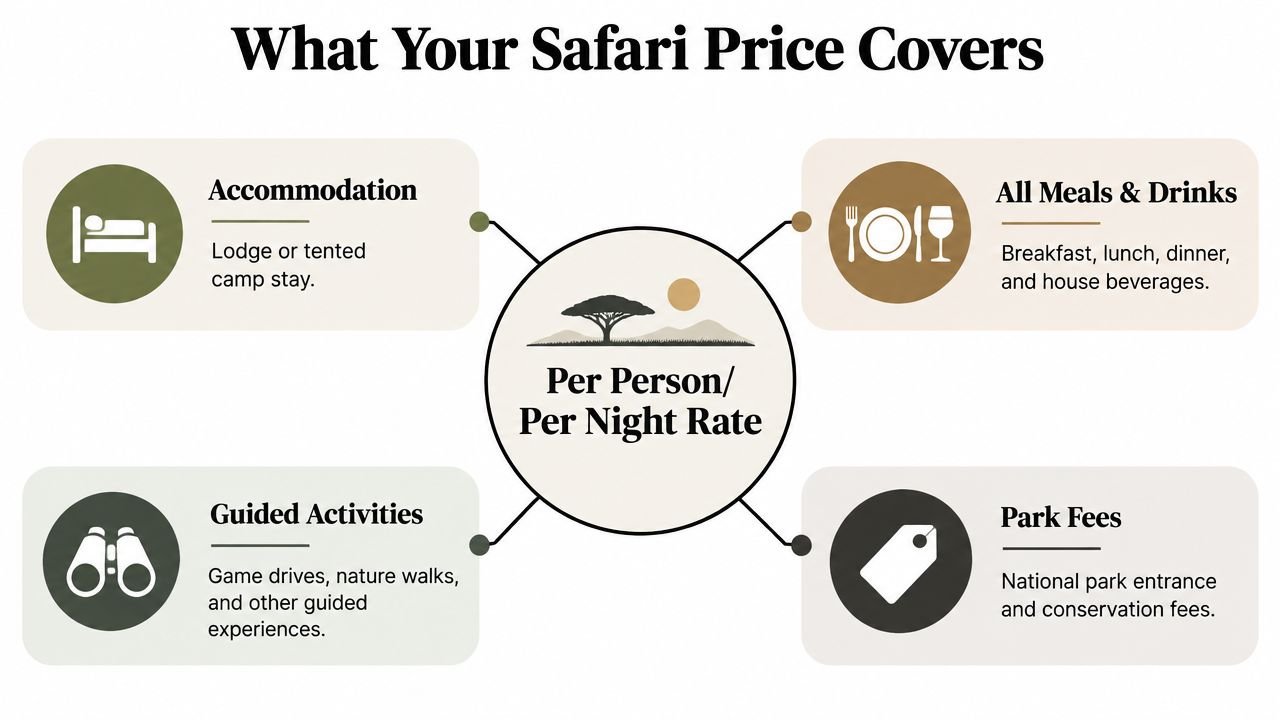
Most Delta quotations use a per person, per night figure rather than a room price. That distinction matters. If two people share a tent, the quote usually applies to each traveller, while a single traveller may face a different rate or a single supplement depending on the property.
Think of a remote camp as an all-inclusive island resort with no road, supermarket, or restaurant nearby. The rate typically pays for your tent or lodge room, meals, selected drinks, guiding, and scheduled activities. The camp has to coordinate nearly everything on your behalf because you can't leave on foot and arrange a restaurant meal elsewhere.
The usual included elements
A standard full-board camp rate commonly covers:
- Accommodation: Your tent, room, or chalet for the booked nights.
- Meals and house drinks: Breakfast, lunch, dinner, and the beverages specified by the camp.
- Guided activities: Depending on location and water conditions, these may include game drives, mokoro outings, boating, or guided walks.
- Camp service and guiding: Staff, housekeeping, and the guide team form part of the operating cost.
The exact list varies by camp. Premium spirits, private vehicles, specialist activities, laundry, and some transfers may sit outside the standard package. You should ask for an inclusion schedule instead of assuming that “full board” means every cost on the ground.
For a sense of how a high-end property presents its accommodation and guest experience, Haute Black's review of Xigera Safari Lodge offers helpful destination-specific context. It shouldn't replace a formal quotation, but it can help you understand why a remote lodge is sold as a complete wilderness experience rather than just a room.
What you need to check separately
Park access, conservation levies, foreign-registered vehicle charges, and aircraft transfers may be separate lines. Even activities can have different pricing depending on whether they're operated by the camp, a community trust, or a Maun-based provider.
Before comparing options, place every quote into the same format: nights, camp category, season, meals, activities, transfers, fees, and exclusions. This broader Botswana safari cost breakdown can also help you frame the comparison beyond a single lodge rate.
Budget Mid Range and Luxury Safari Price Bands
A first-time traveller may compare a lodge's nightly rate with a hotel price and expect the same type of budget. In the Okavango Delta, the rate is only one layer. The final cost usually stacks accommodation, access fees, guiding, vehicles, and light-aircraft transfers. A cheaper room can still produce an expensive itinerary if reaching it requires several remote connections.
Safari labels therefore describe more than tent size or meal quality. “Budget,” “mid-range,” and “luxury” also signal the camp's location, concession access, vehicle arrangements, guiding style, and supporting infrastructure. A mobile or entry-level safari may use simpler facilities and road-based or public-access areas. Permanent mid-range camps generally provide established accommodation and full-board service. Private-concession luxury camps add greater privacy, controlled vehicle numbers, specialist service, and access arrangements that require more coordination.
A practical comparison
The table gives a planning framework rather than a universal quotation. Green-season rates can vary by camp and itinerary, while peak-season prices reflect stronger demand and more expensive remote operations.
| Safari Style | Green Season Per Night | Peak Season Per Night | Typical 7 Night Total |
|---|---|---|---|
| Mobile or entry-level | Lower-cost options may be available through simpler camps and road-based arrangements | Usually higher, but product and access vary | Depends heavily on accommodation and transfers |
| Mid-range permanent camp | USD 500 to USD 800 per person per night for commonly cited permanent camps | Rates rise with demand and camp location | Often part of a USD 5,000 to USD 10,000 per person five-to-seven-night fly-in programme before international flights |
| Luxury private concession | Green-season rates may be 20% to 50% lower than comparable peak rates | About USD 950 to USD 1,800+ per person per night for premium concession camps, with luxury rates reaching USD 1,000 to USD 2,500+ | Roughly USD 7,000 to USD 17,000 per person for a high-end seven-night stay |
The seasonal and premium-camp ranges are outlined in this Okavango Delta safari planning guide. For mid-range camps and fly-in programme budgeting, consult this guide to planning and booking an Okavango Delta safari.
Match the tier to your priorities
Mid-range is often the clearest compromise for travellers seeking comfortable accommodation, full-board service, and strong guiding without the highest private-concession rate. It may still include aircraft transfers, park access charges, and other remote-area costs, so “mid-range” does not mean inexpensive in the way it might at a road-accessible destination.
Luxury pricing pays for a combination of setting and control. A private concession can provide a quieter vehicle environment, more flexible activities, and more personal service. Compare the access and privacy you will use, not only the room. A closer look at Okavango Delta lodges can help you relate each accommodation style to the overall safari experience.
How Season and Logistics Drive the Final Price
A traveller may choose a camp by its nightly rate, then discover that the final bill is shaped just as much by the season and the journey to reach it. Two forces work together: the annual flood cycle and the logistics of moving people through remote camps. They affect which camps operate, which activities are possible, how wildlife viewing changes, and how much demand the operator must accommodate.
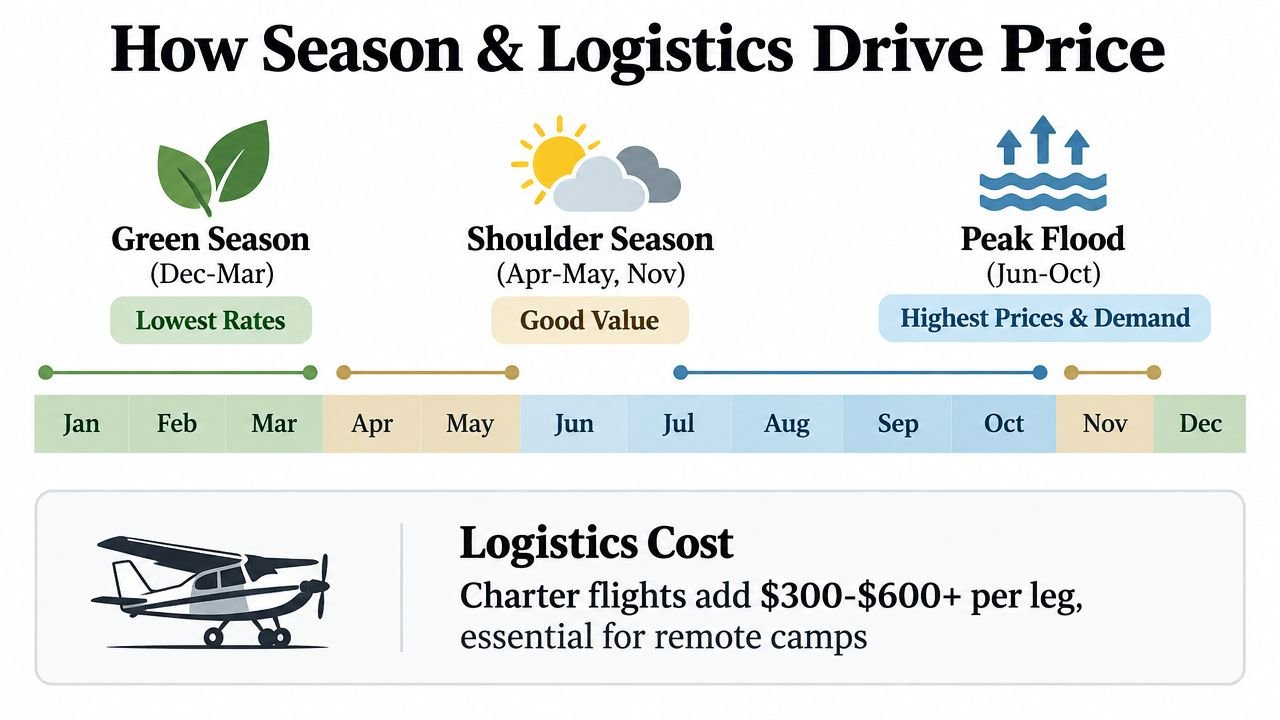
The strongest game-viewing period generally runs from roughly May or June through October. During this time, water levels, wildlife concentration, and traveller demand are often high, so peak-season rates rise. Green-season pricing can be 20% to 50% lower, depending on the camp category and itinerary design, as outlined in the seasonal guidance linked earlier.
The flood changes more than the scenery
The Delta's water follows a seasonal cycle, reshaping channels, lagoons, islands, and floodplains. That changing map influences whether a camp can offer boating or mokoro trips, where animals gather, and how guides plan each day.
Green season still offers a worthwhile safari, with thicker vegetation, shifting water conditions, and a quieter travel environment. Travellers who prioritise peak water levels and concentrated wildlife viewing may accept the higher rate. Those with greater date flexibility may find better value outside the busiest period. This guide to the best time to visit the Okavango Delta helps match seasonal conditions with personal priorities.
Aircraft legs multiply the effect
Remote camps commonly require light-aircraft transfers from Maun or another camp. One planning guide places these transfers at about USD 150 to USD 350 per person per leg. Its broader five-to-seven-night fly-in programmes commonly reach USD 5,000 to USD 10,000 per person before international flights, depending on the route and camp choices.
The calculation resembles a stack of building blocks. Each camp adds its nightly rate, while each flight adds an access cost. A two-camp itinerary may need fewer aircraft legs than a circuit of several camps, and each extra hop can also add handling time and another camp's accommodation charge. The Watatu Travel planning guide explains how adding camps can raise the total disproportionately.
For that reason, removing one unnecessary camp change may save more than selecting a slightly cheaper room. The right comparison is the full route, not the nightly price alone.
Hidden Fees and Transfer Costs Most Travellers Miss
A lodge quote can resemble the visible part of an iceberg. The nightly rate is above the surface, while park entry, vehicle charges, conservation levies, activities, and internal aviation sit underneath. Reviewing each line shows whether the price covers access to the Delta or only the bed and meals.
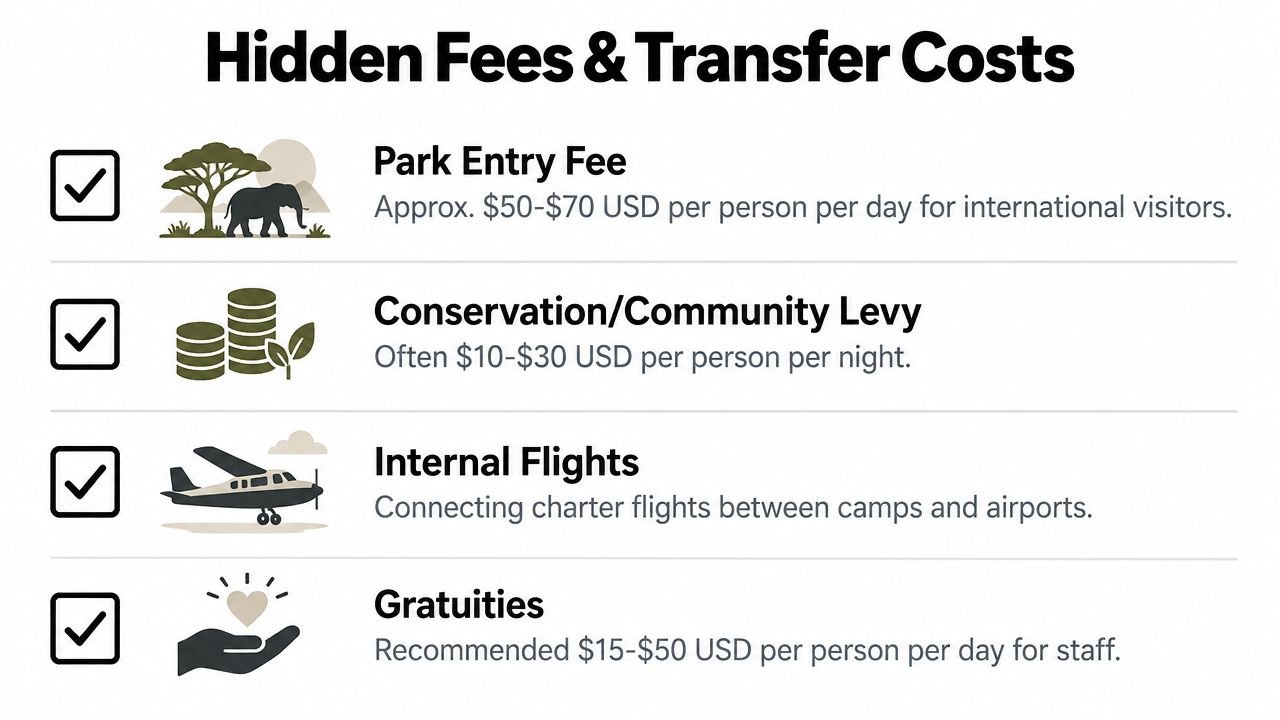
Public-access Moremi illustrates the difference. An independent 2026 cost guide lists international non-resident entry at BWP 290 per adult per day and BWP 145 per child aged 8 to 17, plus BWP 150 per foreign-registered vehicle per day. It also lists a community trust mokoro excursion at USD 120 to USD 180 per person, a full-day mokoro trip from Maun at USD 171, a Moremi game drive at USD 315, and scenic flights from USD 335 to USD 1,287. These figures are summarised in this Okavango Delta travel-cost guide.
Audit the quote line by line
Ask the operator to identify each cost clearly:
- Park or reserve access: Confirm whether public-area entry is included or paid separately.
- Vehicle charges: Check whether a foreign-registered vehicle fee applies to a self-drive or road-based route.
- Conservation levy: Verify the amount, currency, and whether it applies per person per night.
- Activities: Ask which mokoro trips, drives, boats, or flights are included.
- Aircraft transfers: Confirm every leg, including airport-to-camp and camp-to-camp movements.
- Personal spending: Clarify drinks, gratuities, laundry, insurance, visas, and international flights.
A separate pricing guide cites a USD 60 per person per night conservation levy at certain lodge rates. That would add USD 420 for a week, so the levy should have its own line rather than being buried in the room price.
There is no single entry fee for the entire Delta. Public-access Moremi uses daily entry and vehicle charges, while fly-in travellers may instead pay concession fees and aircraft costs. This Okavango Delta safari cost guide notes that light-aircraft transfers and scenic flights can range from roughly USD 220 to USD 600 per person each way, depending on the route and operator.
Arrival plans can create another separate bill. For practical planning around Zimbabwe and Botswana, review the Victoria Falls Airport transfer information. Keep that regional transfer separate from the Delta quotation, so an airport journey is not mistaken for an included camp transfer.
Sample Itineraries With Example Pricing
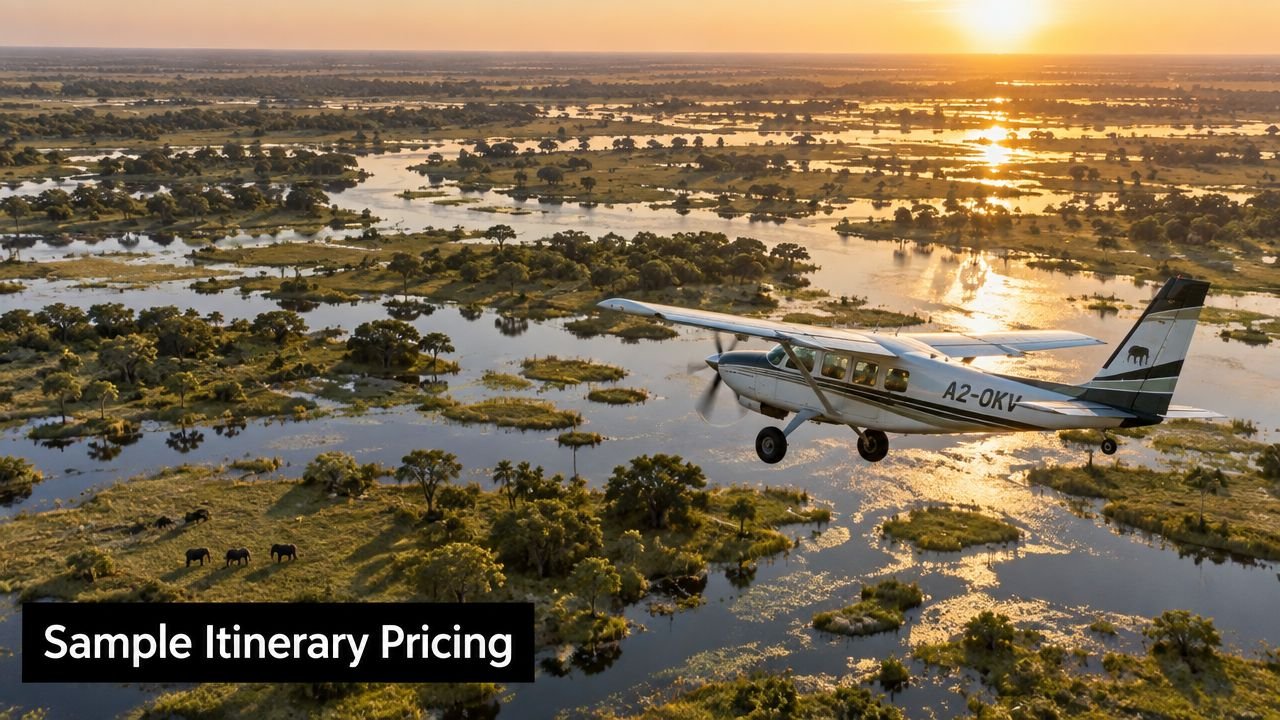
A five-night safari can produce very different totals depending on how the route is built. Accommodation is only the first layer. Access fees, conservation or concession charges, activities, and light-aircraft transfers can reshape the final bill, especially when camps are far apart.
Consider a value-focused five-night fly-in programme using mid-range permanent camps. At USD 500 to USD 800 per person per night, accommodation alone would be approximately USD 2,500 to USD 4,000 per person. The route may then require several aircraft legs, each costing about USD 150 to USD 350 per person, before applicable park, concession, conservation, or activity charges. Treat the nightly rate like the base of a house. The transport and access costs are the additional floors that determine the completed price.
A five-night quotation therefore needs more detail than the phrase “five-night price.” One camp keeps the itinerary simpler and may avoid an extra aircraft movement. Two camps can provide different habitats and activities, yet the changeover adds another flight and introduces a second camp's rate structure. For travellers who mainly want time in the Delta, a single-base stay can make the cost easier to understand.
A peak-season luxury circuit
Now consider seven nights in premium private-concession camps during the high-demand flood period. Premium concession rates are commonly cited at about USD 950 to USD 1,800 or more per person per night, while luxury peak-season rates can reach USD 1,000 to USD 2,500 or more. A high-end seven-night stay is estimated at roughly USD 7,000 to USD 17,000 per person, depending on camp category and route design. Rex Clarke Adventures' safari guide provides these ranges.
That accommodation figure still does not describe the whole circuit. Scheduled flights between camps, applicable levies, and activities outside the package may sit separately. Several stops can therefore cost more than a longer stay at one well-chosen camp, because each movement adds another layer to the total.
How to use these examples
Use either itinerary as a worksheet, not as a universal quotation:
- Multiply the nightly rate by the number of nights.
- List every aircraft leg separately.
- Add entry, vehicle, conservation, concession, and activity charges.
- Check exclusions before adding international flights and personal expenses.
This approach lets you compare quotations that use different package names. It also shows whether a lower headline rate comes from a cheaper plan or from costs being left outside the accommodation figure.
Smart Booking Tips to Save Without Compromising Experience
Start by deciding what you want to protect. If peak flood conditions are essential, keep the dates and reduce unnecessary camp changes. If your priority is wildlife, guiding, or a first Delta experience rather than a particular month, ask about green or shoulder-season alternatives.
Compare like with like
Request quotations using the same brief. Specify the number of nights, room-sharing arrangement, preferred activities, arrival point, and whether you want one camp or a multi-camp route. Then ask each operator to show:
- Nightly accommodation: State the season and whether the rate is per person sharing.
- Internal transport: List every light-aircraft or road-transfer leg.
- Fees and levies: Separate park, conservation, concession, and vehicle charges.
- Activities: Identify included drives, mokoro excursions, boats, and scenic flights.
- Exclusions: Mark international flights, insurance, visas, gratuities, premium drinks, and personal purchases.
This prevents a lower headline quote from winning because it leaves more items outside the package.
Use route design as a budget tool
A shorter route isn't always cheaper if it requires awkward transfers. Conversely, adding another camp may increase variety while pushing up aircraft costs. Ask a Botswana specialist to compare a single-base stay with a two-camp plan before you commit.
Travellers from the UK, US, and Europe should also consider whether the Delta fits naturally with Victoria Falls or Chobe in the same regional journey. A combined itinerary can make logistical sense, but only if the operator clearly separates regional transfers from Delta accommodation and concession costs.
Before paying a deposit, ask one question: “What will I still need to pay after I arrive in Botswana?”
Maximum Adventure Trails can help travellers compare Botswana safari options, accommodation, activities, and transfers in one planning conversation. Visit Maximum Adventure Trails with your dates, preferred season, and target budget, and request a line-by-line Okavango Delta itinerary that shows the full cost stack before you book.