

- 97 Views
- 22 Min Read
- (0) Comment
The popular advice is to choose the wildlife volunteering opportunity that promises the closest animal encounter. That's the wrong starting point. A meaningful placement isn't a cheaper safari with a conservation label. It's a work commitment whose value depends on the contribution you want to make, your tolerance for early starts and demanding field conditions, your budget, your travel region, and the level of support you need.
The strongest wildlife conservation volunteer opportunities use different methods. Some collect telemetry and behavioural data for reserve managers. Others restore habitat, support citizen-science research, or provide low-barrier local stewardship. The right choice depends on whether you want rigorous monitoring, practical land management, a science-led expedition, or an accessible way to begin close to home.
This roundup places particular emphasis on Southern Africa, while including credible global and United States options. Each placement is assessed by its conservation method, field intensity, duration and scheduling, cost transparency, accommodation, training, conservation outputs, application requirements, support model, and ethical safeguards. Readers planning travel around Victoria Falls, Hwange, Chobe, or the Okavango Delta can use Maximum Adventure Trails for related safari, activity, and accommodation planning, but the volunteer placement itself should be evaluated separately from sightseeing.
The comparison is based on the supplied program descriptions and published details. Dates, fees, inclusions, visa rules, health requirements, and availability can change, so reconfirm them with the operator and relevant official authorities before booking. For broader advice on preparing to volunteer overseas, the guide from Kindness Community Foundation is another useful planning reference.
Table of Contents
- 1. African Impact African Big 5 Wildlife Conservation in Greater Kruger
- 2. Wildlife ACT Endangered Species Conservation in Zululand
- 3. Conservation Travel Africa Endangered Wildlife Projects and Victoria Falls Options
- 4. Earthwatch Institute Wildlife and Ecosystem Science Expeditions
- 5. Biosphere Expeditions Conservation Expeditions
- 6. The Nature Conservancy Volunteer Workdays and Stewardship
- 7. U.S. National Park Service Volunteers-In-Parks
- 7-Program Wildlife Conservation Volunteer Comparison
- Build a Responsible Volunteer Plan
1. African Impact African Big 5 Wildlife Conservation in Greater Kruger
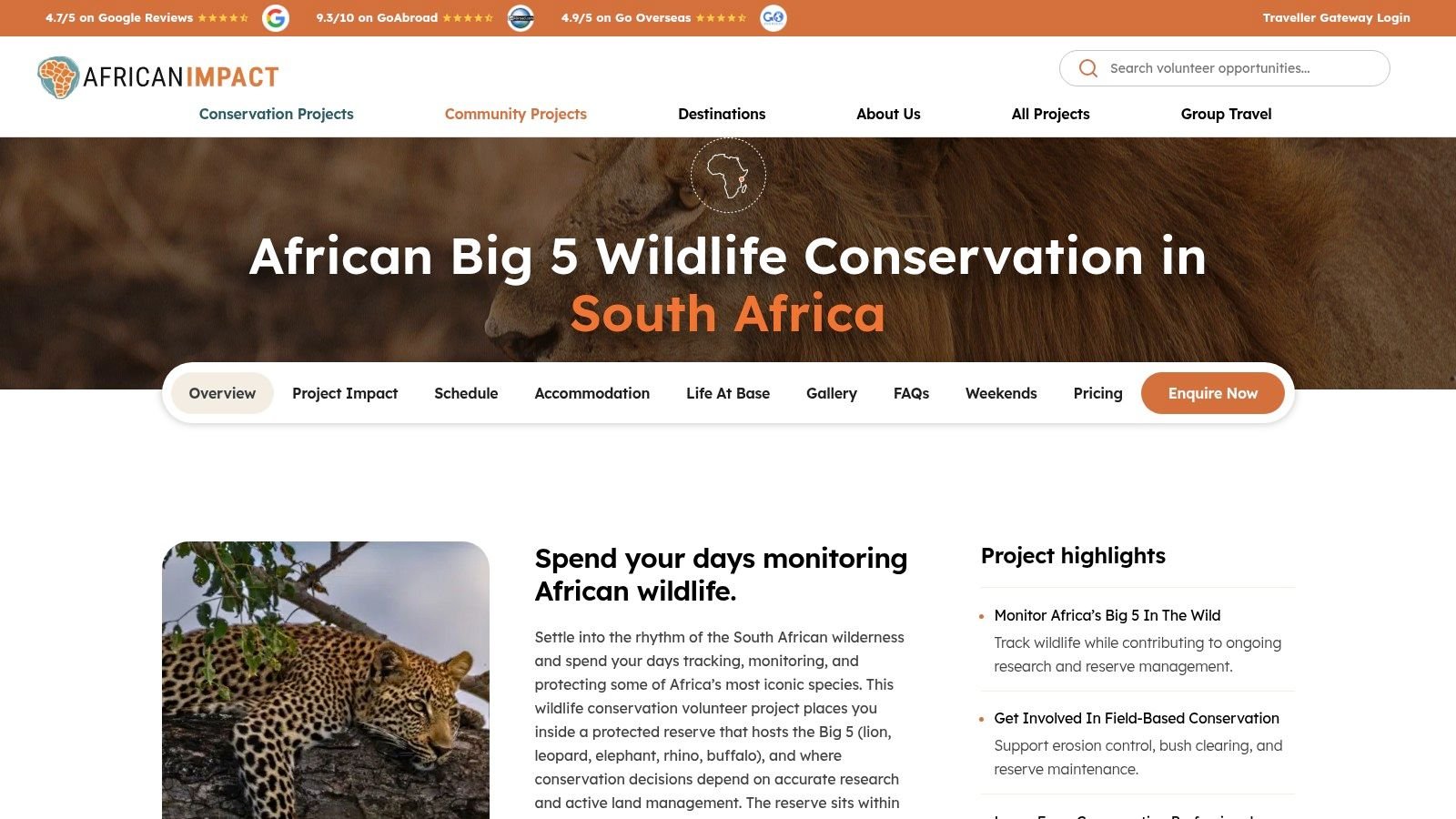
African Impact's African Big 5 Wildlife Conservation project suits volunteers who want a structured introduction to reserve-based monitoring without pretending the experience is a conventional safari. The placement operates in the Greater Kruger area, where volunteers help track and record lions, leopards, elephants, rhinos, and buffalo. The practical value lies in the data collection, not in how many memorable sightings appear in a travel diary.
Volunteers receive field training in tracking, species identification, and data recording before contributing to practical conservation activities. The program's published description also connects volunteer-collected information with reserve management decisions, giving the work a clearer impact pathway than programs that describe tasks only as “animal care.”
What the working week demands
This is a camp-based placement with full board, support staff, equipment, and logistics assistance. Airport transfers are included according to the published program information, which reduces the friction that can make remote conservation placements difficult for first-time volunteers. The operator also publishes tiered pricing by duration and explains inclusions and exclusions, making it easier to separate the placement fee from flights, insurance, personal spending, and other travel costs.
Practical rule: Treat every field day as conservation work first and wildlife viewing second.
The schedule has fixed start days and seasonal windows, so flexibility matters. You'll need to align your travel dates with the program calendar rather than arrive whenever a safari itinerary happens to pass through the region. Field days can begin early and run long, with repeated tracking, observation, recording, and travel across reserve terrain.
Best fit and ethical trade-off
This is a strong fit for a first-time volunteer who wants training, meals, equipment, and on-site support, or for a repeat participant who wants a defined monitoring role. It's less suitable if your priority is relaxed game viewing, late mornings, or a lodge-style experience. A sustainable safari can complement the placement, but it shouldn't replace the discipline of the volunteer schedule. For responsible trip planning, see this sustainable safari guide.
The main question to ask before paying is how the project turns observations into management decisions, and how volunteers receive feedback about the data they helped collect. That answer tells you more about conservation value than the Big Five branding.
Visit African Impact's African Big 5 Wildlife Conservation program.
2. Wildlife ACT Endangered Species Conservation in Zululand
Wildlife ACT is built around a more concentrated field model. Volunteers join small teams assisting professional monitors across protected areas in Zululand, with daily work focused on endangered and priority species rather than general reserve activities. The program explicitly frames itself as field work, not a safari, and that distinction should guide your expectations from the moment you apply.
The monitoring toolkit includes telemetry, GPS, and camera traps. Depending on the project and current conservation needs, volunteers may support monitoring for African wild dogs, cheetahs, rhinos, vultures, and other priority species. The work involves patience and repetition. Locating a signal, following a track, observing animals without interfering, and recording information accurately can take far longer than a visitor expects from a wildlife holiday.
A hands-off model with real demands
Wildlife ACT's published materials emphasize ethical, non-invasive monitoring and a no-contact approach. That's important because direct handling, feeding, petting, or guaranteed encounters can make a project serve visitor expectations rather than animal welfare. Here, the volunteer's role is to assist a professional team, collect useful observations, and support protected-area management without making animals accustomed to people.
Placements can rotate between different reserves, with rotations possible every two weeks according to the supplied program description. The published start dates help applicants plan, but the fixed structure also limits spontaneity. You'll need to check the current calendar and understand whether a chosen start date matches the species and reserve work available at that time.
- Field intensity: Expect long days, limited downtime, and changing conditions rather than a relaxed camp routine.
- Skills development: Learn how monitoring teams use telemetry, GPS, camera traps, species identification, and observation records.
- Accommodation model: Self-catering camp life offers fewer amenities than a lodge-based project, so personal preparation matters.
- Support structure: Work is supervised by professional monitors, but volunteers still need independence, resilience, and cooperative habits.
The program identifies a WWF-supported partnership, which adds useful context, but you should still ask how your fees are allocated, who leads the fieldwork, and what reports or management outputs result from the monitoring.
Who should choose it
Choose Wildlife ACT if you want the most work-focused option in this roundup and you're comfortable with early mornings, rougher conditions, and repetitive data collection. Don't choose it because you expect close animal contact. A broader Africa safari guide can help with leisure planning, but the placement itself demands a separate mindset.
Review the Wildlife ACT endangered species conservation program.
3. Conservation Travel Africa Endangered Wildlife Projects and Victoria Falls Options
Conservation Travel Africa is useful for travelers who want to compare several project styles while building a wider Southern African itinerary. Its portfolio includes data-driven endangered wildlife conservation in South Africa and community-conservation experiences around Victoria Falls in Zimbabwe. That combination makes it more flexible than a single-site placement, but flexibility also means you must inspect each project rather than assume every listing has the same field standards.
The South African endangered-wildlife projects emphasize intensive monitoring of species such as wild dogs, cheetahs, rhinos, and vultures. Small project sizes, often up to five volunteers, can create more personalized field time and closer contact with the professional team. The Victoria Falls options take a different route by combining conservation with community work, so the daily tasks, seasonal availability, and local partner relationships require particular attention.
Strong itinerary fit, variable project detail
The operator publishes rates, inclusions, airport logistics guidance, and biweekly start dates for many projects in 2026. Those details make initial planning easier, especially for travelers comparing a volunteer commitment with flights through Richards Bay or nearby regional gateways. Still, a headline rate doesn't answer every cost question. Confirm meals, transfers, accommodation, local transport, equipment, insurance expectations, and personal expenses in writing.
Some pages may trigger anti-bot checks and require a reload or verification before the details appear. That's a small practical inconvenience, but it matters when you're trying to compare dates or payment terms. Zimbabwe and Victoria Falls community roles may also change with season and partner needs, so applicants should request the current task list rather than rely on a broad destination label.
Small team size can improve field access, but it doesn't automatically prove conservation impact. Ask what the team records, who uses the information, and what the community partner controls.
Best use of the program
This option works best for travelers who want to combine a focused conservation placement with Victoria Falls, Hwange, Chobe, or another regional journey. Keep the two purposes separate. Volunteer days should be judged by work outputs and ethical safeguards, while sightseeing should be planned around rest and exploration. A safari and Victoria Falls itinerary can help organize the travel portion without turning the volunteer role into an add-on attraction.
Choose the South African projects for greater monitoring intensity. Choose the Victoria Falls options only after confirming the community partner, seasonal tasks, local leadership, and expected outputs.
Explore Conservation Travel Africa's endangered wildlife conservation programs.
4. Earthwatch Institute Wildlife and Ecosystem Science Expeditions
Earthwatch Institute is the clearest choice for volunteers who want a citizen-science expedition rather than a general conservation placement. Its expeditions pair participants with researchers working on active studies across wildlife, habitats, and marine environments. Volunteers aren't assigned outdoor tasks. They're trained to follow standardized research protocols so that observations can contribute to a defined scientific project.
The expedition catalog provides practical filters, including dates, locations, fitness levels, and task descriptions. The published 2026 calendar includes projects such as Maasai Mara restoration, but future availability should be checked directly because expedition schedules and spaces can change. The program pages also describe fees and group capacity, allowing applicants to compare the expedition commitment with other options before making travel arrangements.
Better for research-minded volunteers
Earthwatch's strongest feature is methodological clarity. Pre-departure materials and in-field training prepare participants to use the project's procedures, whether the work involves wildlife behaviour, habitat restoration, or another ecosystem study. That structure helps prevent the common problem of volunteer labor producing observations that are interesting to visitors but unusable for researchers.
You should still read the task description closely. “Wildlife science” can mean long observation periods, careful sampling, data entry, habitat work, or physically active surveys. Fitness information is therefore more important than destination appeal. A project in a famous wildlife region may involve fewer animal sightings and more time recording environmental conditions.
- Choose it for: Standardized research, researcher supervision, and a defined scientific question.
- Avoid it if: You want a short, flexible placement that can be added to an existing holiday at the last minute.
- Budget carefully: Expedition fees are usually higher than low-barrier local volunteering, and airfare is typically separate.
- Book early: Popular spaces can fill months in advance, so waiting may remove the project that best matches your interests.
The ethical fit
Citizen science works ethically when researchers define the need for participant labor, train volunteers properly, and explain how the resulting data is used. Earthwatch's emphasis on published research outcomes and standardized protocols provides a stronger basis for evaluation than vague promises of “helping wildlife.” Ask whether volunteers can access expedition reports or later findings, and whether local researchers and communities hold meaningful roles.
For regional travel around Southern Africa, use the placement as the scientific core and add leisure activities separately. A guide to sustainable safari destinations can support that planning.
Browse Earthwatch wildlife and ecosystem science expeditions.
5. Biosphere Expeditions Conservation Expeditions
Biosphere Expeditions takes a non-profit, science-driven approach for volunteers who want both field participation and financial clarity. Its portfolio covers terrestrial and marine projects across Africa and other regions, with small-team work alongside scientists. The important distinction is that the program pages describe research methods, project aims, expedition reports, and how participant contributions are allocated.
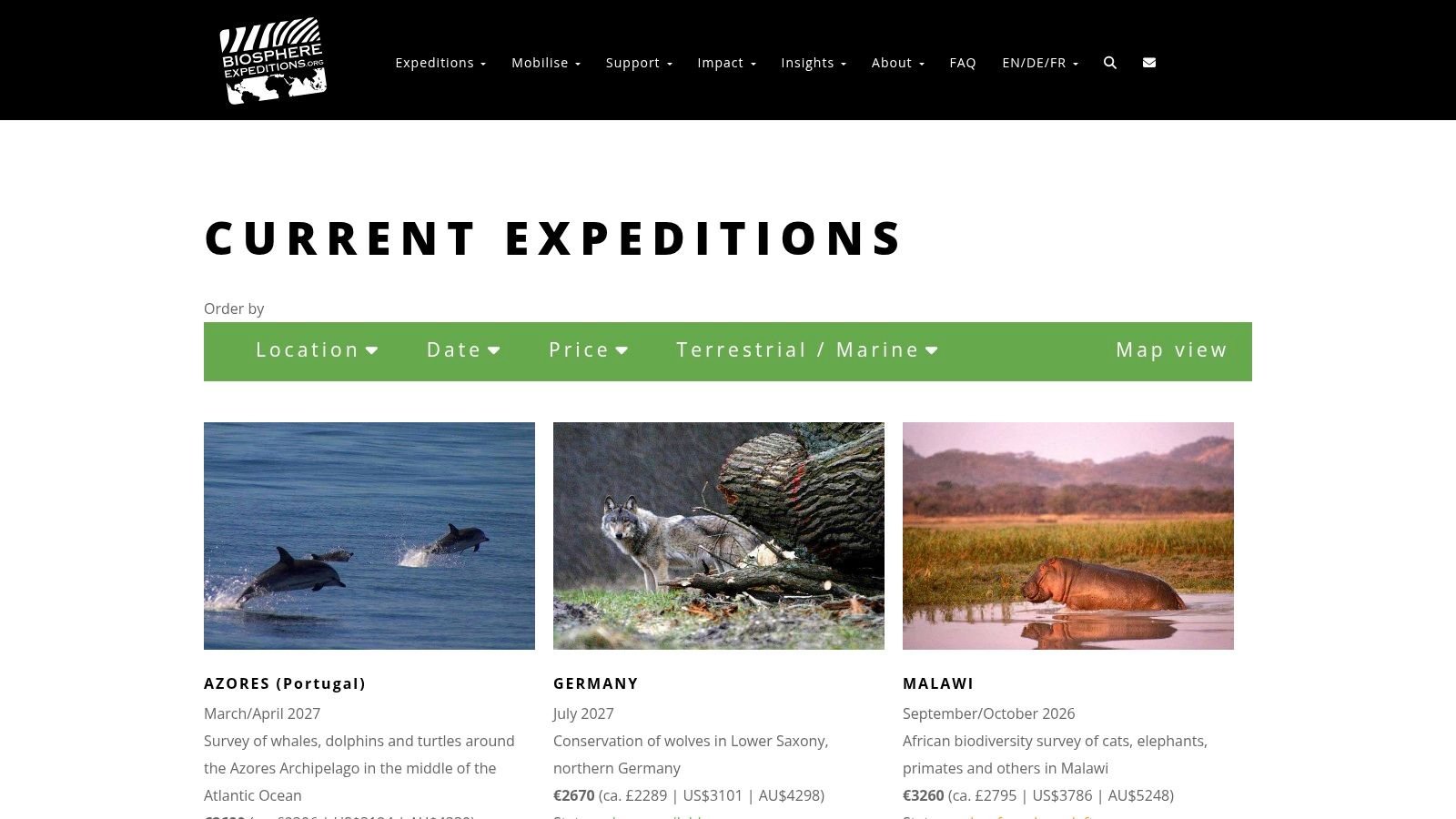
That transparency changes the application conversation. Instead of evaluating a placement only by location or species, you can examine the scientific method, the field window, the expedition report history, and the stated relationship between participant payments and local conservation work. The operator states that at least two-thirds of contributions go to projects, a quantitative allocation claim that appears in the supplied program description and should still be confirmed against the current terms before booking.
Follow the money and the method
The availability list publishes expedition dates and prices in euros, with United States dollar equivalents shown for comparison. Exchange-rate changes can affect the practical cost, and airfare remains extra. Ask whether the listed fee covers accommodation, meals, transfers, equipment, permits, training, and project contributions, then budget separately for travel insurance, personal equipment, and time away from work.
Public expedition reports are particularly valuable. They let prospective volunteers examine what previous teams did, what researchers learned, and whether the project produces a continuing record rather than a sequence of disconnected trips. A report won't remove every uncertainty, but it's more useful than promotional wildlife photography alone.
Ask before booking: What will the team measure, what will volunteers physically do each day, and where can you read the project's previous results?
Strengths and limitations
The scientist-led, small-team model can offer meaningful training and closer supervision. It also suits experienced volunteers who want a fixed field window and a defined research role. However, expedition dates are inflexible, spaces may be competitive, and the program's scientific focus may leave little room for spontaneous tourism.
Biosphere is a strong ethical fit for applicants who prioritize data collection, reporting, and financial accountability over animal contact. It's less suitable for someone seeking a low-cost, open-ended volunteer stay. If Victoria Falls is part of the wider trip, plan the expedition and sightseeing as separate commitments. Regional conservation planning around the falls can be supported through conservation efforts in Victoria Falls.
Check Biosphere Expeditions' current availability.
6. The Nature Conservancy Volunteer Workdays and Stewardship
The Nature Conservancy offers a different answer to the question of what wildlife volunteering should look like. Its United States opportunities focus on local stewardship rather than international travel, with state-by-state roles shaped by seasonal conservation needs. Volunteers may help with habitat restoration, invasive-species removal, native planting, fencing, or monitoring support.
That work can feel less dramatic than tracking a large mammal across a protected reserve, but habitat stewardship often provides the practical foundation on which wildlife conservation depends. A restored area, a healthier native plant community, or better-managed habitat can matter even when the volunteer never sees a charismatic species. The important test is whether the task addresses a documented local need and whether staff explain the intended ecological result.
The lowest barrier in the roundup
These workdays typically require no program fee and can involve short commitments. Basic on-site training and group-friendly formats make them suitable for beginners, families where the event permits them, local organizations, and travelers who want to contribute without paying for an overseas package. Exact requirements vary by state and event, so check the current listing for age limits, accessibility, weather policies, tools, and physical demands.
The trade-off is clear. You're unlikely to receive live-in accommodation, an extended field curriculum, or daily wildlife monitoring. Roles focus more on habitat than on direct work with large or endangered animals. That isn't a weakness, but it does mean you should choose this option for stewardship rather than expect an expedition.
- Best for beginners: Build practical experience without committing to international logistics.
- Best for local networks: Meet staff and other volunteers working in a nearby conservation system.
- Best for accessibility: Start with a short event and assess your physical comfort before pursuing more demanding fieldwork.
- Best for honest impact: Ask what area, habitat, or monitoring process the work supports.
A useful first step
The Nature Conservancy is particularly valuable for someone who wants to test whether conservation work suits them. Digging, planting, clearing invasive species, and working outdoors can reveal more about your preferences than a polished program page. It also helps distinguish a genuine interest in ecological work from an interest in wildlife tourism.
Find a Nature Conservancy volunteer opportunity.
7. U.S. National Park Service Volunteers-In-Parks
The National Park Service Volunteers-In-Parks program offers a formal route into public-land stewardship across the United States. Listings appear through National Park Service pages and Volunteer.gov, with roles covering wildlife monitoring support, habitat restoration, species surveys, data entry, stewardship, and visitor-science activities. The variety is the program's central strength, but it also means applicants must search carefully for the method and ecosystem that match their goals.
Some opportunities are seasonal, while others run year-round. A role may involve field surveys in one park, careful data handling in another, or public education somewhere else. The National Park Service also provides a documented volunteer framework and training resources, including Reference Manual 7, which gives applicants more institutional context than an informal local project.
Formal structure, uneven logistics
Volunteering is free, but wildlife-specific positions can be competitive. Some roles require applications, screening, background checks, or lengthy onboarding. Those steps can be frustrating if you're trying to volunteer during a short holiday, yet they also signal that the agency takes access, safety, and responsibility seriously.
Housing is rarely provided for short-term roles, so accommodation and transport can become the main practical obstacles. Read every listing for work location, schedule, physical requirements, application deadlines, and whether the role involves public contact. If you're comparing the best national parks in the US for wildlife and outdoor travel, don't assume the most famous park will offer the most relevant volunteer role.
A formal agency program can be more demanding to enter, but the application process may protect both the volunteer and the conservation work.
Who gets the most value
This is a good fit for people who want to build competencies and references with a federal land agency, return to the same region over time, or sample different conservation methods without paying an overseas placement fee. It's also useful for students, career changers, and residents who can commit to the local logistics.
The main limitation is that a short-term visitor may have little control over the work location or timetable. Apply with a specific method in mind, such as habitat restoration, species surveys, data entry, or visitor science, and treat the park name as secondary. That approach produces a better match than applying solely because a destination is famous.
Explore National Park Service Volunteers-In-Parks opportunities.
7-Program Wildlife Conservation Volunteer Comparison
| Program | Implementation Complexity 🔄 | Resource Requirements ⚡ | Expected Outcomes 📊 | Ideal Use Cases 💡 | Key Advantages ⭐ |
|---|---|---|---|---|---|
| African Impact – African Big 5 Wildlife Conservation (Greater Kruger, South Africa) | Moderate 🔄, structured schedule, fixed start windows | Camp-based living, full board, travel to reserve; medium cost | Direct data feeding reserve management; measurable monitoring outputs 📊 | First-time or repeat volunteers seeking hands-on Big 5 monitoring | Clear impact pathway, strong logistics and support, transparent pricing ⭐⭐⭐ |
| Wildlife ACT – Endangered Species Conservation (Zululand, South Africa) | High 🔄, telemetry, camera-trap work, intensive field effort | Physically demanding, self-catered camps, small teams; lower amenities | High-quality species monitoring and field-skill development 📊 | Experienced or committed volunteers wanting intensive, work-focused field experience | WWF partnership, strong conservation credibility, focused skill training ⭐⭐⭐⭐ |
| Conservation Travel Africa – Endangered Wildlife + Victoria Falls options (SA & Zimbabwe) | Moderate 🔄, curated placements, small teams, variable schedules | Variable by project; integrates travel to Victoria Falls region; published rates | Personalized field time; regional itinerary integration for wider trips 📊 | Volunteers wanting conservation + Victoria Falls/Chobe/Hwange combo | Transparent pricing, small teams, good logistics for multi-destination trips ⭐⭐⭐ |
| Earthwatch Institute – Wildlife & Ecosystem Science Expeditions (Global) | Medium–High 🔄, standardized scientific protocols and training | Higher expedition fees, airfare extra, pre-departure materials required | Contributes to published research; rigorous, standardized data outputs 📊 | Volunteers seeking scientific rigor and measurable research contributions | Strong data integrity, standardized methods, published outcomes ⭐⭐⭐⭐ |
| Biosphere Expeditions – Conservation Expeditions (Africa & worldwide) | Moderate 🔄, scientist-led small teams, fixed expedition windows | Participant fees (EUR), airfare extra, spots can be competitive | Transparent reports and direct funding impact; clear fee allocation 📊 | Those wanting NGO-led science with clear funding impact and reports | High transparency on fee use, long track record, scientist-led expeditions ⭐⭐⭐ |
| The Nature Conservancy (TNC) – Volunteer Workdays & Stewardship (US) | Low 🔄, short events, basic onsite training | No program fee, local participation, minimal equipment | Local habitat restoration and stewardship outcomes 📊 | Beginners or locals seeking low-barrier conservation experience | Free or low-cost, frequent opportunities, great for skill-building and networking ⭐⭐ |
| U.S. National Park Service – Volunteers-In-Parks (VIP) Program (US) | Low–Moderate 🔄, formal framework, some roles require applications/checks | No fee; onboarding and background checks for some roles; housing rare | Diverse contributions (surveys, stewardship, visitor-science); formal training records 📊 | Volunteers seeking federal-agency experience and documented competencies | Wide variety of parks/roles, formal training and recognition, free to participate ⭐⭐⭐ |
Build a Responsible Volunteer Plan
Start with the conservation method, not the destination. If you want field science, prioritize telemetry, camera traps, standardized surveys, behavioural observation, GPS work, or researcher-led data collection. If you want practical land management, look for habitat restoration, native planting, invasive-species removal, fencing, or monitoring support. A citizen-science expedition offers a different experience from a reserve-monitoring team, while a local workday may be the most honest choice if you have limited time, budget, or field experience.
Then compare the complete cost rather than the headline fee. Add flights, transfers, accommodation before or after the placement, meals not included, insurance, visas, vaccinations or other health preparation, equipment, communications, and personal spending. Some operators publish inclusions and exclusions clearly, while others require more questions. Ask for the current fee schedule and payment terms in writing, and don't treat a low initial price as proof that a program is accessible or ethical.
Confirm the dates, start-day rules, accommodation, meal arrangements, field transport, training, equipment, and supervision before you pay. Ask what happens on a normal workday, how physically demanding the role is, whether downtime exists, and what happens if weather or animal movements change the schedule. Visa and health requirements vary by destination and nationality, so confirm current rules with the program, the relevant embassy or consulate, and official government authorities.
A responsible application should cover more than enthusiasm. Prepare the following information and questions before submitting a form:
- Program fit: State the conservation method you want and explain any relevant study, field, outdoor, data, language, or teamwork experience.
- Dates and availability: Confirm the exact placement window, fixed start days, minimum stay, and whether seasonal work affects the tasks.
- Fitness and skills: Read the physical requirements and disclose limitations that affect field safety or participation.
- Screening: Check whether the operator requires references, background checks, medical information, interviews, or other approvals.
- Payment terms: Request cancellation rules, deposit conditions, refund provisions, currency details, and a written list of inclusions.
- Insurance and documents: Confirm required travel insurance, passport validity, visa documents, emergency contacts, and copies of important records.
Funding can make a serious placement more attainable, but no source guarantees eligibility or an award. Search for conservation grants, university or school support, employer assistance, group sponsorship, community fundraising, and transparent personal budgeting. If you fundraise publicly, explain exactly what the money covers, which costs remain personal, and what the project does. That clarity protects donors and helps you evaluate the program yourself.
Pack for work rather than photographs. Durable field clothing, closed footwear, sun and rain protection, personal medication, document copies, reliable communications, and a refillable hydration system are sensible starting points. Follow guide instructions around wildlife without exception. Don't approach animals, separate from the team, feed wildlife, or assume a calm animal is safe.
The ethical test is simple but demanding. Avoid direct-contact animal attractions unless an independently justified conservation intervention requires it and qualified authorities control the process. Reject projects that guarantee hands-on encounters, cub handling, bottle-feeding, petting, or staged wildlife contact. Ask whether local staff lead the work, whether the project produces measurable monitoring or restoration outputs, and whether community partnerships shape decisions rather than appearing as decorative language.
Conservation volunteering has become a substantial operational resource, not a niche pastime. In Western Australia, the Department of Biodiversity, Conservation and Attractions recorded 6,632 active volunteers contributing 895,580 hours in registered projects during the 2022–23 financial year, an average of 135 hours per volunteer. The same report recorded 2,646 volunteer park passes for people contributing over 50 hours and 368 volunteers contributing more than 500 hours, demonstrating how structured programs can support protected-area management at meaningful scale. See the DBCA volunteer snapshot for the published figures.
The model also has deep roots. Organized international conservation volunteering emerged in the 1980s through programs including Operation Raleigh in the United Kingdom and Earthwatch in the United States. A long-running Namibia program hosted 1,905 volunteers between 1990 and 2021, including working guests, student interns, and Earthwatch volunteers, with women representing 69.6% of participants, as described in the Joint Nature Conservation Committee's conservation volunteering review. In the United Kingdom, volunteer time contributed to 13 conservation charities and public bodies increased by 62% from 2000 to 2023, then rose another 4% in the latest available year, according to the JNCC UK indicator.
If your trip includes Victoria Falls, Hwange, Chobe, Moremi, or the Okavango Delta, keep sightseeing separate from the conservation commitment. Reserve time to rest, understand the placement's work requirements, and avoid presenting a safari add-on as evidence of conservation impact. That separation makes the trip more honest and usually more enjoyable.
Maximum Adventure Trails can help you plan the safari, scenic adventures, activities, accommodation, and multi-day travel that surround a conservation placement in Victoria Falls, Hwange, Chobe, Moremi, and the Okavango Delta. Use Maximum Adventure Trails to organize the sightseeing portion separately, then choose your volunteer project on field impact, transparency, and ethical fit.